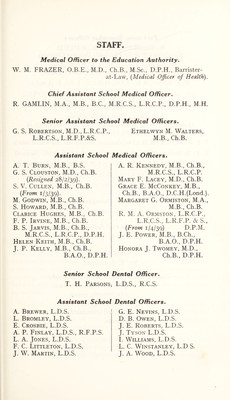
[Report 1939] / School Medical Officer of Health, Liverpool.
- Liverpool (England). Council.
- Date:
- 1939
Licence: Attribution 4.0 International (CC BY 4.0)
Credit: [Report 1939] / School Medical Officer of Health, Liverpool. Source: Wellcome Collection.
10/60 (page 8)
![point of view, the children in the partially sighted classes. His expert knowledge on the question of defective vision in children was such that he was invited by the Board of Education to partici¬ pate in some research work which they organised in 1923 for the purpose of enquiring into the factors in childhood leading to the development or aggravation of defective vision and squint. His advice was also sought by the Board of Education when they wTere enquiring into the problems connected with partially sighted children. Dr. Livsey was always most conscientious in his work, and his clinical records were of an exemplary high standard. 3. In January, 1940, the department suffered a severe loss in the death of Dr. Dingwall Eordyee who for 15 years had acted as certifying officer for mentally defective children, in which capacity he was an acknowledged expert. Dr. Eordyee was for many years Honorary Physician to the Royal Liverpool Children’s II ospital where he was widely recognised as an expert in the treatment of heart conditions, in which connection he always stressed preventive treatment. He was a strong advocate of residential schools of recovery for rheumatic children. His enthusiasm for preventive treatment led him to accept the post of Honorary Director of the Liverpool and District Child Guidance Clinic and his services were eagerly sought by, and freely given to, many institutions. Dr. Fordyce was most enthusiastic in the work which he carried out for the Education Committee’s special schools, and his charm of manner not only endeared him to all officials with w]jom he came in contact but made him much loved by the children and respected by their parents. 4. Some months prior to the outbreak of war, the Medical Officer of Health appealed for volunteers from the full-time medical staff and health visitors to organise first aid posts and train volunteers who had offered their services to these posts, to which appeal a most gratifying response was made. On the declaration of war, it became necessary to fully equip and man on a war-time basis all these first aid posts for the recep¬ tion of casualties in case severe raiding should occur, accordingly](https://iiif.wellcomecollection.org/image/b29738313_0010.jp2/full/800%2C/0/default.jpg)