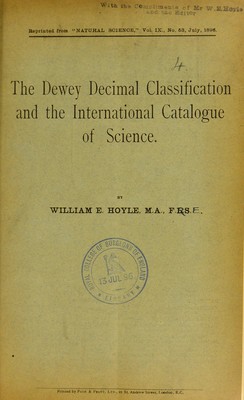
The Dewey Decimal Classification and the International Catalogue of Science / by William E. Hoyle.
- Hoyle, William Evans, 1855-1926.
- Date:
- 1896
Licence: Public Domain Mark
Credit: The Dewey Decimal Classification and the International Catalogue of Science / by William E. Hoyle. Source: Wellcome Collection.
Provider: This material has been provided by The Royal College of Surgeons of England. The original may be consulted at The Royal College of Surgeons of England.
5/12 page 45
![These numbers, always with the same signification, can be added to the number belonging to any subject which admits of being considered geographically, whether it be poetry or periodicals, beetles or mosses; and numbers are provided for carrying out the subdivisions as far as the countries in the British Isles or the States of the American Union.1 Those who wish to see the whole system set forth should consult Dewey’s original work,2 and I may, perhaps, be allowed to refer any who are curious to see it applied to the literature of natural science, to an effort of my own to carry out its principles.3 Such, in briefest outline, is the Decimal Classification of Melvill Dewey, which has been published for more than twenty years, has been adopted by upwards of 300 libraries in America, in this country, and on the Continent, and is now used by Messrs. Lafontaine and Otlet in the various publications issued by the Institut International de Bibliographie at Brussels, and by Dr. Field in the work of the “Concilium bibliographicum ” at Zurich. My own experience, ex- tending over the past five years, enables me to speak of it with great confidence as a thoroughly practical scheme, though I confess, on first acquaintance, I regarded it with considerable suspicion; and I have never met anyone,-who had given it a fair trial, that was not deeply impressed with its many valuable qualities. It is, of course, obvious that Decimal classification and the Dewey classification are not necessarily united. Any number of schemes might be elaborated, and decimal class-numbers applied to them : in fact, within the last few months a rival champion has entered the lists against the American system, under the auspices of no less a body than the International Catalogue Committee of the Royal Society, and it behoves all who are interested in the conflict (which means practically all scientific men) to make a critical examination of the combatants before deciding which they will back. At the outset it may be observed that it is incumbent on the new-comer to show marked superiority over the present champion, for in its absence the well-known principle would be applied—namely, that it is better to adopt a classification which has been long in print and is widely adopted, unless the superior merits of the new one fully compensate for the change. We may now proceed to examine a few sections of the Royal Society’s scheme, confining our attention to those that relate to topics treated of in Natural Science. One of the most conspicuous features 3[In this Journal, the numbers indicative of geographical divisions have been added within round brackets, a method proposed, for the avoidance of confusion, by the Brussels Institute, and now generally adopted.—Ed. Nat. Sci.] 1 Dewey, Decimal Classification and relativ index. Fifth Edition, 1894. Library Bureau, Boston, 146 Franklin Street, and London, 21 Bloomsbury Street. Price 25s. 8 Manchester Museum Handbooks. Catalogue of the books and pamphlets in the Library Manchester Cornish 1895 Price 2s 6d](https://iiif.wellcomecollection.org/image/b22330161_0007.jp2/full/800%2C/0/default.jpg)