The origin of the deflections Q, R and S in axial electrocardiograms of the dog : preliminary communication / by Thomas Lewis.
- Thomas Lewis
- Date:
- [1915]
Licence: Public Domain Mark
Credit: The origin of the deflections Q, R and S in axial electrocardiograms of the dog : preliminary communication / by Thomas Lewis. Source: Wellcome Collection.
1/2
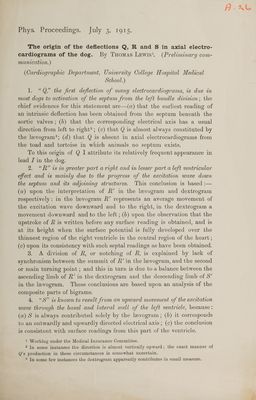
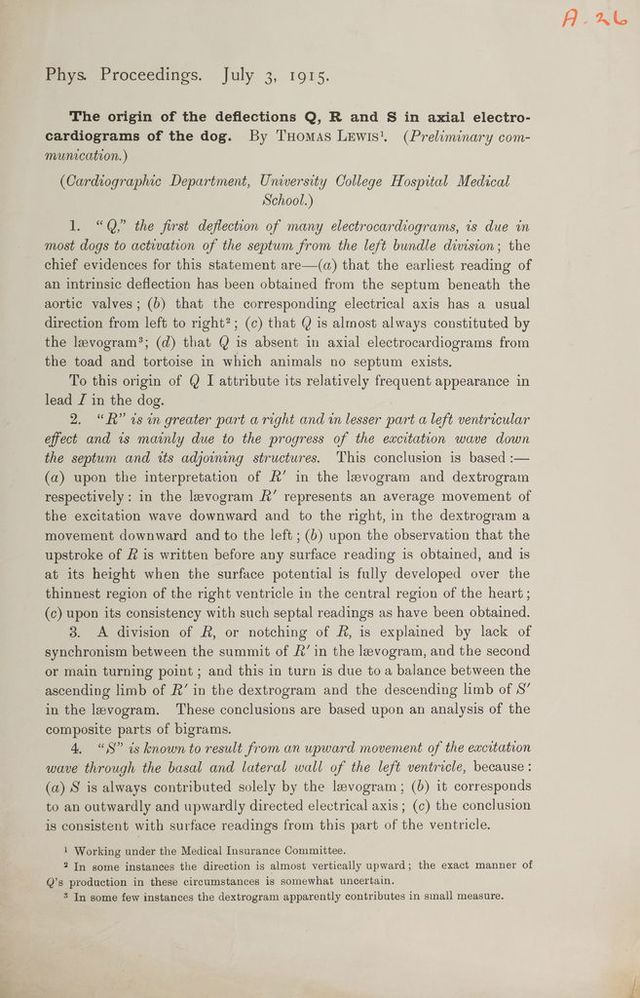
![Pays Proceedings. july 3, 1915. The origin of the deflections Q, R and S in axial electro- cardiograms of the dog. By THomas Lewis. (Preliminary com- munication. ) (Cardiographic Department, University College Hospital Medical School.) 1. “Q,.” the first deflection of many electrocardiograms, is due in most dogs to activation of the septum from the left bundle dimsion; the chief evidences for this statement are—(qa) that the earliest reading of an intrinsic deflection has been obtained from the septum beneath the aortic valves; (b) that the corresponding electrical axis has a usual direction from left to right?; (c) that Q is almost always constituted by the levogram*; (d) that @ is absent in axial electrocardiograms from the toad and tortoise in which animals no septum exists. To this origin of Q I attribute its relatively frequent appearance in lead I in the dog. 2. “RR” 7s wn greater part a right and in lesser part a left ventricular effect and 1s mainly due to the progress of the excitation wave down the septum and its adjoining structures. This conclusion is based :— (a) upon the interpretation of A’ in the levogram and dextrogram respectively: in the levogram &’ represents an average movement of the excitation wave downward and to the right, in the dextrogram a movement downward and to the left ; (b) upon the observation that the upstroke of & is written before any surface reading is obtained, and is at its height when the surface potential is fully developed over the thinnest region of the right ventricle in the central region of the heart ; (c) upon its consistency with such septal readings as have been obtained. 3. A division of AR, or notching of R, is explained by lack of synchronism between the summit of R’ in the leevogram, and the second or main turning point ; and this in turn is due to a balance between the ascending limb of R’ in the dextrogram and the descending limb of S’ in the levogram. These conclusions are based upon an analysis of the composite parts of bigrams. 4. “iS” is known to result from an upward movement of the excitation wave through the basal and lateral wall of the left ventricle, because : (a) S is always contributed solely by the levogram; (b) it corresponds to an outwardly and upwardly directed electrical axis ; (c) the conclusion is consistent with surface readings from this part of the ventricle. 1 Working under the Medical Insurance Committee. 2 In some instances the direction is almost vertically upward; the exact manner of Q’s production in these circumstances is somewhat uncertain. % In some few instances the dextrogram apparently contributes in smal] measure. Axe](https://iiif.wellcomecollection.org/image/b33449156_0001.jp2/full/800%2C/0/default.jpg)