Lectures on man: being a series of discourses on phrenology and physiology / Delivered by Professor L.N. Fowler in Great Britain.
- Lorenzo N. Fowler
- Date:
- 1886
Licence: Public Domain Mark
Credit: Lectures on man: being a series of discourses on phrenology and physiology / Delivered by Professor L.N. Fowler in Great Britain. Source: Wellcome Collection.
Provider: This material has been provided by the Francis A. Countway Library of Medicine, through the Medical Heritage Library. The original may be consulted at the Francis A. Countway Library of Medicine, Harvard Medical School.
258/368 page 252
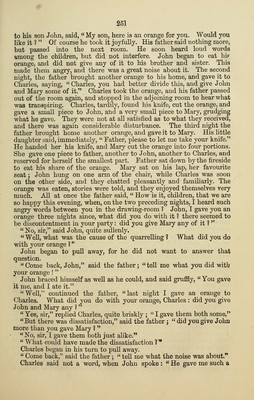
![leetle stingy piece, that it only put the taste into my mouth, and I had rather have had none at all. Well, Mary, how is it to-night we all appear to be very happy ? What have you done with your orange 1 Mary replied : Father, I love you, I love John, and I love Charles ; I would much prefer to give away the whole orange than to quarrel over it. The father said: Children, the Bible teaches that ' It is more blessed to give than to receive ;' and you see how happy we have all been this evening by the course pursued by little Mary. These children would never forget the lesson taught to them by their father by this simple experiment. Some persons have a propensity to steal. They frequently take articles which they do not wish to use. Phrenology does not make them steal; it only reveals the fact that there is a faculty of the brain which, when perverted, leads to stealing. When the science of geology explains the surface of the earth, geology does not make the earth, but enlightens us concerning it. The question will be asked. How is the stealing propensity to be remedied ? Some will whip and beat their children, thinking to cure them by this method. Others will put locks on to the drawers and closets, so as to remove temptation in every form. What is the result? Beating the child creates fear of punishment, but does not touch the primitive influence of the faculty of Acquisitiveness. It is but a partial remedy for the time being, while the disposition to steal remains as strong as before, and cunning or duplicity is developed in the child, by such treatment. The mother is very desirous to prevent her wilful boy from forming this dangerous habit. Suppose he has committed the act, she gives him a good shaking, and, whipping him severely, says, Let me catch you stealing again : you shall have another beating much worse than this ! The little boy will think, Oh, but I'll manage that you shall not catch me stealing next time ! The result is greater scheming in the accomplishment of the act. The second plan, to lock-up everything, is no better than the first. We know that the ingenuity of the rascal is generally equal to that of the man who attempts to circumvent him. The more curious and difficult the lock is, the greater the effort to understand it. Bars and bolts are easily broken by the determined thief. How shall we prevent children from stealing ] By educating the faculty, by gratifying it in some legitimate way, and balancing it, by calling into exercise some other faculty of the mind to produce har- mony. Suppose you have a child who has stolen, I will tell you how to proceed. Take your child into a room where you can converse alone with him, I would say, James, look at me, and tell me if you would like for me to know everything that you have done within two or three days. Shall I write an account of your actions on a piece of paper, and take it to your teacher to have him read it aloud to his scholars 1 If you have done right, you would not, I am sure, object to having it](https://iiif.wellcomecollection.org/image/b21053029_0258.jp2/full/800%2C/0/default.jpg)



 No text description is available for this image
 No text description is available for this image
 No text description is available for this image