Manual of practical hygiene / ed., F. S. B. François De Chaumont, M. D., F. R. S.
- Edmund Alexander Parkes
- Date:
- 1883
Licence: Public Domain Mark
Credit: Manual of practical hygiene / ed., F. S. B. François De Chaumont, M. D., F. R. S. Source: Wellcome Collection.
Provider: This material has been provided by The University of Leeds Library. The original may be consulted at The University of Leeds Library.
30/806 (page 6)
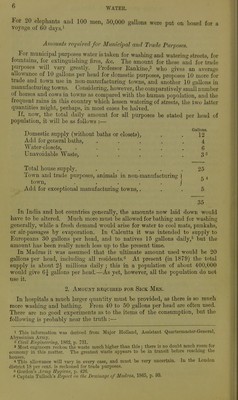
![WATER. For 20 elephants and 100 men, 50,000 gallons were put on board for a voyage of 60 days.i Amounts required for Municipal and Trade Purposes. For municipal purposes water is taken for washing and watering streets, for fountams, for extinguishing fires, &c. The amount for these and for trade purposes will vary greatly. Professor Eanldne,2 who gives an average allowance of 10 gallons per head for domestic purposes, proposes 10 more for trade and town use in non-manufacturing towns, and another 10 gallons in manufacturing towns. Considering, however, the comparatively smdl number of horses and cows in towns as compared with the human population, and the frequent rains in this country which lessen watering of streets, the two latter quantities might, perhaps, in most cases be halved. If, now, the total daily amount for all purposes be stated per head of population, it will be as follows :— .Domestic supply (without baths or closets), Add for general baths. Water-closets, .... Unavoidable Waste, Total house supply, ..... 25 Town and trade purposes, animals in non-manufacturing \ ^ town, ...../ Add for exceptional manufacturing towns,. . . 5 35 In India and hot countries generally, the amounts now laid down would have to be altered. Much more must be allowed for bathing and for washing generally, while a fresh demand would arise for water to cool mats, punkahs, or air-passages by evaporation. In Calcutta it was intended to supply to Europeans 30 gallons per head, and to natives 15 gallons daily,^ but the amount has been really much less up to the present time. In Madras it was assumed that the ultimate amount used would be 20 gallons per head, including all residents.At present (in 1879) the total supply is about 2| millions daily ; this in a population of about 400,000 would give 6| gallons per head.—As yet, however, all the population do not use it. 2. Amount eequired for Sick Men. In hospitals a much larger quantity must be provided, as there is so much more washing and bathing. From 40 to 50 gallons per head are often used. There are no good experiments as to the items of the consumption, but the following is probably near the truth :— 1 This information was derived from Major Holland, Assistant Quartermaster-General, Abyssinian Army. Civil Engineering, 1862, p. 731. 3 Most engineers reckon the waste much higher than this ; there is no doubt much room for economy in this matter. Tlie greatest Waste appears to be in transit before reaching the houses. . T i.1 T J 4 This allowance will vary in every case, and must be very uncertain. In the l<ondon district 18 per cent, is reckoned for trade purposes. 5 Gordon's A rm]/ Hycjicne, p. 426. 6 Captain TuUoch's Reioort on the Drainage of Madras, 1865, p. 93. Gallons. 12 4 6 33](https://iiif.wellcomecollection.org/image/b21508410_0030.jp2/full/800%2C/0/default.jpg)