The constitution of chaulmoogric and hydnocarpic acids / by Marmaduke Barrowcliff and Frederick B. Power.
- Barrowcliff, Marmaduke.
- Date:
- 1907
Licence: In copyright
Credit: The constitution of chaulmoogric and hydnocarpic acids / by Marmaduke Barrowcliff and Frederick B. Power. Source: Wellcome Collection.
Provider: This material has been provided by The Royal College of Surgeons of England. The original may be consulted at The Royal College of Surgeons of England.
4/24 page 558
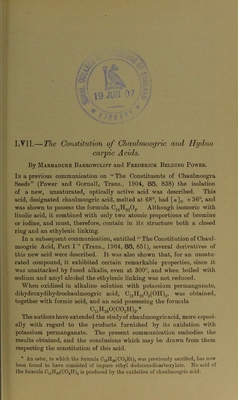
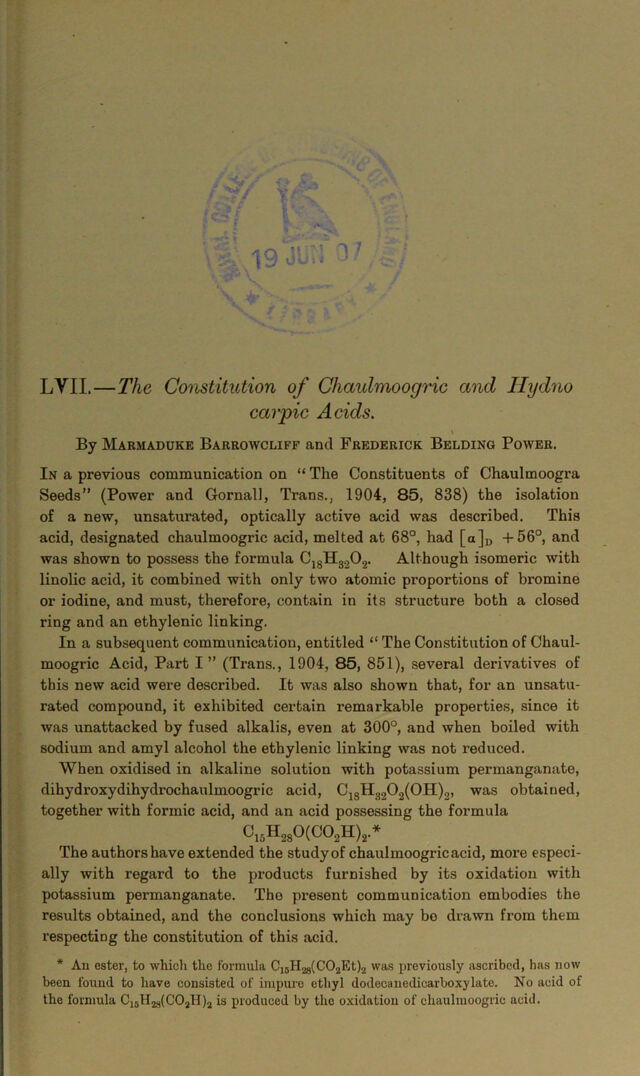
!['When a dilute aqueous solution of chaulmoogric acid in an excess of potassium hydroxide is treatedat temperatures below 10° with an amount of potassium permanganate equivalent to one atomic proportion of oxygen, a considerable portion of the acid is recovered unchanged. This is clue to the very sparing solubility of the potassium salt in water at low temperatures. If, however, an amount of permanganate equivalent to 2—3 atomic proportions of oxygen is employed at a temperature of 18—20°, two isomeric dihydroxydihydrochaulmoogric acids having the formula 0jgH3202(0H)2 can be isolated, whilst formic acid is also produced. The acid to which the name a-dihydroxydihydro- chaulmooyric acid may he applied melts at 105°, and has [aji, +11'G® It is identical with the dihydroxy-acid previously described (Power and Gox’nall, loc. cit.). The isomeric acid, designated as fi-dihydroxydihydro- chaulvioogric acid, melts at 93°, and has [aJo - 14'2° On repeating the oxidation with the use of an amount of permangan- ate equivalent to four atomic proportions of oxygen, an acid of the formula C^gHgoO^ was produced. This was isolated in the form of its methyl ester, which had the composition C^gllg^O^, melted at 64°, and gave a semicarbazone melting at 110°. It thus appears that this is the methyl ester of a hydroxyketodihydrocJiaulmoogric acid. On hydrolysis with alcoholic sodium hydroxide this ester neutralised two equivalents of the alkali, notwithstanding the fact that it is derived from a monocarboxylic acid. This property is probably due to the open- ing of the ring by the hydrolysis of the grouping •CH(OH)*CO*, with the formation of the sodium salt of a hydroxydicarboxylic acid, ^18^34^5- The acid liberated from this salt was found to have the formula ^18^32^4’ but it did not again yield the original ester, and would therefore appear to be a lactonic acid, formed by the elimination of a molecule of water. By the oxidation of chaulmoogric acid in alkaline solution with an excess of permanganate, an amount of the latter equivalent to 6—7 atomic proportions of oxygen was consumed. A tricarboxylic acid (m. p. 68°), having the formula C^gHg.20,j, was thus obtained, together with ?i-dodecanedicarboxylic acid, [CH2]i2(C02H)2, a smaller quantity of ?i-undecanedicarboxylic acid, [CH2]2i(C02H)2, and still smaller quantities of oxalic and malonic acids. The tricarboxylic acid is a very stable compound, and the numerous attempts to obtain from it such degradation products as would throw light on its constitution were unsuccessful. In order to ascertain whether the same products would be obtained under different conditions, an oxidation of chaulmoogric acid was con- ducted in acetic acid solution. The n-dodecanedioarboxylic acid and the](https://iiif.wellcomecollection.org/image/b2242507x_0006.jp2/full/800%2C/0/default.jpg)