The cyclopaedia of practical medicine: comprising treatises on the nature and treatment of diseases, materia medica and therapeutics, medical jurisprudence, etc., etc (Volume 1).
- Date:
- 1845
Licence: Public Domain Mark
Credit: The cyclopaedia of practical medicine: comprising treatises on the nature and treatment of diseases, materia medica and therapeutics, medical jurisprudence, etc., etc (Volume 1). Source: Wellcome Collection.
Provider: This material has been provided by the National Library of Medicine (U.S.), through the Medical Heritage Library. The original may be consulted at the National Library of Medicine (U.S.)
23/790
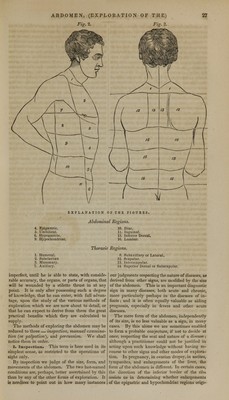
![Fig, 2. Fig. 3. EXPLANATION OF THE FIGURE! Abdominal Regions. 4. Epigastric. 5. Umbilical. 6. Hypogastric. 9. Hypochondriac. 1. Humeral. 2. Subclavian 3. Mammary. 7. Axillary. 10. Iliac. 11. Inguinal. 15. Inferior Dorsal, 16. Lumbar. Thoracic Regions. imperfect, until he is able to state, with conside- rable accuracy, the organs, or parts of organs, that will be wounded by a stiletto thrust in at any point. It is only after possessing such a degree of knowledge, that he can enter, with full advan- tage, upon the study of the various methods of exploration which we are now about to detail, or that he can expect to derive from them the great practical benefits which they are calculated to supply. The methods of exploring the abdomen may be reduced to three — inspection, manual examina- tion (or palpation), and percussion. We shall notice them in order. I. Inspection. This term is here used in its simplest sense, as restricted to the operations of sight only. By inspection we judge of the size, form, and movements of the abdomen. The two last-named conditions are, perhaps, better ascertained by this than by any of the other forms of exploration. It is needless to point out in how many instances 8. Subaxillary or Lateral. ]l2. Scapular. 13. Interscapular. 14. Superior Dorsal or Subscapular. our judgments respecting the nature of diseases, as derived from other signs, are modified by the size of the abdomen. This is an important diagnostic sign in many diseases, both acute and chronic, more particularly perhaps in the diseases of in- fants ; and it is often equally valuable as aiding prognosis, especially in fevers and other acute diseases. The mere form of the abdomen, independently of its size, is no less valuable as a sign, in many cases. By this alone we are sometimes enabled to form a probable conjecture, if not to decide at once, respecting the seat and nature of a disease ; although a practitioner could not be justified in acting upon such knowledge without having re- course to other signs and other modes of explora- tion. In pregnancy, in ovarian dropsy, in ascites, tympanites, and enlargements of the liver, the form of the abdomen is different. In certain cases, the direction of the inferior border of the ribs assists us in determining whether enlargements of the epigastric and hypochondriac regions origt-](https://iiif.wellcomecollection.org/image/b21116763_0023.jp2/full/800%2C/0/default.jpg)


 No text description is available for this image
 No text description is available for this image
 No text description is available for this image