Paralyses, cerebral, bulbar and spinal : a manual of diagnosis for students and practitioners / by H. Charlton Bastian.
- Henry Charlton Bastian
- Date:
- 1886
Licence: Public Domain Mark
Credit: Paralyses, cerebral, bulbar and spinal : a manual of diagnosis for students and practitioners / by H. Charlton Bastian. Source: Wellcome Collection.
Provider: This material has been provided by Royal College of Physicians, London. The original may be consulted at Royal College of Physicians, London.
41/720 page 21
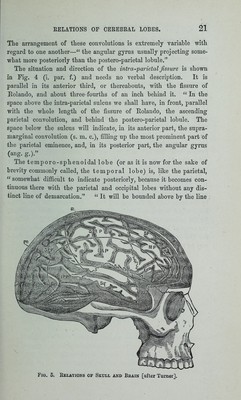
![The arrangement of these convolutions is extremely variable with regard to one another—11 the angular gyrus usually projecting some- what more posteriorly than the postero-parietal lobule.” The situation and direction of the intra-parietal fissure is shown in Fig. 4 (i. par. f.) and needs no verbal description. It is parallel in its anterior third, or thereabouts, with the fissure of Rolando, and about three-fourths of an inch behind it. 11 In the space above the intra-parietal sulcus we shall have, in front, parallel with the whole length of the fissure of Rolando, the ascending parietal convolution, and behind the postero-parietal lobule. The space below the sulcus will indicate, in its anterior part, the supra- marginal convolution (s. m. c.), filling up the most prominent part of the parietal eminence, and, in its posterior part, the angular gyrus (ang. g.) ” The temporo-sphenoidal lobe (or as it is now for the sake of brevity commonly called, the temporal lobe) is, like the parietal, “ somewhat difficult to indicate posteriorly, because it becomes con- tinuous there with the parietal and occipital lobes without any dis- tinct line of demarcation.” “ It will be bounded above by the line Fig. 5. Relations of Skull and Bkain [after Turner].](https://iiif.wellcomecollection.org/image/b24975199_0041.jp2/full/800%2C/0/default.jpg)



 No text description is available for this image
 No text description is available for this image
 No text description is available for this image