Improvements in or relating to mineral fillings for teeth / [William Francis Mellersh].
- Mellersh, William Francis.
- Date:
- 1903
Licence: Public Domain Mark
Credit: Improvements in or relating to mineral fillings for teeth / [William Francis Mellersh]. Source: Wellcome Collection.
1/4
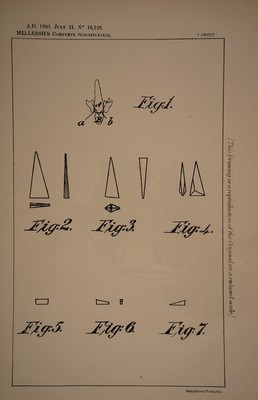
![A.D, 1903 (Under International Convention.) 31st Jan., 1903 Date claimed for Patent under Patents Act, 1901,' being date of first Foreign Application (in - United States), Date of Application (in the United Kingdom), 21st July, 1903 Accepted, 15th Oct., 1903 COMPLETE SPECIFICATION. ^‘Improvements in or relating to Mineral Fillings for Teeth.8’ I, William Francis Mellersh of Stedham House, Surbiton, in the County of Surrey, Dentist, do hereby declare the nature of this invention and in what manner the same is to be performed to be particularly described and ascertained in and by the following statement: — 5 My invention relates to an improvement in dentistry, which consists in filling* cavities and angles of natural teeth by means of a porcelain core covered with enamel in such a manner that the repaired tooth is practically indistinguishable as regards appearance from an undamaged tooth. By my invention angles and extensive contours are readily produced with 10 expenditure of much less time and labour than heretofore, when enamel only has been used and the contour thus produced can be cut and polished as required. My invention is applicable more or less to all teeth, but is perhaps of greatest value for the front teeth, which are more conspicuous. In order to make my invention clear, I have illustrated it in the accompanying 15 drawing, in which Figure 1 shews by way of example a central upper tooth repaired at each of its lower angles in the manner hereinafter set forth. In Figure 1 A indicates an upper tooth, B a lower tooth. The letters <i and h indicate tips or corners replaceable on my system. 20 Figures 2, 3 and 4 illustrate forms of the mineral cores suitable for the operation set forth, drawn on a considerably enlarged scale. Figures 5, 6 and 7 illustrate similar pieces on a scale approximating to the natural size. • The above forms are illustrated by way of example only, and I do not confine 25 my invention to the use of cores of the configurations illustrated, because the injuries which teeth may suffer may require larger, smaller or t somewhat differently shaped cores, but those illustrated are forms found to be of the most general practical usefulness. My improved cores are composed of a porcelain material, similar to that 30 usually employed for making what are known as “English artificial teeth”. The shape of the core is preferably that of a right-angled triangle having its upper angle very acute and beveled to a chisel-shaped edge. The base of this triangle also tapers to an edge to form the cutting edge of the tooth. The advantage of this form of core is that by turning it over, it can be made a right 35 hand or a left hand core at will. The method of use of these cores is substantially as follows. The damaged tooth having been prepared by the removal of the decayed portion and having a recess cut in the sound portion of the tooth. to give srifficient hold for the piece to be attached, an accurate hollow impression of the interior 40 of this recess is taken by any of the well known methods, as by the use of gold or platinum foil, for instance. [Price 8d.]](https://iiif.wellcomecollection.org/image/b30734782_0001.jp2/full/800%2C/0/default.jpg)