Roman oculists' medicine stamps and collyria / [C.J.S. Thompson].
- Thompson, C. J. S. (Charles John Samuel), 1862-1943
- Date:
- [1920?]
Licence: In copyright
Credit: Roman oculists' medicine stamps and collyria / [C.J.S. Thompson]. Source: Wellcome Collection.
121/150 (page 7)
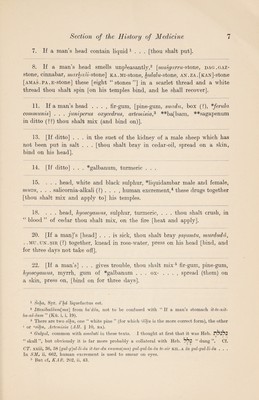
![7. If a man’s head contain liquid * 1 . . . [thou shalt put]. 8. If a man’s head smells unpleasantly,2 [musgarru-stone, dag.gaz- stone, cinnabar, marliasi-stone] ka . Mi-stone, hulalu-stone, an . za . [KAN]-stone [amas.pa.E-stone] these [eight “ stones ”] in a scarlet thread and a white thread thou shalt spin [on his temples bind, and he shall recover]. 11. If a man’s head . . . , fir-gum, [pine-gum, suadu, box (?), *ferula communis] . . . juniperus oxycedrus, artemisia,3 **ba[lsam, **sagapenum in ditto (??) thou shalt mix (and bind on)]. 13. [If ditto] ... in the suet of the kidney of a male sheep which has not been put in salt . . . [thou shalt bray in cedar-oil, spread on a skin, bind on his head]. 14. [If ditto] . . . *galbanum, turmeric . . . 15. ... head, white and black sulphur, *liquidambar male and female, muzu, . . . salicornia-alkali (?) . . . , human excrement,4 these drugs together [thou shalt mix and apply to] his temples. 18. ... head, hyoscyamus, sulphur, turmeric, . . . thou shalt crush, in “ blood ” of cedar thou shalt mix, on the fire [heat and apply]. 20. [If a man]’s [head] ... is sick, thou shalt bray sasumtu, murdudu, . .mu. un.sir (?) together, knead in rose-water, press on his head [bind, and for three days not take off]. 22. [If a man’s] . . . gives trouble, thou shalt mix5 fir-gum, pine-gum, hyoscyamus, myrrh, gum of *galbanum . . . ox- . . . , spread (them) on a skin, press on, [bind on for three days]. V 1 Seha, Syr. s'ha liquefactus est. 2 Ittenibassum[ma\ from ba'asu, not to be confused with “ If a man’s stomach it-te-nit- ba-as-sum ” (Ku. i, i, 19). 3 There are two sihu, one “ white pine ” (for which isihu is the more correct form), the other i or Usihu, Artemisia {AH. § 10, ba). 4 Gulgul, common with ameluti in these texts. I thought at first that it was Heb. Tpnbn “ skull ”, but obviously it is far more probably a collateral with Heb. bbn “ dung ”. Cf. CT. xxiii, 36, 58 [gul-g]ul-li-su it-tar-du enuma{ma) gul-gul-la-su te-sir kil.a sa gul-gul-li-su . . . In SM. ii, 662, human excrement is used to smear on eyes. 5 But cf. KAB. 202, ii, 43.](https://iiif.wellcomecollection.org/image/b30622670_0121.jp2/full/800%2C/0/default.jpg)