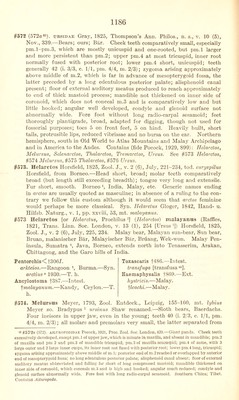
Key-catalogue of parasites reported for carnivora (cats, dogs, bears, etc.) : with their possible public health importance / by C.W. Stiles and Clara Edith Baker.
- Charles Wardell Stiles
- Date:
- 1935
Licence: In copyright
Credit: Key-catalogue of parasites reported for carnivora (cats, dogs, bears, etc.) : with their possible public health importance / by C.W. Stiles and Clara Edith Baker. Source: Wellcome Collection.
280/322 (page 1184)
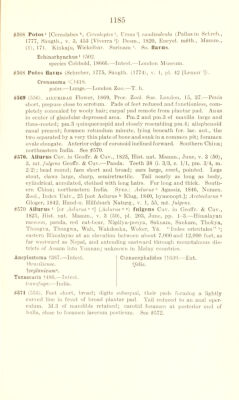
![#566 *Bassariscus [or Basaris c] astutus Lichtenstein, 1830, Abh. ph.-Kl. K. pr. Ak. Wiss. (1827), 119 [Bassaris b ]) Coues, 1887, Sci., v. 9, May 27, 516. Civet Cat, common raccoon-fox, gemeines Katzenfrett, cacamizli, cacamistl, cacomistl. S. Mexico *; western U Mesocestoides <Cf299.—Intest. bassarisci.—New York Zoo, from Mexico *.—T. h. Uncinaria 390ZL—Intest. Hotoris.—Texas. Ixodes fS66.—Ext. rubidus.—Guanajuata *, Mexico *. S. A. Neotrichodectes <tl099.—Ext. [*mephitidis 8 Osborn.—Calif.] Phalacropsylla <11623.—Ext. *paradisea.—Paradise *, Ariz.— Civet cat t. h. Trichodectes fllOO.—Ext. thoracicus.—Lake CoA, Calif.—T. h. #566 Bassariscus astutus astutus (Lichtenstein, 1830, Abh. ph.-Kl. K. pr. Ak. Wiss. 1827, 119 [Bassaris b °]) Miller, 1912, U. S. Nat. Mus., Bui. 79,88. Southern Mexico b #566 ^Bassariscus astutus oregonus (Rhoads, 1S94, Proc. Acad. Nat. Sci., Phila., v. 45, Jan. 30, 416 [Bassariscus flavus]) Miller & Rehn, 1901, Proc. Boston Soc. Nat. Hist., v. 30, Dec. 30, 230. Grant’s Pass, Oregon *. Fide Merriam, 1897, 186-187, this should stand as Bassariscus raptor. Neotrichodectes <C 11099.—- Ext. [mephitidis 8 Osborn.] #566 *Bassariscus (Bassariscus) astutus raptor (Baird, 1859, Mamm. Mex- ican boundary, 19 [Bassaris h °]) Elliott, 1901, Synop. Mamm. N. Amer., Zool. ser., v. 2, 316. Robber raccoon-fox. Washington (supposed to have been brought from California). So. astutus oregonus, fide Miller, 1924, 113. #567 (557). potosinae Trouess., 1904c, Cat. Mamm., 183.—Kinkajous. Man- dible very massive, the rami early fused by a long symphysis, the lower edge straight by the growth posteriorly of a large lamina, sometimes rounded, sometimes angled, beneath the angular process, which is reduced to a small excrescence beneath the condyle; inner dentary foramen beneath base of anterior edge of coronoid; palate parallel-sided, as wide in front as behind, depressed behind molars; paroccipitals and mastoids standing away from bulla, which has carotid foramen set forwards much nearer for. lac. med. than for. lac. post.; molars flat-crowned even when newly cut; pm.l absent above and below. Tail prehensile. Two ventral cutaneous glands. Anal glands aborted. See #568. Syn. cercoleptinae Trouess., 1897c, Cat. Mamm., v. 1, fasc. 1, 248. #568. Potos 64 Geolfr. & Cuv., 1795, Mag. encycl., v. 2, 1S7 (for Kincajou) tsd. (1904; 1924) Viverra1 caudivolvula Schreb. so. flavus Schreb.—Kinkajous, Wickelbar. Teeth 36 (i. 3/3, c. 1/1, pm. 3/3, m. 2/2); molars with low flat crowns, very obscurely tuberculated. Skull short, rounded, with fiat upper surface. Clavicles very rudimentary. Head broad and round. Ears short. Body long, musteline. Legs short. Tail long, tapering, prehensile. Fur short and soft. Tongue long, very extensile. Forests of warmer parts of South and Central America. Syns.: Caudivolvulus » Dumfiril, 1S06, Zool. Analytique, Paris, 14, mt. le kinkajou; Cercolabes h ° Grev6,1894, Nova Acta Leop., Halle, 217, mt. caudivolvus [not Cercolabes Brandt, 1835, rodent]; Cercoleples° Uliger, 1811, Prodr. Syst. Mamm. et Avium, 127-128, mt. caudivolvula; Kincajou m0 Lacfipede, 1799, Button's Hist, nat., Didot ed., Quadr., XIV, 154, mt. caudivol- vulus; Kinkajou0 Lacfipede, 1799, Tabl. Mamm., 7, mt. caudivolvula; Kinkaschu«« Fischer, 1813, Zoog., ed. 3, v. 1, 14; Kinlcaschus00 Fischer, 1813, Zoog., ed. 3, v. 1, 21; Kinkojou Gill, 1872a, 67.](https://iiif.wellcomecollection.org/image/b29809162_0280.jp2/full/800%2C/0/default.jpg)