[Report 1935] / School Medical Officer of Health, Norfolk County Council.
- Norfolk (England). County Council.
- Date:
- 1935
Licence: Attribution 4.0 International (CC BY 4.0)
Credit: [Report 1935] / School Medical Officer of Health, Norfolk County Council. Source: Wellcome Collection.
13/52 (page 11)
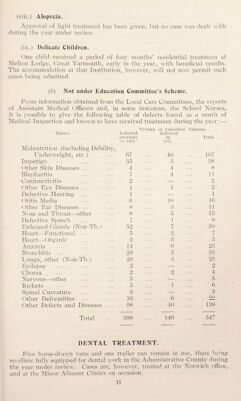
![instances the only member, and it is impossible to estimate the full value of the voluntary service so rendered. Without exception, the live Com¬ mittees are those on which the teaching staff is represented. Following inspection, the names of children with defects calling for treatment are entered in a Medical Log Book for the information of the Care Committee, while the Committee are invited to meet the Medical Officer at the end of the inspection to discuss any necessary cases. Reports are requested periodically, and in stubborn cases further action is taken from the office, the parents interviewed by a member of the professional staff, or the assistance of the N.S.P.C.C. Inspectors obtained. WORK OF THE NURSES. (a) Minor Ailments. (i) The six equipped clinics at Dereham, North Walsham, Wells, Fakenham, Wymondham and Terrington, have been in use throughout the year. Single morning sessions are held each week on specific days, and once each month the Assistant Medical Officer attends. A Table of defects dealt with appears on page 12. (ii) Nurses also treat minor ailments at the schools and, wdiere necessary, visit the homes and advise the parents to call in a doctor. Such cases are shown in Table IV, found on page 41. (b) Surveys of Children for Uncleanliness. Number of visits to schools ... ... ••• ••• 3,413* Average number of visits to each school •• • ... ... 6'7 Total number of examinations ... ••• ... ... 187,375 Number of individual children found unclean (i.e., vermin or nits) ••• ••• ... ... ... ... 2,042 Number of children excluded at the Nurses’ visits ••• 156 Number of Special Warning Letters re Nits sent to parents 3 Number of letters sent on first exclusion ... ••• 45 Number of ‘‘Final Warning” Letters sent to parents 18 Number of Homes visited ... ... ... ••• 564 * Includes 2371 complete surveys of all children in school. Result of ‘‘following up”— Clean ... ... ... 1,120 Improved ... ••• ... ••• ••• 744 Unsatisfactory ••• ••• ... ... 178 The foregoing figures show that the standard of cleanliness amongst the school population is still further improved. Every credit must be given to the Nursing Staff for their diligent work, and there are other factors w-hich help to account for the present state of affairs. Teachers habitually encourage the children to take a personal pride in themselves, whilst the stigma of being one of the few children in the school whom the Nurse comes to see because of uncleanliness, is probably a great incentive to a child to strive to ensure removal from that category as soon as possible. When children are frequently in an unclean condition the Nurse visits the parents and urges the regular use of a metal comb, which can be loaned for a period to parents unable to purchase. The combs answer the purpose admirably, removing both pediculi and nits. Broadly speaking, the standard of living to-day being higher than that of post-war years brings in its train 1]](https://iiif.wellcomecollection.org/image/b29911230_0013.jp2/full/800%2C/0/default.jpg)