[Report 1943] / School Medical Officer of Health, Salop / Shropshire County Council.
- Shropshire (England). County Council.
- Date:
- 1943
Licence: Attribution 4.0 International (CC BY 4.0)
Credit: [Report 1943] / School Medical Officer of Health, Salop / Shropshire County Council. Source: Wellcome Collection.
8/14 (page 4)
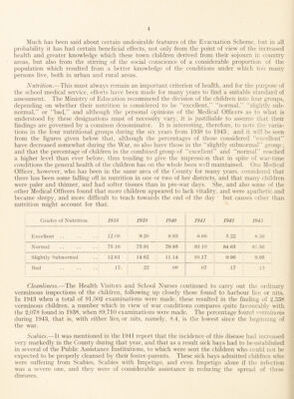
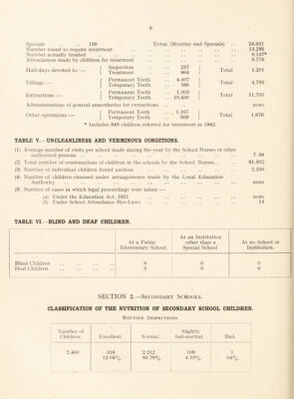
![Much has been said about certain undesirable features of the Evacuation Scheme, but in all probability it has had certain beneficial effects, not only from the point of view of the increased health and greater knowledge which these town children derived from their sojourn in country areas, but also from the stirring of the social conscience of a considerable proportion of the population which resulted from a better knowledge of the conditions under which too many persons live, both in urban and rural areas. Nutrition.—This must always remain an important criterion of health, and for the purpose of the school medical service, efforts have been made for many years to find a suitable standard of assessment. The Ministry of Education recommend the division of the children into four groups, depending on whether their nutrition is considered to be “excellent,” “normal,” “slightly sub¬ normal,” or “bad,” and although the personal opinions of the Medical Officers as to what is understood by these designations must of necessity vary, it is justifiable to assume that their findings are governed by a common denominator. It is interesting, therefore, to note the varia¬ tions in the four nutritional groups during the six years from 1938 to 1943; and it will be seen from the figures given below that, although the percentages of those considered “excellent” have decreased somewhat during the War, so also have those in the “slightly subnormal” group ; and that the percentage of children in the combined group of “excellent” and “normal” reached a higher level than ever before, thus tending to give the impression that in spite of war-time conditions the general health of the children has on the whole been well maintained. One Medical Officer, however, who has been in the same area of the County for many years, considered that there has been some falling off in nutrition in one or two of her districts, and that many children were paler and thinner, and had softer tissues than in pre-war days. She, and also some of the other Medical Officers found that more children appeared to lack vitality, and were apathetic and became sleepy, and more difficult to teach towards the end of the day ' but causes other than nutrition might account for that. Grades of Nutrition. 1938 1939 1940 1941 1942 1943 ! Excellent 12.06 9.26 8.93 6.66 5.22 8.36 1 Normal ] 75.16 75.91 79.85 83.10 84.65 81.56 Slightly Subnormal 12.61 14.62 11.14 10.17 9.96 9.95 Bad .17* .22 .09 .07 .17 .13 Cleanliness.—The Health Visitors and School Nurses continued to carry out the ordinary verminous inspections of the children, following up closely those found to harbour lice or nits. In 1943 when a total of 91,502 examinations were made, these resulted in the finding of 2,338 verminous children, a number which in view of war conditions compares quite favourably with the 2,078 found in 1938, when 89,710 examinations were made. The percentage found verminous during 1943, that is, with either lice* or nits, namely, 8.4, is the lowest since the beginning of the war. Scabies.—It was mentioned in the 1941 report that the incidence of this disease had increased very markedly in the County during that year, and that as a result sick bays had to be established in several of the Public Assistance Institutions, to which were sent the children who could not be expected to be properly cleansed by their foster-parents. These sick bays admitted children who were suffering from Scabies, Scabies with Impetigo, and even Impetigo alone if the infection was a severe one, and they were of considerable assistance in reducing the spread of these diseases.](https://iiif.wellcomecollection.org/image/b30087429_0008.jp2/full/800%2C/0/default.jpg)