Volume 1
Cooper's dictionary of practical surgery and encyclopaedia of surgical science.
- Samuel Cooper
- Date:
- 1861-1872
Licence: Public Domain Mark
Credit: Cooper's dictionary of practical surgery and encyclopaedia of surgical science. Source: Wellcome Collection.
Provider: This material has been provided by The University of Glasgow Library. The original may be consulted at The University of Glasgow Library.
34/1104 (page 22)
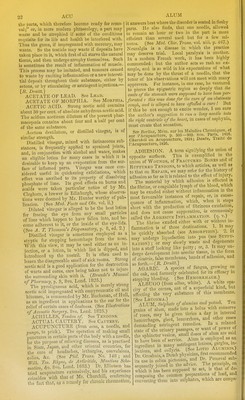
![ACU the parts, which therefore become ready for remo- or, in more modern phraseology, u part may waste and bo atrophied if some of the conditions requisite for its life and health be interfered with. Thus the gums, if impregnated with mercury, may waste. So the testicle may waste if deposits have taken place in it, which first of all starve the natural tissue, and then undergo atrophy themselves. Such is sometimes the result of inflammation of muscle. This process may be imitated, and tumours caused to waste by exciting inflammation or a new intersti- tial deposit throughout their substance, either by setons, or by stimulating or astringent injections.— [E. Druilt.S ACETATE OF LEAD. See Lead. ACETATE OF MORPHIA. See Mohphia ACETIC ACID. Strong acetic acid contains about 30 per cent, of absolute anhydrous acetic acid. The acidum aceticum dilutum of the present phar- macoposia contains about four and a half per cent of the same substance. Acetum destilatum, or distilled vinegar, is of similar strength. Distilled vinegar, mixed with farinaceous sub- stances, is frequently applied to sprained joints, and, in conjunction with alcohol and water, makes an eligible lotion for many cases in which it is desirable to keep up an evaporation from the sur- face of inflamed parts. Vinegar was once con- sidered useful in quickening exfoliations, which effect was ascribed to its property of dissolvmg phosphate of lime. Its good effects on bums and scalds were taken particular notice of by Mr. Cleghorn, a brewer in Edinburgh, whose observa- tions were deemed by Mr. Hunter worthy of pub- lication. (See Med. Facts and Ohs. vol. ii.) Diluted vinegar is alleged to be the best lotion for freeing the eye from any small particles of lime which happen to have fallen into, and be- come adherent to it, or the inside of the eye-lids. (See A. T. Thomson's Dispensatory, p. 8, ed. 2.) Distilled vinegar is sometimes employed as a styptic for stopping hemorrhage from the nose. With this view, it may be used either as an m- iection, or a lotion, in which lint is dipped, and introduced up the nostril. It is often used to lessen the disagreeable smell of sick rooms. Strong acetic acid is a good application for the destruction of warts and corns, care being taken not to injure the surrounding skin with it. {Brande's Manual of Pharmacy,^. 9, 8vo. Lond. 1825.) The pvroligneous acid, which is merely strong acetic acid impregnated with empyreumatic o'' J^'' bitumen, is commended by Mr. Buchanan, of Hull, as an ingredient in applications to the ear for the relief of certain cases of deafness. (See Illustrations of Acoustic Surgery, 8vo. Lond. 1825.) ACHILLES, Tendon of. See Tendons. ACTUAL CAUTERY. See Cautery. ACUPUNCTURE (from acus, a needle, and punyo, to prick). The operation of making small punctures in certain parts of the body with a needle, for the purpose of relieving diseases, as is practised in Siam, Japan, and other oriental countries, for the cure of headaches, lethargies, convulsions, colics, &c. (See Mil. Trans. No. Ui! ; and Wilfi Ten. liliyne, de Arthritide, Mantissa Sche- maticu, ffc. 8vo. Lond. UWA.) Dr. Elliotson has tried acupuncture extensively, and his experience coincides with that of Mr. Churchill, confirming the fact that, as a remedy for chronic rheumatism ALUM it answers best where the disorder is seated in fleshy parts. He also finds, that one needle, allowed to remain an hour or two in the part is more efficient than several used but for a few mi- nutes. (See Med. Chir. Trans, vol. xiii. p. 467.) Neuralgia is a disease in which the practice may deserve trial. Local paralysis is another. In a modern French work, it has been highly commended: but the author sets so rash an ex- ample, and is so wild in his expectations of what may be done by the thrust of a needle, that the tenor of his observations will not meet with many approvers. For instance, in one case, he ventured to pierce the epigastric region so deeply that tlie coats of the stomach were supposed to have been per- forated : this was done for the cxire of an obstinate cough, and is alleged to have effected a cure ! But if this be not enough to excite wonder, I am sure the author's suggestion to run a long needle into the right ventricle of the Jieart, in cases of asphyxia, must create that sensation. See Berlioz, Mem. sur les Maladies Chroniqueg. et sur ('Acupuncture, p. 305-309. 8vo. Pans. 1816. ChurchiU on Acupuncture, 1824; Dantii, Trait6 de I'Acupuncture, 1826. ADHESION. A term signifying the union of opposite surfaces. This is exemplified in the union of Woonds, of Fractured Bones and of Ruptured Tendons, to which articles, as well as to that on Repair, we may refer for the history of adhesion so far as it is related to the effect of injury. The material by which adhesion is effected is the fibrine, or coagulable lymph of the blood, which may be exuded either without inflammation in the most favourable instances of repair, or, in conse- quence of inflammation, which, when it stops short with the production of fibrinous exudation, and does not cause suppuration, is erroneously called the Adhesive Inflammation, (q. v.) The fibrine exuded either with or without in- flammation is of three destinations. 1. I* J^ay be quickly absorbed (see Absorption). 2. It may undergo liquefaction into pus (see Suppu- ration) ; or may slowly waste and degenerate into a stuff looking like putty; or, 3. It may un- dergo development into areolar tissue, in the form of cicati-ix, false membrane, bands of adhesion, and so forth.—[A Drtiitt.'] AGARIC. A species of fungus, growing on the oak and formerly celebrated for its efticacy m stopping bleeding. (See Hemorrhage.) ALBUGO (from alius, white). A white opa- city of the cornea, not of a superficial kind, but affecting the very substance of this membrane. (See Leucoma.) „ , . , . i AhVM, Suljyitato of alumina ayidpotas/i. len crains of alum, made into a bolus with conserve of roses, may be given thrice a day in internal hemorrhages, gleet, leucorrhcca, and other cases demanding astringent remedies. In a relaxed state of the urinary passages, or want of power of the sphincter vesicae, small doses of alum are said to have been of service. Alum is employed as an ingredient in many astringent lotions, giirgles, in- iections, and coUyria. (See LoTio Alum.nis.) Dr. Groshuis,a Dutch physician, first recommended its use in cobca pictonum and Dr. Perceval sub- sequently joined in the advice. 1 he pnnc.plo, on which it has been supposed to act, is that of d^ composing the common preparations of lead, and converting them into sulphates, which are compa-](https://iiif.wellcomecollection.org/image/b21461806_0001_0034.jp2/full/800%2C/0/default.jpg)