Natural history in Shakespeare's time : being extracts illustrative of the subject as he knew it / Made by H. W. Seager, M. B., &c. Also pictures thereunto belonging.
- Seager, H. W. (Herbert West), 1848-
- Date:
- 1896
Licence: Public Domain Mark
Credit: Natural history in Shakespeare's time : being extracts illustrative of the subject as he knew it / Made by H. W. Seager, M. B., &c. Also pictures thereunto belonging. Source: Wellcome Collection.
Provider: This material has been provided by the Harvey Cushing/John Hay Whitney Medical Library at Yale University, through the Medical Heritage Library. The original may be consulted at the Harvey Cushing/John Hay Whitney Medical Library at Yale University.
283/376 (page 271)
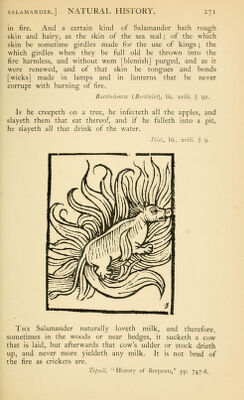
![in fire. And a certain kind of Salamander hath rough skin and hairy, as the skin of the sea seal ; of the which skin be sometime girdles made for the use of kings; the which girdles when they be full old be thrown into the fire harmless, and without wem [blemish] purged, and as it were renewed, and of that skin be tongues and bonds [wicks] made in lamps and in lanterns that be never corrupt with burning of fire. Barthohiticzc {Berthelet), bk. xviii. 5^ 92. If he creepeth on a tree, he infecteth all the apples, and slayeth them that eat thereof, and if he falleth into a pit, he siayeth all that drink of the water. Ibid., bk. xviii. ,^ 9. The Salamander naturally loveth milk, and therefore, sometimes in the woods or near hedges, it sucketh a cow that is laid, but afterwards that cow's udder or stock drieth up, and never more yieldeth any milk. It is not bred of the fire as crickets are. Topscll, '• History of Serpents, pp. 747-8.](https://iiif.wellcomecollection.org/image/b2100433x_0283.jp2/full/800%2C/0/default.jpg)