Natural history in Shakespeare's time : being extracts illustrative of the subject as he knew it / Made by H. W. Seager, M. B., &c. Also pictures thereunto belonging.
- Seager, H. W. (Herbert West), 1848-
- Date:
- 1896
Licence: Public Domain Mark
Credit: Natural history in Shakespeare's time : being extracts illustrative of the subject as he knew it / Made by H. W. Seager, M. B., &c. Also pictures thereunto belonging. Source: Wellcome Collection.
Provider: This material has been provided by the Harvey Cushing/John Hay Whitney Medical Library at Yale University, through the Medical Heritage Library. The original may be consulted at the Harvey Cushing/John Hay Whitney Medical Library at Yale University.
286/376 (page 274)
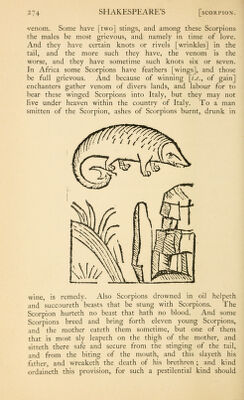
![7-l\ •venom. Some have [two] stings, and among these Scorpions the males be most grievous, and namely in time of love. And they have certain knots or rivels [wrinkles] in the tail, and the more such they have, the venom is the worse, and they have sometime such knots six or seven. In Africa some Scorpions have feathers [wings], and those be full grievous. And because of winning \i.e.^ of gain] enchanters gather venom of divers lands, and labour for to bear these winged Scorpions into Italy, but they may not live under heaven within the country of Italy. To a man smitten of the Scorpion, ashes of Scorpions burnt, drunk in wine, is remedy. Also Scorpions drowned in oil helpeth and succoureth beasts that be stung with Scorpions. The Scorpion hurteth no beast that hath no blood. And some Scorpions breed and bring forth eleven young Scorpions, and the mother eateth them sometime, but one of them that is most sly leapech on the thigh of the mother, and sitteth there safe and secure from the stinging of the tail, and from the biting of the mouth, and this slayeth his father, and wreaketh the death of his brethren ; and kind ordaineth this provision, for such a pestilential kind should](https://iiif.wellcomecollection.org/image/b2100433x_0286.jp2/full/800%2C/0/default.jpg)