Natural history in Shakespeare's time : being extracts illustrative of the subject as he knew it / Made by H. W. Seager, M. B., &c. Also pictures thereunto belonging.
- Seager, H. W. (Herbert West), 1848-
- Date:
- 1896
Licence: Public Domain Mark
Credit: Natural history in Shakespeare's time : being extracts illustrative of the subject as he knew it / Made by H. W. Seager, M. B., &c. Also pictures thereunto belonging. Source: Wellcome Collection.
Provider: This material has been provided by the Harvey Cushing/John Hay Whitney Medical Library at Yale University, through the Medical Heritage Library. The original may be consulted at the Harvey Cushing/John Hay Whitney Medical Library at Yale University.
303/376 (page 291)
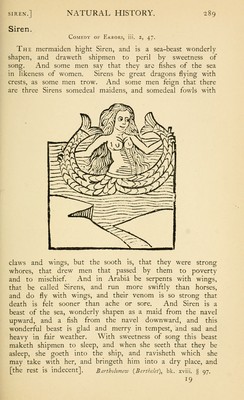
![Sore, Sorel. Love's Labour's Lost, iv. 2, 59, 60. Sore, a deer of four years old. Sorel, a deer of three years. m/«,/,^. Dictionary, s.v. Sow. Macbeth, iv. i, 64. A sow rooteth and diggeth the earth to get her meat and food, and overturneth and rooteth that she mav come with the teeth to mores [roots] and roots. And the young sow conceiveth against the evenness of day and night in springing - time, and farroweth sometime twenty pigs at once, but she eateth all sometime, out-taken the first, for he is most kindly to her, and she giveth him alway the first teat. The Sow is an unclean beast, and a right great glutton, and coveteth and desireth baths, fens and puddles, and resteth herself therein, and waxeth fat. And the seventh part of her meat turneth into hair and blood, and mtO other such. Bartholomew {BertMet), bk. xviii. .^ 99. V. Swine, Boar. Spaniel. Midsummer Night's Dream, ii. i, 203-7. The best sort of these dogs came from Spain. Minsheu's Dictionan, j.c-. The water-spagnel is taught by his master to seek for things that are lost (by words and tokens), and if he meet any person that hath taken them up, he ceaseth not to bay at him, and follow him, till he appear in his master's presence. They use to shear their hinder parts, that so they may be the less annoyed in swimming. I mav here also add the land-spagnel attending a hawk who are taught by falconers to retrieve and raise part- ridges. Thev are for the most part white, or spotted with red or black. Topsell, Four-footed Beasts, p. 122.](https://iiif.wellcomecollection.org/image/b2100433x_0303.jp2/full/800%2C/0/default.jpg)