Notes on some of the chemical reactions of narcotine and meconic acid / by T. G. Wormley.
- Wormley, Theodore George.
- Date:
- 1860
Licence: Public Domain Mark
Credit: Notes on some of the chemical reactions of narcotine and meconic acid / by T. G. Wormley. Source: Wellcome Collection.
Provider: This material has been provided by Royal College of Physicians, London. The original may be consulted at Royal College of Physicians, London.
2/10 page 2
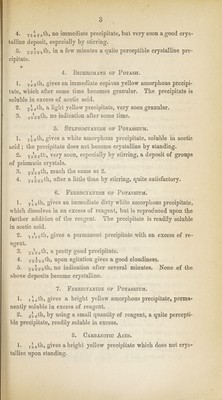
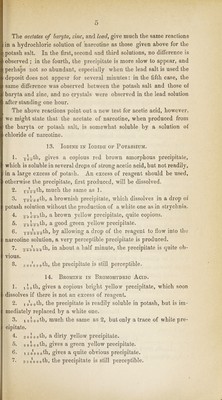
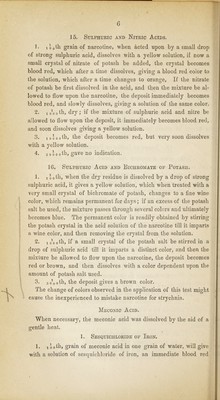
![3. an immediate precipitate, wliicli very soon is crys- talline. If there be much excess of the reagent, the precipitate will not be produced. 4. immediate cloudiness, which almost immediately becomes crystalline, and after a little time there is a rather abundant deposit of aciculated and branched crystals. 5. ooth, a perceptible cloudiness, soon much the same as in 4. 6. only a faint cloudiness at first, but very soon there is a deposit of aciculated crystals, which when examined by a mi- croscope are rather abundant.^ In applying the reagent to solutions as dilute as this and the one preceding, it is necessary to use the least possible quantity, otherwise there will be no deposit. 2. Ammonia. 1. grain of narcotine gives with ammonia an immediate- white curdy precipitate, not readily soluble in excess of reagent, but. readily, in a few drops of strong acetic acid. After a little time the ! precipitate becomes crystalline, the crystals having the same form ass those produced by potash. 2. T6oo^^> much the same as ]. 3* immediate cloudiness, which very soon becomess crystalline; to obtain the ppt. the least possible quantity of reagentt must be used. By suspending, for a few moments, a drop of am-- monia over the narcotine solution, the latter is covered by a white. cloudiness, which very soon becomes crystalline. 4. by applying the vapor of ammonia, no cloudiness is- produced, but soon there is a very good deposit of crystals. 5. __.J.^_th, by using a small quantity of the ammoniacal vapor,’ there is soon produced a pretty fair deposit. - The carbonates of potash and ammonia, behave in the same man- ner as the alkalies. Several specimens of iodide of potassium gave,*, also, the same reactions, and the same crystalline form. i 3. Chromate of Potash. 1. TO 17th, gives an immediate copious yellow amorphous precip-' t itate, which is readily soluble in acetic acid. 2. a yellow precipitate, soon crystals, same as producec : by potash. 3. much the same as 2, Much increased by stirring.](https://iiif.wellcomecollection.org/image/b28271701_0004.jp2/full/800%2C/0/default.jpg)