Elements of the philosophy of plants: containing the principles of scientific botany ... with a history of the science, and practical illustrations / By A.P. de Candolle and K. Sprengel. Translated from the German.
- Augustin-Pyramus de Candolle
- Date:
- 1821
Licence: Public Domain Mark
Credit: Elements of the philosophy of plants: containing the principles of scientific botany ... with a history of the science, and practical illustrations / By A.P. de Candolle and K. Sprengel. Translated from the German. Source: Wellcome Collection.
490/544 (page 438)
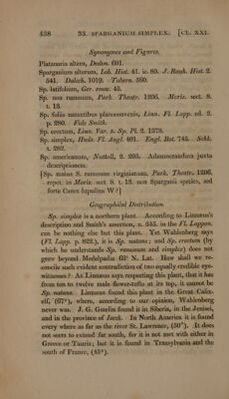
![Synonymes and Figures, Platanaria altera, Dodon. 601. Sparganium alterum, Lob, Hist. 41. ic. 80. J. Bauh. Hist. 2 541. Dalech. 1019. « Tabern. 560. Sp. latifolium, Ger. emac. 45, Sp. non ramosum, Park. Theatr. 1206, . Moris. sect. 8. t. 13. | Sp. foliis natantibus planoconvexis, Linn. Fl. Lapp. ed. 2 p. 280... Fide Smith. Sp. erectum, Linn. Var. 2. Sp. Pl,.2. 1378. Sp. simplex, Huds. Fl. Angl. 401... Engl. Bot. 745... Schk, 6.282, Sp. americanum, Nuttally 2, 203. _Admunerandum. juxta deseriptionem. [Sp. maius S. ramosum virginianum, Park. Theatr. 1206, _vepet.. in Moris. sect. 8, t. 18. non Sparganii species, sed fortis Carex lupulina W ?] Geographical Distribution. Sp. simplex is a. northern plant. According to Linnzus’s description and Smith’s assertion, n. 345. in the Fl. Lappon. can be nothing else but this plant. Yet Wahlenberg says (Fl. Lapp. p. 822.), it is Sp. natans ; and Sp. erectum (by which he understands Sp. ramosum and simplew) does not grow beyond Medelpadia : 63° N. Lat. : How shall we re- concile such evident contradiction of two equally credible eye- witnesses ?. As Linnzus says respecting this plant, that it has from ten to twelve male flower-tufts at its top,.it cannot be Sp. natans.. Linneus found this plant in the Great. Calix- elf, (67°), where, according to our opinion, W ahlenberg never was. J.G. Gmelin found it in Siberia, in the Jenisei, and in the province of /sezk. In North America. it is found every where as far as the river St. Lawrence, (50°). ‚It does not seem to extend far south, for it is not met with either in Greece or Tauris; but it is found in Transylvania and the south of France, (45°).](https://iiif.wellcomecollection.org/image/b33283552_0490.jp2/full/800%2C/0/default.jpg)