Text-book of structural and physiological botany / by Otto W. Thomé ... and Alfred W. Bennett.
- Thomé, Otto W. (Otto Wilhelm), 1840-1925.
- Date:
- 1885
Licence: Public Domain Mark
Credit: Text-book of structural and physiological botany / by Otto W. Thomé ... and Alfred W. Bennett. Source: Wellcome Collection.
Provider: This material has been provided by University of Bristol Library. The original may be consulted at University of Bristol Library.
442/506 (page 420)
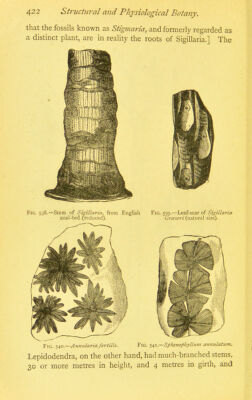
![In reference to the relative position of the strata, and to the fossil remains (chiefly those of animals) found in them, a number oigeological systems are distinguished, which are again divided into groups. The lowest strata of the Primary or Palceozoic age {i.e. the period of the oldest living beings)—viz. the strata of the Silurian' system—contain the earliest remains that have been preserved of the vegetable world. Only a few marine Algas are known ; but others may have altogether perished, their existence being indicated only by the occurrence of carbonaceous or bituminous limestone. In the Devonian system the number of species, genera, and families has greatly increased. In addition to a con- siderable number of Algae, the first land-plants have made their appearance. They consist almost entirely of the re- mains of Vascular Cryptogams, with a few Cycadese and Coniferae. The aspect of this period, as also of that next in succession, must have been extraordinarily uniform and monotonous ; but vegetable life had extended over the sur- face of the earth in a variety and luxuriance of forms far surpassing our existing vegetation. In the Carbo7iiferoiis period Ferns attained a special de- velopment. We find lofty trees or shrubs with multipinnate leaves several feet in length, forming magnificent groups of plants, in the shade of which other smaller species grew as underwood (Figs. 540-542). Among the largest forms of which these forests were composed were certain Lyco- podiacese—to which nothing now existing is comparable —^known as Sigillarice and Lepidodendra (Figs. 535-539)- gens, 43 genera, 142 species ; Gymnosperms, 56 genera, 363 species ; Cryptogams, 152 genera, 1,172 species; Doubtful, 35 genera, 197 species. Since that time the number of both genera and species has been enormously increased, especially by the additions to the Tertiaiy flora made by Heer and Ettingshausen.—Ed.] , , , r .t ' [Geologists now distinguish the oldest stratified beds from the superimposed Silurian as the LaureiiHan .ind Cambrian systems. They contain but few remains of organic life.—Ed.]](https://iiif.wellcomecollection.org/image/b21445771_0442.jp2/full/800%2C/0/default.jpg)