Task Force report : narcotics and drug abuse annotations and consultants' papers.
- United States. Task Force on Narcotics and Drug Abuse.
- Date:
- [1967]
Licence: Public Domain Mark
Credit: Task Force report : narcotics and drug abuse annotations and consultants' papers. Source: Wellcome Collection.
112/172 (page 102)
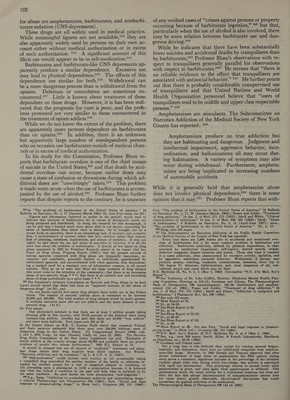
![for abuse are amphetamines, barbiturates, and nonbarbi- turate sedatives (CNS depressants) . These drugs are all widely used in medical practice. While meaningful figures are not available,”*? they are also apparently widely used by persons on their own ac- count either without medical authorization or in excess of such authorization. 7%? A significant amount of this illicit use would appear to be in self-medication.?** Barbiturates and barbiturate-like CNS depressants ap- parently produce a similar dependence. Excessive use may lead to physical dependence.**> The effects of this dependence are similar for both.?2** Withdrawal can be a more dangerous process than is withdrawal from the opiates. Delerium or convulsions are sometimes en- countered.?37_ Little is known about treatment of those dependent on these drugs. However, it is has been indi- cated that the prognosis for cure is poor, and the prob- lems presented are very similar to those encountered in the treatment of opiate addicts.?** While we do not know the extent of the problem, there are apparently more persons dependent on barbiturates than on opiates.?*° In addition, there is an unknown but apparently large number of nondependent persons who on occasion use barbiturates outside of medical chan- nels or in excess of medical authorization. In his study for the Commission, Professor Blum re- ports that barbiturate overdose is one of the chief means dental overdose can occur, because earlier doses may cause a state of confusion or drowsiness during which ad- ditional doses are “unwittingly” taken.?41_ This problem is made more acute when the use of barbiturates is accom- panied by the use of alcohol.”4? Professor Blum further reports that despite reports to the contrary, he is unaware 232In ‘“‘The problems of barbiturates in the United States of America,’’ 16 Bulletin on Narcotics, No. 1, 17 (January-March 1964) Dr. Joel Fort states (at 20): Figures and information [referred to earlier in the article] would tend: to indicate that amounts of barbiturates far in excess of therapeutic needs are being produced and distributed. In doing the research for this monograph, it can be said that I learned much more about what is not known concerning the abuse of barbiturates than about what is known. As is brought out in a recent book on narcotics, there is an astonishing lack of accurate and complete data, a predominance of opinion rather that fact, emotion rather than reason, lack of planning, omiesions, duplications, and misuse of statistics. If this can rightly be said about the use and abuse of narcotics in America, it is all the more true about the problem of barbiturates. A special ad hoc panel on drug abuse appointed in 1963 by President Kennedy stated in its report [Ad hoc Panel on Drug Abuse, Progress Report (1962)] that the present records of various agencies connected with drug abuse are frequently inaccurate, in- complete and unreliable, generally limited to individuals apprehended by enforcement agencies, and uncoordinated with other agencies, thus demonstrat- ing a marked need for a standard core of information common to all record systems. They go on to state that there are large numbers of drug abusers who never come to the attention of the community; that there is an increasing abuse of non-narcotic drugs * * *; that there is an entirely new and increasing abuse of drugs periodically on a spree basis * * *, 238 The President’s Advisory Commission on Narcotic and Drug Abuse in its final report merely stated that there had been an ‘‘apparent increase in the abuse of dangerous drugs’’ (at 35), and No one knows exactly how many drug abusers there really are in the United States. The number of narcotic addicts alone is estimated to be between 45,000 and 100,000. The total number of drug abusers would be much greater. It includes narcotics users who are not addicts and the many abusers of non- narcotic drug. (At 4.) Dr. Fort states: One physician’s estimate is that there are at least 1 million people taking sleeping pills in this country, with 10-25 percent of the habitual users being unsuspecting addicts. Another has said that there are 50,000 ‘‘true addicts” and many more habitués. Fort, supra note 232 at 20. In the Senate debate on H.R. 2, Senator Dodd stated that unnamed Federal and State agencies estimated that there were over 100,000 habitual users of dangerous drugs in the United States. 111 Congressional Record 140%, cols. 2 and 3, 89th Cong., Ist sess. (Senate) (daily ed. June 23, 1965). The Narcotic Drug Study Commission of the New Jersey Legislature has said, ‘‘Estimates of heroin addicts in the country average about 60,000 and probably there are greater numbers of people who misuse barbiturates.’’ 1965 N.J. Report at 73. It should be stressed that not all abusers of ‘medically’? depressant and stimu- lant drugs obtain their drug supplies from illicit markets. See Winick, ‘Narcotics addiction and its treatment,” 22 L. & C.P.. 9, 13 (1957). 234 “‘Self-medication” would include such conduct as (a) occasionally taking a controlled drug prescribed for another member of the family or otherwise in- tended for another person for a real or imagined ailment or condition, or (5) prevailing upon a pharmacist to refill a prescription because it is believed that what has helped a condition in the past will help what is believed to be the same condition. As used herein the term presupposes ‘‘self-diagnosis.”’ 5 E.g., Essig, ‘Addiction to nonbarbiturate sedatives and tranquilizing drugs,’’ 5 Clinical Pharmacology and Therapeutics 334 (1964) ; Fort, ‘‘Social and legal response to pleasure-giving drugs,” in Blum (ed.), Utopiates 205, 211 (1964) ’ of any verified cases of “‘crimes against persons or property occurring because of barbiturate ingestion,” * but that, particularly when the use of alcohol is also involved, there may be some relation between barbiturate use and dan- gerous driving.?*4 While he indicates that there have been substantially fewer suicides and accidental deaths by tranquilizers than by barbiturates,?*° Professor Blum’s observations with re- spect to tranquilizers generally parallel his observations with respect to barbiturates.2*° He stresses that “there is no reliable evidence to the effect that tranquilizers are associated with antisocial behavior.” *4* He further points out that there is probably considerable unsupervised use of tranquilizers and that United Nations and World Health Organization personnel believe that “users of tranquilizers tend to be middle and upper class respectable persons.” 748 Amphetamines are stimulants. The Subcommittee on Narcotics Addiction of the Medical Society of New York County has reported: 7*° Amphetamines produce no true addiction but they are habituating and dangerous. Judgment and intellectual impairment, aggressive behavior, inco- ordination, and hallucinations all may occur dur- ing habituation. A variety of symptoms may also occur during withdrawal. Furthermore, ampheta- mines are being implicated in increasing numbers of automobile accidents. While it is generally held that amphetamine abuse does not involve physical dependence,”*° there is some opinion that it may.” Professor Blum reports that with- Fort, ‘“‘The problem of barbiturates in the United States of America,” 16 Bulletin on Narcotics, No. 1, 17, 25 (January-March, 1964) ; Fraser and Grider, ‘“‘Treatment of drug addiction,”’ 14 Am. J. of Med. 571, 572 (1953) ; Isbell and White, “‘Clinical characteristics of addictions,” 14 Am. J. of Med. 558, 562 (1953); Isbell, ‘‘Abuse of barbiturates,” 9 Bulletin on Narcotics, No. 2, 14 (April-June 1957); anon., “The problem of barbiturates in the United States of America.” Id., p. 15. 238 Essig, note 235 supra. 237 The Subcommittee on Narcotics Addiction of the Public Health Committee of the Medical Society of the County of New York has reported: Every year there are 3,000 deaths due to accidental and intentional over- dose of barbiturates but a far more common problem is habituation and addiction. Barbiturate addiction, defined by physical dependence, is char- acterized by intellectual impairment, self-neglect, slurred speech, tremor, defective judgment, bizzare behavior and ataxia. Those who treat it consider it a nasty addiction, often characterized by excessive activity, agitation, and by aggressive, sometimes paranoid behavior. Withdrawal, if abrupt, may produce nausea, vomiting, weakness, tremulousness, ingomnia, fever (up to 105 degree F) delerium, hallucinations, and, most dangerous of all, con- vulsions, stupor and coma which may be fatal. N.Y. ess 22, No. 9, 3, 4 (May 5, 1966) (hereinafter ‘‘N.Y. C’ty Med. Soc’y Report’’). 238 See Testimony of Dr. John Griffith, Director, Oklahoma Mental Health Plan- ning Committee, Hearings at 312-13; Goodman and Gilman, The Pharmacological Basis of Therapeutics 298 (amphetamines), 305-06 (barbiturates and ampheta- mines) (3d ed. 1965); Fraser and Grider, ‘‘Treatment of drug addiction,’”’ 14. Am. J. of Med. 571, 576 (1953); Isbell and Fraser, ‘‘Addiction to analgesics and barbiturates,’’ 2 Pharmacol. Rev. 355, 390 (1950). 239 See note 233 supra. 240 Blum Report at 54. 241 Td., at 54-55. 244 See Blum Report at 56. 243 Td., at 55. 244 See Blum Report at 55-56. 245 Id., at 48-49. 246 See Blum Report at 47-52. 247 Td., at 49. °48 Blum Report at 48. See also Fort, ‘‘Social and legal response to pleasure- giving drugs,’’ in Blum (ed.), Utopiates 205, 211 (1964). *49 N.Y. Med. Soc’y Report, 22 N.Y. Medicine No. 9, at 4 (May 5, 1966). 259 See, e.g., note 249 supra; Smith, Kline, & French Laboratories, Handbook on Dexedrine, etc., 20-25 (1966). 251 Goodman and Gilman state: For a long time it was believed that, except for craving, general fatigue, lassitude, and depression, there were no withdrawal symptoms from ampheta- mine-like drugs. However, in 1963 Oswald and Thacore observed that after abrupt withdrawal of large doses of amphetamine the EEG pattern during sleep shows a consistent, significant increase in the percentage of the rhomben cephalic phase (that time during which low-voltage, fast activity is associated with rapid eye movements). This percentage returns to normal levels when amphetamine is given, and rises again when amphetamine is withheld. This phenomenon meets the usual criteria for a withdrawal symptom but does not alter the fact that abrupt discontinuation of sympathomimetic’ amines does not cause major, grossly observable, physiological disruptions that would necessitate the gradual reduction of the medication. The Pharmacological Basis of Therapeutics 298 (3d ed. 1965).](https://iiif.wellcomecollection.org/image/b32179911_0112.jp2/full/800%2C/0/default.jpg)