[Report of the Medical Officer of Health for Kensington Borough].
- Kensington (London, England). Royal Borough.
- Date:
- [1913]
Licence: Attribution-NonCommercial 4.0 International (CC BY-NC 4.0)
Credit: [Report of the Medical Officer of Health for Kensington Borough]. Source: Wellcome Collection.
23/100 page 15
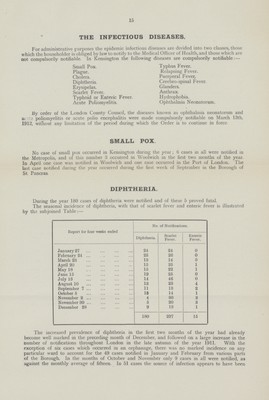
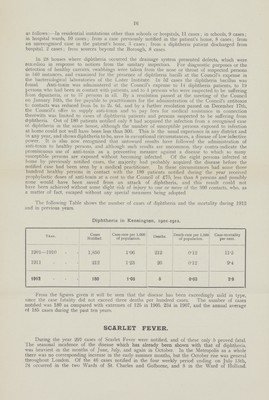
![15 THE INFECTIOUS DISEASES. For administrative purposes the epidemic infectious diseases are divided into two classes, those which the householder is obliged by law to notify to the Medical Officer of Health, and those which are not compulsorily notifiable. In Kensington the following diseases are compulsorily notifiable:— Small Pox. Typhus Fever. Plague. Relapsing Fever. Cholera. Puerperal Fever. Diphtheria. Cerebro-spinal Fever. Erysipelas. Glanders. Scarlet Fever. Anthrax. Typhoid or Enteric Fever. Hydrophobia. Acute Poliomyelitis. Ophthalmia Neonatorum. By order of the London County Council, the diseases known as ophthalmia neonatorum and acute poliomyelitis or acute polio encephalitis were made compulsorily notifiable on March 13th, 1912, without any limitation of the period during which the Order is to continue in force. SMALL POX. No case of small pox occurred in Kensington during the year; 6 cases in all were notified in the Metropolis, and of this number 3 occurred in Woolwich in the first two months of the year. In April one case was notified in Woolwich and one case occurred in the Port of London. The last case notified during the year occurred during the first week of September in the Borough of St. Pancras. DIPHTHERIA. During the year 180 cases of diphtheria were notified and of these 5 proved fatal. The seasonal incidence of diphtheria, with that of scarlet fever and enteric fever is illustrated by the subjoined Table:— /###]Report for four weeks ended No. of Notifications. Diphtheria. Scarlet Fever. Enteric Fever. January 27 24 24 0 February 24 25 26 0 March 23 13 16 0 April 20 15 25 1 May 18 15 22 1 June 15 19 25 0 July 18 14 46 0 August 10 13 23 4 September 7 11 13 2 October 5 13 14 1 November 2 4 80 2 November 30 5 20 3 December 28 9 13 1 180 297 15 The increased prevalence of diphtheria in the first two months of the year had already become well marked in the preceding month of December, and followed on a large increase in the number of notifications throughout London in the late autumn of the year 1911. With the exception of six cases which occurred in an orphanage, there was no marked incidence on any particular ward to account for the 49 cases notified in January and February from various parts of the Borough. In the months of October and November only 9 cases in all were notified, as against the monthly average of fifteen. In 51 cases the source of infection appears to have been](https://iiif.wellcomecollection.org/image/B18235682_0023.jp2/full/800%2C/0/default.jpg)

 No text description is available for this image
 No text description is available for this image
 No text description is available for this image