A practical guide to operations on the teeth : to which is prefixed a historical sketch of the rise and progress of dental surgery / by James Snell, dentist.
- Snell, James, 1976-
- Date:
- 1831
Licence: Public Domain Mark
Credit: A practical guide to operations on the teeth : to which is prefixed a historical sketch of the rise and progress of dental surgery / by James Snell, dentist. Source: Wellcome Collection.
Provider: This material has been provided by University of Bristol Library. The original may be consulted at University of Bristol Library.
187/232 (page 167)
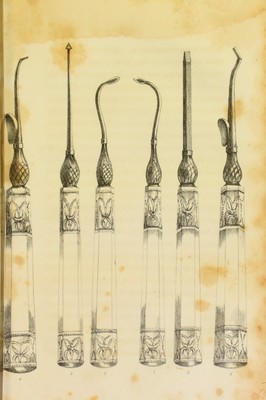
![recommended by some, to make the lower part larger than the rim, with the view of prevent- ing the stopping falling out. Judging from my own experience, I should say, decidedly, that this method is highly objectionable in every way, it being unfavourable to perfectly fitting the cavity, and consequently to the retention of the stopping. If it be ever admissible, it is when fusible metal is used, which admits of more management in some particulars than gold; but, as has been already observed, where a tooth cannot be stopped without using the fusible metal, it is much better to remove it at once. The operation of stopping, when there is no mechanical obstruction to be removed, is simply this. The aperture should be first di- vested of every particle of caries ; this must be done most perfectly; for should any portion, however small, be left, the operation will not succeed. For this purpose various instruments are requisite. If the aperture is small, having an irregular shape, the enamel should be first cut with the file-headed instrument [Fig. 2,] to a sufficient size; next, a broach-shaped instru- ment, [Fig. 3,] the size of the aperture, should be introduced, having a curve, if the situation](https://iiif.wellcomecollection.org/image/b21444407_0187.jp2/full/800%2C/0/default.jpg)