A practical guide to operations on the teeth : to which is prefixed a historical sketch of the rise and progress of dental surgery / by James Snell, dentist.
- Snell, James, 1976-
- Date:
- 1831
Licence: Public Domain Mark
Credit: A practical guide to operations on the teeth : to which is prefixed a historical sketch of the rise and progress of dental surgery / by James Snell, dentist. Source: Wellcome Collection.
Provider: This material has been provided by University of Bristol Library. The original may be consulted at University of Bristol Library.
188/232 (page 168)
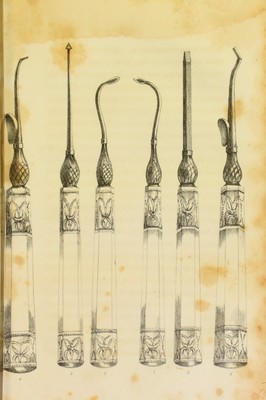
![1()8 of the caries requires it. This should be ro- tated in circles of the wrist, until the caries part is removed entirely, and sound bone ob- servable at the bottom of the cavity. This in- strument will leave a cavity shaped precisely as is most desirable. A powerful magnifying mir- ror should then be used, to show whether the aperture has been completely cleansed from ca- ries. This being satisfactorily ascertained, the hole should be perfectly dried out with fine lint, a point to be most especially attended to, as the smallest quantity of damp remaining would be likely to prevent the success of the operation. A portion of gold should then be taken, more than sufficient to fill the cavity; for should it be too small, it will be useless, as no second portion can be introduced with success. It must consequently be removed, and that part of the operation, under such circumstances, commenced afresh with a larger piece of gold. The gold should be introduced with one of the stopping instruments in the plate, [Fig. 4 and 5] the instrument having a curve suited exactly to the situation of the aperture, and being some- what less in circumference than the hole itself. The gold should not be pressed too hard until](https://iiif.wellcomecollection.org/image/b21444407_0188.jp2/full/800%2C/0/default.jpg)