Volume 1
A text-book of human physiology : including histology and microscopical anatomy with special reference to the requirements of practical medicine / by L. Landois ; translated from the seventh German edition with additions by William Stirling.
- Landois, L. (Leonard), 1837-1902. Lehrbuch der Physiologie des Menschen. English
- Date:
- 1891
Licence: Public Domain Mark
Credit: A text-book of human physiology : including histology and microscopical anatomy with special reference to the requirements of practical medicine / by L. Landois ; translated from the seventh German edition with additions by William Stirling. Source: Wellcome Collection.
558/602 page 518
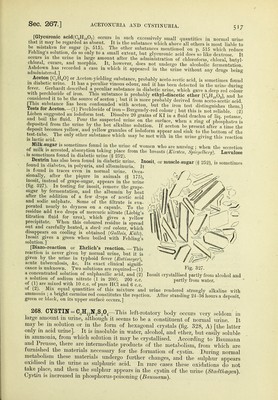
![269. LEUCIN = C^'S^.^.'SO^- TYROSIN = CgHi.NOg.—Both bodies occur m the urine in acute yellow atrophy of the liver, and in poisoning by phosphorus. (Their formation during pancreatic digestion has been referred to in § 170, II.) As the urea excreted is usually diminished at the same time, it is assumed that, m these diseases, the further oxidation of the derivatives of the proteids is interfered with. Lencin, which is either precipitated spontaneously or obtained after evaporating an alcoholic extract of the concentrated urine, occurs in the form of yellowish-brown balls (fig. 329, a, a), often with concentric markings, or with fine spines on their surface. When heated it sublimes without fusing. Tyrosin forms silky colourless sheaves of needles (fig. 329, b, h). When boiled Avith mercuric nitrate and nitric acid it gives a red colour, and afterwards a Fig. 328. A, crystals of cystin ; B, oxalate of lime ; c, hour-fflass forms of B. Fig. 329. a, a, leucin balls ; h, b, tyrosin sheaves ; c, double balls of ammonium urate. brownish-red precipitate. Piria's Test.—When slightly heated with a few drops of concentrated sulphuric acid, it dissolves with a temporary deep red colour. On diluting with water, adding barium carbonate until it is neutralised, boding, filtering, and adding dilute ferric chloride, a violet colour is obtained (Piria, Stcideler). 270. DEPOSITS IN UEINE.—Deposits may occur in normal and in patho- logical urine, and they may be either organised or unorganised. I. Organised Beposits. A Blood : red and white blood-corpuscles and sometimes fibrin (figs. 320-322). b' Pus in greater or less amount in catarrh or inflammation of the urinary passages. I ns cells exactly rlsemble colourless blood-corpuscles (figs. 14, 323). Bonne's Test.-Pour off the supernatant fluid and add a piece of caustic potash to the deposit; if it be pus it becomes gelatinous, ropy, and more viscid (alkali-albuminate). Mucus, when so acted on, becomes more fluid and mixed with flocculi. i ^ t, -4. • C. Epithelium of various forms occurs, but it is not always possible to say whence it is derived. B. Spermatozoa may be present. , . ,t i E Lower organisms occur in the urinary passages very seldom, but they may be present, e^g., in the bladder, when germs are introduced from without by means of a dirty catheter. [Before introducing a cathetei into the bladder one ought always to make sure that the instrument is perfectly aseptic] Micrococci are found in the urine in certain diseases, e.g., diphtheria, ihe following forms are distinguished :—](https://iiif.wellcomecollection.org/image/b20417688_001_0558.jp2/full/800%2C/0/default.jpg)



 No text description is available for this image
 No text description is available for this image
 No text description is available for this image