Introduction to the study of chemical philosophy : the principles of theoretical and systematic chemistry / by William A. Tilden.
- Tilden, William A. (William Augustus), Sir, 1842-1926.
- Date:
- 1876
Licence: Public Domain Mark
Credit: Introduction to the study of chemical philosophy : the principles of theoretical and systematic chemistry / by William A. Tilden. Source: Wellcome Collection.
277/314 (page 257)
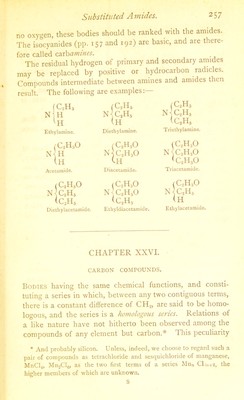
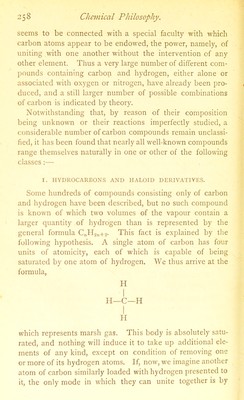
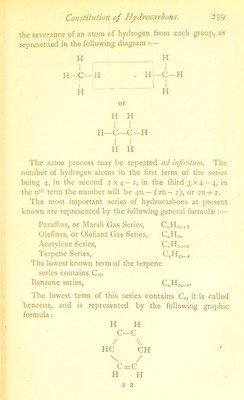
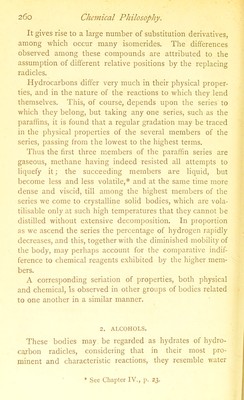
![no oxygen, these bodies should be ranked with the amides. The isocyanides (pp. 157 and 192) are basic, and are there- fore called carbamines. The residual hydrogen of primary and secondary amides may be replaced by positive or hydrocarbon radicles. Compounds intermediate between amines and amides then result. The following are examples:— C,HS (C2PI5 (C2H6 N- H n^c2h5 n]c2h6 ic2h5 H (h Ethylamine. Diethylamine. Triethylamine. c2h3o fC2H3o (C2H30 N-l H n]c.,h3o nc2h3o Ih CH <c2h3o Acetamide. Diacetamide. Triacetamide. (C2H3O (C2H30 N •; C2H30 (C,H30 N c2h5 n^c2h5 <c2h5 <c2h5 (h Diethylacetamide. Ethyldiacetamide. Ethylacetamide. CHAPTER XXVI. CARBON COMPOUNDS. Bodies having the same chemical functions, and consti- tuting a series in which, between any two contiguous terms, there is a constant difference of CH2, are said to be homo- logous, and the series is a homologous series. Relations of a like nature have not hitherto been observed among the compounds of any element but carbon.* This peculiarity * And probably silicon. Unless, indeed, we choose to regard such a pair of compounds as tetrachloride and sesquichloride of manganese, MnCl.,, Mn2Cl6, as the two first terms of a series Mnn Cl;,1+2, the higher members of which are unknown.](https://iiif.wellcomecollection.org/image/b28062784_0277.jp2/full/800%2C/0/default.jpg)