A manual of dental anatomy : human and comparative / by Charles S. Tomes.
- Charles Sissmore Tomes
- Date:
- 1889
Licence: Public Domain Mark
Credit: A manual of dental anatomy : human and comparative / by Charles S. Tomes. Source: Wellcome Collection.
52/528 page 40
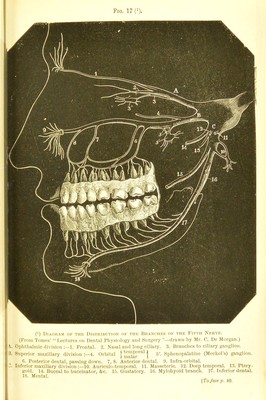
![of the maxillary bones, and these again are found to be largely influenced by the dentition of the animal, so that it comes to be true to say that the face of an animal largely depends upon its dentition. Thus, to take a lion as an example, the snout is broad owing to the wide separation between the canines, which gives them a good purchase in grasping a living prey; its shortness enables them to be used at a greater mechanical advantage than would be the case were they further removed from their fulcrum at the joint, and the breadth of the face below the eyes is conferred by the widely spreading zygomatic arches, which are obliged to be wide to give passage to the very powerful temporal imiscles, and attachment to the masseters. Without going into further details, which the reader can readily supply for himself, it will be seen, therefore, that the contour of the face is largely determined by the dentition in this instance, and it is in marked conti'ast with the long thin snouts of the insectivora, whose forceps-like front teeth as a rule merely pick up unresisting prey, or with the long weak snouts of the horse and the herbivora generally. The face of the boar, again, is largel}' determined by the great muscles which move the jaw, and by the bony processes Avhich give attachment to them. If you extend the jaws forward a little, project the teeth, and widen the mouth in man, you get a coarse animal type of fiice; and, conversely, by a reduction of the maxillary region, perha])S even below the limits which will afford space for the regular disposition of the teeth, you get a refined oval type of face. The jaws of a negro are large relatively to the cranium, as arc also those of exceptionally big men, such as we call giants, though this is not universally true ; in rickets the reverse is the case. The nerves of the teeth are derived from branches of the fifth nerve, the nerve of sensation of the whole side of the face and head : the lower teeth through the inferior maxil-](https://iiif.wellcomecollection.org/image/b21499305_0052.jp2/full/800%2C/0/default.jpg)