Licence: Public Domain Mark
Credit: The fossil iguanodon. Source: Wellcome Collection.
Provider: This material has been provided by The Royal College of Surgeons of England. The original may be consulted at The Royal College of Surgeons of England.
2/2 page 28
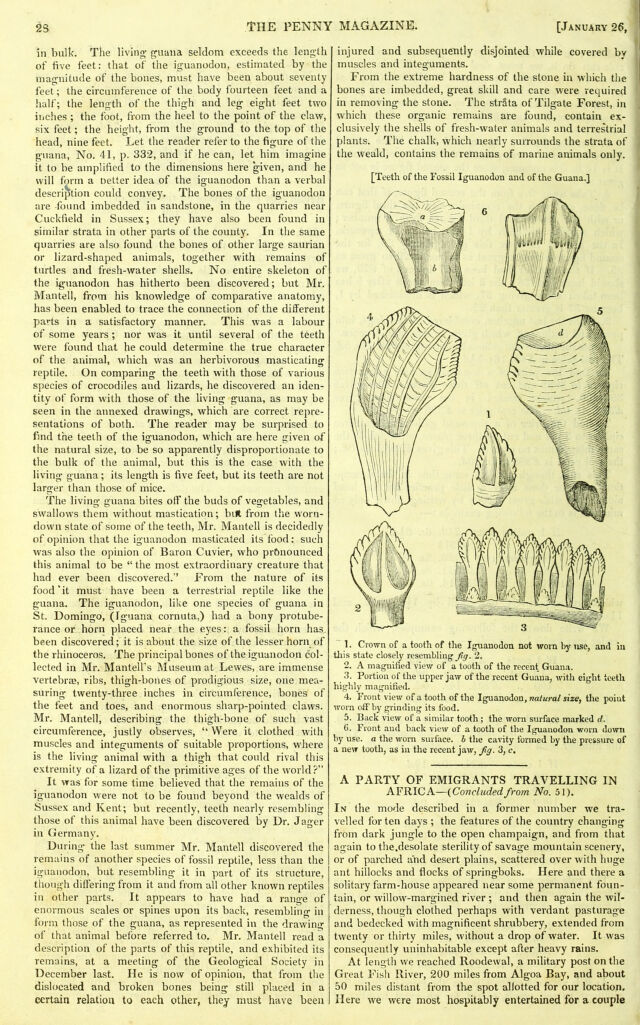
![in bulk. The living- guana seldom exceeds the length of five feet: that of the iguanodon, estimated by the magnitude of the bones, must have been about seventy feet; the circumference of the body fourteen feet and a half; the length of the thigh and leg eight feet two inches; the foot, from the heel to the point of the claw, six feet; the height, from the ground to the top of the head, nine feet. Let the reader refer to the figure of the guana, No. 41, p. 332, and if he can, let him imagine it to be amplified to the dimensions here given, and he will form a oetter idea of the iguanodon than a verbal description could convey. The bones of the iguanodon are found imbedded in sandstone, in the quarries near Cuckfield in Sussex; they have also been found in similar strata in other parts of the county. In the same quarries are also found the bones of other large saurian or lizard-shaped animals, together with remains of turtles and fresh-water shells. No entire skeleton of the iguanodon has hitherto been discovered; but Mr. Mantell, from his knowledge of comparative anatomy, has been enabled to trace the connection of the different parts in a satisfactory manner. This was a labour of some years; nor was it until several of the teeth were found that he could determine the true character of the animal, which was an herbivorous masticating reptile. On comparing the teeth with those of various species of crocodiles and lizards, he discovered an iden- tity of form with those of the living guana, as may be seen in the annexed drawings, which are correct repre- sentations of both. The reader may be surprised to find the teeth of the iguanodon, which are here given of the natural size, to be so apparently disproportionate to the bulk of the animal, but this is the case with the living guana; its length is five feet, but its teeth are not larger than those of mice. The living guana bites off the buds of vegetables, and swallows them without mastication; belt from the worn- down state of some of the teeth, Mr. Mantell is decidedly of opinion that the iguanodon masticated its food: such was also the opinion of Baron Cuvier, who pr&nounced this animal to be “ the most extraordinary creature that had ever been discovered.” From the nature of its food'it must have been a terrestrial reptile like the guana. The iguanodon, like one species of guana in St. Domingo, (Iguana cornuta,) had a bony protube- rance or horn placed near the eyes: a fossil horn has been discovered; it is about the size of the lesser horn of the rhinoceros. The principal bones of the iguanodon col- lected in Mr. Mantell’s Museum at Lewes, are immense vertebra;, ribs, thigh-bones of prodigious size, one mea- suring twenty-three inches in circumference, bones of the feet and toes, and enormous sharp-pointed claws. Mr. Mantell, describing the thigh-bone of such vast circumference, justly observes, “ Were it clothed with muscles and integuments of suitable proportions, where is the living animal with a thigh that could rival this extremity of a lizard of the primitive ages of the world?” It was for some time believed that the remains of the iguanodon were not to be found beyond the wealds of Sussex and Kent; but recently, teeth nearly resembling those of this animal have been discovered by Dr. Jager in Germany. During the last summer Mr. Mantell discovered the remains of another species of fossil reptile, less than the iguanodon, but resembling it in part of its structure, though differing from it and from all other known reptiles in other parts. It appears to have had a range of enormous scales or spines upon its back, resembling in form those of the guana, as represented in the drawing of that animal before referred to. Mr. Mantell read a description of the parts of this reptile, and exhibited its remains, at a meeting of the Geological Society in December last. He is now of opinion, that from the dislocated and broken bones being still placed in a certain relation to each other, they must have been injured and subsequently disjointed while covered by muscles and integuments. From the extreme hardness of the stone in which the bones are imbedded, great skill and care were required in removing the stone. The strata of Tilgate Forest, in which these organic remains are found, contain ex- clusively the shells of fresh-water animals and terrestrial plants. The chalk, which nearly surrounds the strata of the weald, contains the remains of marine animals only. [Teeth of the Fossil Iguanodon and of the Guana.] 1. Crown of a tooth of the Iguanodon not worn by use, and in this state closely resembling fig. 2. 2. A magnified view of a tooth of the recent Guana. 3. Portion of the upper jaw of the recent Guana, with eight teeth highly magnified. 4. Front view of a tooth of the Iguanodon, natural size, the point worn off by grinding its food. 5. Back view of a similar tooth; the worn surface marked cl. 6. Front and back view of a tooth of the Iguanodon worn down by use. a the worn surface, b the cavity formed by the pressure of A PARTY OF EMIGRANTS TRAVELLING IN AFRICA—(Concludedfrom No. 51). In the mode described in a former number we tra- velled for ten days ; the features of the country changing from dark jungle to the open champaign, and from that again to the.desolate sterility of savage mountain scenery, or of parched and desert plains, scattered over with huge ant hillocks and flocks of springboks. Here and there a solitary farm-house appeared near some permanent foun- tain, or willow-margined river ; and then again the wil- derness, though clothed perhaps with verdant pasturag-e and bedecked with magnificent shrubbery, extended from twenty or thirty miles, without a drop of water. It was consequently uninhabitable except after heavy rains. At length we reached Roodewal, a military post on the Great Fish River, 200 miles from Algoa Bay, and about 50 miles distant from the spot allotted for our location. Here we were most hospitably entertained for a couple](https://iiif.wellcomecollection.org/image/b22288600_0004.jp2/full/800%2C/0/default.jpg)