Introduction to the study of inorganic chemistry / by William Allen Miller.
- Miller, William Allen, 1817-1870.
- Date:
- 1871
Licence: Public Domain Mark
Credit: Introduction to the study of inorganic chemistry / by William Allen Miller. Source: Wellcome Collection.
316/332
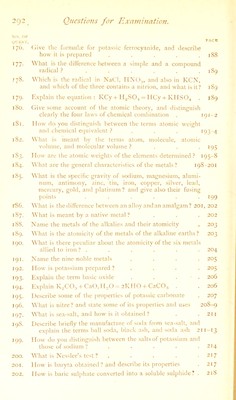
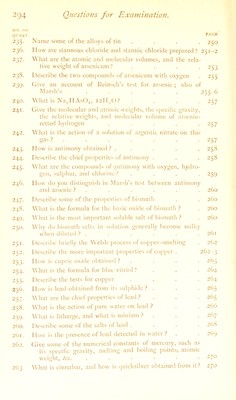
![x^>. or ylKM'. I’ACI 176. (live tile foniuiUc for potassic feirocyanidc, and describe how it is prepared . . . . .188 177. Wliat is the difference between a simple and a compound radical ? . . . . . .189 778. Which is the radical in NaCl, UNO;,, and also in KCN, and which of the three contains a nitrion, ami what is it? 189 179. Explain the equation : KCy + I= 1 ICy + KHSO^ . 189 180. Give some account of the atomic theory, and distinguish clearly the four laws of chemical combination . 191- 2 181. How do you distinguish between the terms atomic weight ami chemical eipiivalent ? . . . 193-4 182. What is meant by the terms atom, molecule, atomic volume, and molecular volume ? . . .195 1S3. How are the atomic weights of the elements determined? 195-8 184. What are the general characteristics of the metals? 198-201 185. What is the specific gravity of sodium, magnesium, alumi- num, antimony, zinc, tin, iron, copper, silver, lead, mercury, gold, ami platinum ? and give also their fusing points ...... 199 rS6. What is the difference between an alloy and an amalgam? 201, 202 187. Wliat is meant by a native metal ? . . , 202 188. Name the metals of the alkalies and their atomicity . 203 189. What is the atomicity of the metals of the alkaline earths? 203 190. What is there peculiar about the atomicity of the six metals allied to iron? ...... 204 191. Name the nine noble metals , , , . 205 192. How is potassium ]ircpared ? , , , , 205 193. Explain the term basic oxide . , . . 206 194. lfx]>lain K.jCO^,-(-Cat', HnO = 2K HO + CaCO^ , 206 195. Describe some of the properties of potassic carbonate . 207 196. What is nitre? and state some of its pro]ierties and u>es 20S-9 197. What is sea-salt, and how is it obtained? . .211 198. Descrilie briefly the manufacture of soda from sea-salt, and explain the terms ball soda, black ash, and soda ash 211-13 199. How do you distinguish between the salts of ]-iotassium and those of sodium ? , . , . . 214 200. 3Vhat is Ncssler’s test ? - . . . -217 201. How is baryta obtained ? and describe its jiroperties . 217 202. How is baric sulphate converted into a soluble sulphide? , 21S](https://iiif.wellcomecollection.org/image/b28099631_0316.jp2/full/800%2C/0/default.jpg)