Introduction to the study of inorganic chemistry / by William Allen Miller.
- Miller, William Allen, 1817-1870.
- Date:
- 1871
Licence: Public Domain Mark
Credit: Introduction to the study of inorganic chemistry / by William Allen Miller. Source: Wellcome Collection.
33/332
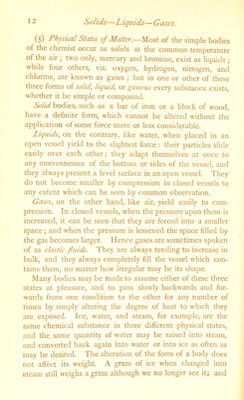
![every litre or other fixed measure of each has a definite weight, as may be easily proved by the use of proper means. All the solid elementary bodies except carbon have been melted, though some require a very intense temperature. Some of the metals, such as platinum and a few of the metals which accompany it in its ores, cannot be melted in ordinary furnaces ; but the extreme heat of the voltaic arc or the electric current produced between the poles of the voltaic battery converts all the metals not merely into liquids but even into vapour, and at this exceedingly intense heat all compounds are separated into their elements. On the other hand, most gases may, by the united action of cold and great pressure, be reduced to the liquid state ; among these are chlorine, sulphurous anhydride, carbonic anhydride, and hydrochloric acid ; several of these liave also been frozen by intense cold into masses like ice or snow. A few gases, including the elements oxygen, hydrogen, and nitrogen, have never been liquefied, though it can scarcely be doubted that their liquefaction, and even freezing, would be effected could we apply a still more intense degree of cold and pressure combined. (6) Mixture distinguished from Combination.—'When once a chemical compound has been formed its components can- not, as a rule, be separated by merely mechanical methods. A piece of marble, as we have seen (p. 8), consists of three elementary Ijodies—carbon, o.xygen, and calcium. It is easy to grind the marble to a powder of extreme fineness, but every fragment of tliat powder is still marble, and no one by mere grinding could sej)arate the carbon, the oxygen, and the calcium from each otlier. I'lie molecule or minutest par- ticle of marble whicli can exist se|)arately is still a compound substance formed of still smaller particles or atonis, of the elements carbon, o.xygen, and calcium. 'I'o accom])lisli the separation of these atoms, which together form the molecule of marble, we must cm])loy some new power; and one which the chemist finds his most useful ally in such cases is](https://iiif.wellcomecollection.org/image/b28099631_0033.jp2/full/800%2C/0/default.jpg)