Introduction to the study of inorganic chemistry / by William Allen Miller.
- Miller, William Allen, 1817-1870.
- Date:
- 1871
Licence: Public Domain Mark
Credit: Introduction to the study of inorganic chemistry / by William Allen Miller. Source: Wellcome Collection.
47/332
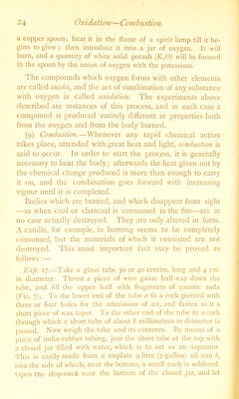
![Oxygen, Test for it. if 3 c.c. of the gas: but this solubility, slight as it may a])pear, is essential to the existence of living animals, for it is only in the dissolved state that the gas finds its way into the blood, and effects the chemical changes in the body necessary to life, both in land animals and in those which live in water. solution of potash may also be shaken up with oxygen with- out sensibly dissolving it \ but if pyrogallic acid be added to the potash solution, the oxygen is rapidly absorbed, and the liquid turns brown. E.vp. IS.—Pass a few bubbles of oxygen into a strong tube, graduated to divisions of 0'5 c. c. each, filled with mercury, and placed in a deep glass full of mercury (Fig. 8). Introduce a solution of potasli (i part of solid potash in 4 of water) by means of a pipette with a point curved upwards, blowing into the pipette* with sufficient force to drive over 8 or 10 drops of the solution. Agitate this liquid briskly with the gas by thrusting the tube down fpiickly into the mercury, and raising it to its former level several times. The oxygen will not alter in volume. Now, with a fresh pipette, intro- duce an equal quantity of a solution of pyrogallic acid (i part of acid and 6 of water). Again agitate the mix- ture. It becomes intensely brown, and the whole of the gas will disappear if pure. If a measured quantity. of air be taken, it is easy in a few minutes to ascertain roughly the proportion of oxygen present by the absorption effected in this way, because the nitrogen is left unchanged, and may be mcasurerl after the absorption of oxygen is over.](https://iiif.wellcomecollection.org/image/b28099631_0047.jp2/full/800%2C/0/default.jpg)