A practical treatise on the treatment of the diseases of the elephant, camel & horned cattle : with instructions for improving their efficiency ; also, a description of the medicines used in the treatment of their diseases ; and a general outline of their anatomy / by W. Gilchrist.
- Gilchrist, W.
- Date:
- 1851
Licence: Public Domain Mark
Credit: A practical treatise on the treatment of the diseases of the elephant, camel & horned cattle : with instructions for improving their efficiency ; also, a description of the medicines used in the treatment of their diseases ; and a general outline of their anatomy / by W. Gilchrist. Source: Wellcome Collection.
52/248 (page 40)
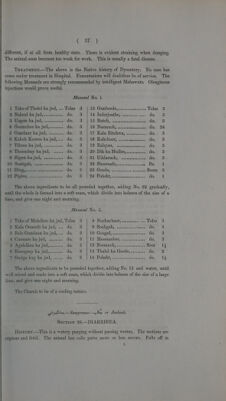
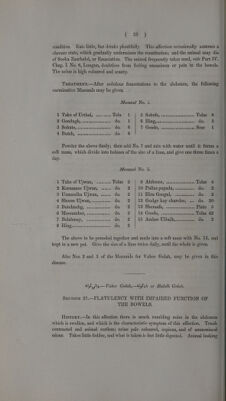
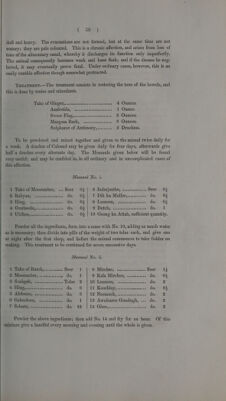
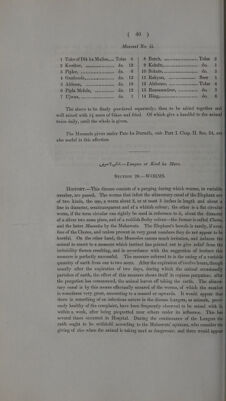
![Mussaul No. iii. 1 Take of Dik ka Mullee,... Tolas 6 SiButch, . s.<.demascoaere BOMBIEe 2 Kowtkee Ares. ote..65ee -G-dovonie SkCohsht;.s iis .aesse avsgauth eerie 3. PiplesPirasitsenssees-ss fe indo. 6 TOmSohute, ....:..ssesacichasadeea 0. eee A Gumnbeede,.....cccrrercesees dot inl 220] ABE Ranga ssc: ave ove crea OCT aahL 5 AR BEII ewes donnien nesses seaado,” Spe) de gAhteeme, -.i0. <0. <5 Sescodbas 2 OLR IEE 6 Pipla Mohde, ........2.+ do: 12 «| 3 eRussasendoor, |....scosses - do: 3 7 CUjWatinges-sarce RAREST Go, SU. 1A Eats auch. isees acs cee do. 6 #I The above to be finely powdered separately; then to be added together and well mixed with 14 seers of Ghee and fried. Of which give a handful to the animal twice daily, until the whole is given. The Mussauls given under Pate ka Durudh, vide Part I. Chap. IT. Sec. 24, are also useful in this affection. i er 6 S.— Lungun or Keed ha Murz. Sectrion 28.— WORMS. History.—This disease consists of a purging during which worms, in variable | number, are passed. The worms that infest the alimentary canal of the Elephant are of two kinds, the one, a worm about 2, or at most 3 inches in length and about a | line in diameter, semitransparent and of a whitish colour; the other is a flat circular worm, if the term circular can rightly be used in reference to it, about the diameter | of a silver two anna piece, and of a reddish fleshy colour—the former is called Chotee, | and the latter Mussodee by the Mahawuts. The Elephant’s bowels is rarely, if ever, free of the Chotee, and unless present in very great numbers they do not appear to be | hurtful. On the other hand, the Mussodee causes much irritation, and induces the | animal to resort to a measure which instinct has pointed out to give relief from the | irritability thence resulting, and in accordance with the suggestion of instinct this | measure is perfectly successful. The measure referred to is the eating of a variable quantity of earth from one to two seers. After the expiration of twelve hours, though usually after the expiration of two days, during which the animal occasionally | partakes of earth, the effect of this measure shows itself in copious purgation; after | the purgation has commenced, the animal leaves off taking the earth. The alimen- tary canal is by this means effectually scoured of the worms, of which the number | is sometimes very great, amounting to a maund or. upwards. It would appear that | there is something of an infectious nature in the disease Lungun, as animals, previ- 1 ously healthy of the complaint, have been frequently observed to be seized with it, within a week, after being picquetted near others under its influence. This has” several times occurred in Hospital. During the continuance of the Lungun the ratib ought to be withheld according to the Mahawuts’ opinions, who consider the | giving of rice when the animal is taking mud as dangerous; and there would appear |](https://iiif.wellcomecollection.org/image/b33582336_0052.jp2/full/800%2C/0/default.jpg)