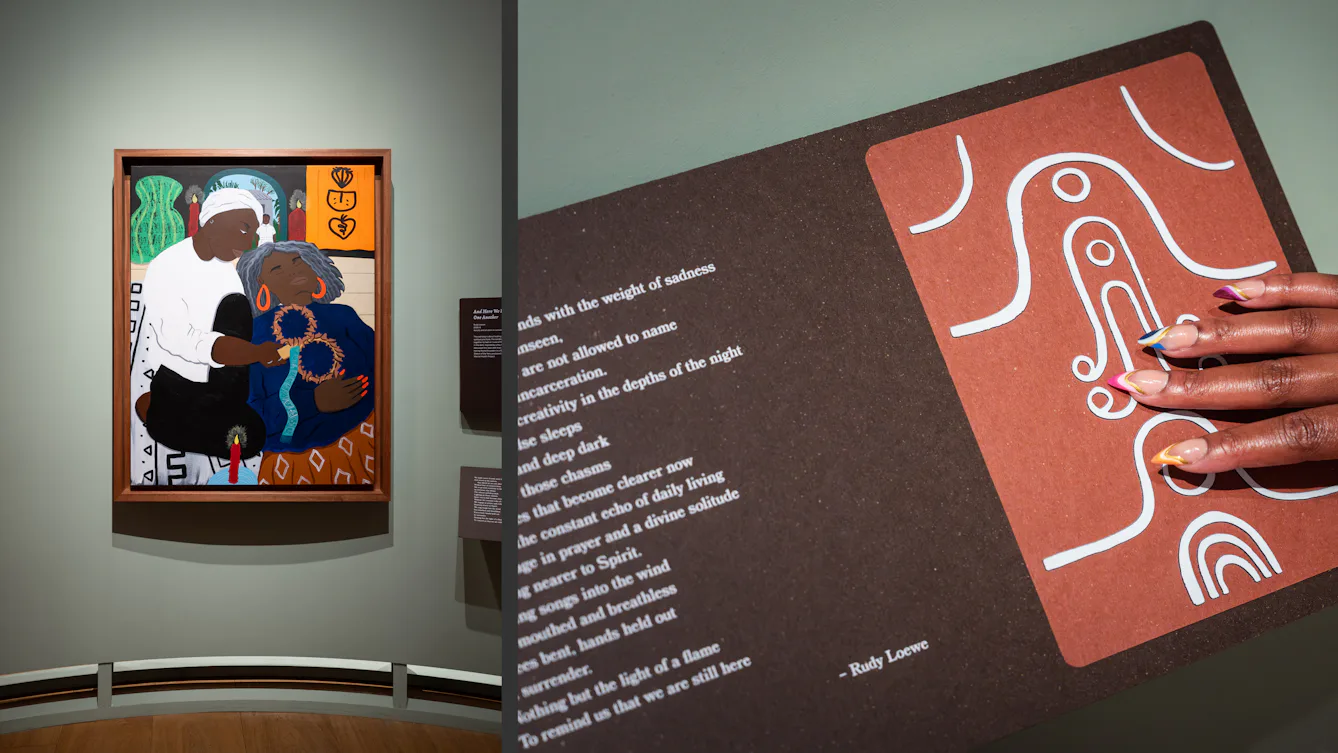
On a softly curved wall in front of you, slightly to the left if you are facing the QR code, is an acrylic on canvas painting, just over a metre tall and 90 centimetres wide. It is called ‘And here we found one another’ and it is the final work in Rudy Loewe’s exhibition.
It shows an older Black woman being cared for by a healer in her home. On the wood-planked floor, which is painted cream, is a white cloth, which extends outside of the scene, decorated with geometric designs – squares and triangles separated by dots – painted in black. There is an orange wall hanging in the background behind the older woman, featuring three symbols arranged in a vertical row.
To the left of that is a framed photograph of one of the woman’s ancestors, a young Black woman in a white shirtdress. She is standing in front of a single-storey grey building. It has a corrugated-tin roof and is surrounded by large leafy plants and trees, set against a dazzling blue sky.
On the far left is what looks like a green vase, highlighted with paler green lines that echo its curving forms.
The healer, who is tending to the older woman, is wearing a white tunic and black trousers. They are sitting on the cloth on the floor with one knee tucked under them, and the other bent up so that the older woman can lean back against it.
The woman appears to be lying down, most of her lower body extending out of frame beyond the lower right-hand corner of the painting. Her grey Afro hair is shoulder length. Her eyes are closed. She wears vibrant orange hoops in her ears, matching her brightly painted nails, contrasting with the deep blue of her shirt.
The healer is holding a rattle over the woman’s chest, it is made of two circles of brown and gold. A turquoise ribbon trails from it, embellished with a series of symbols depicted with fine white lines.
On the floor in front of these two figures, a red candle stands on a pale blue candleholder – sending out a yellow halo around its steady flame. There are more candles either side of the photograph in the background.
The feeling is one of peace and calm.
The tactile symbol for this work is on an angled holder in front of you, to the right of the painting. It is comprised of numerous lines which would be horizontal but for a high peak in the middle. Each peak echoes the one below it, and layered between these are three circles of various sizes. You are invited to run your fingers over it to feel these abstract forms.
Next to the tactile symbol is an invitation text by Rudy Loewe, which they will now read for you:
“We make sweet friends with the weight of sadness
And attend to the unseen, that which we are not allowed to name
Without fear of incarceration.
We erupt with creativity in the depths of the night
As everyone else sleeps
The silence and deep dark
Lighting up those chasms
Quiet voices that become clearer now
Without the constant echo of daily living
We engage in prayer and a divine solitude
Drawing nearer to Spirit.
We sing songs into the wind
Dry-mouthed and breathless
Knees bent, hands held out
In surrender.
Nothing but the light of a flame
To remind us that we are still here
“The tactile element for this artwork is about a shared healing practice.”
That brings us to the end of Rudy Loewe’s exhibition ‘Intimacies of Care – Spaces of Grief and Possibility’.
To return to the entrance area, if you are facing the QR code, then the tactile line continues to your right to lead you around the curved wall in front of you. From there you can turn right through the same archway that you entered this exhibition through. That is where you can return your headset, if you have borrowed one.
Or from there, you can make your way to the parallel exhibition next door: ’Audrey Amiss: The Surviving Exhibitions’.
If you would like to explore that next, continue through the second archway straight ahead of you after you exit this exhibition.
This is the end of the digital guide for Rudy Loewe’s exhibition. Thanks to the artist and VocalEyes for their help in producing this content.