Home Visit us

Accessibility

Contact us

If you’re planning a visit to Wellcome Collection or need help while you’re here, Wellcome Collection staff have been trained to support visitors with accessibility needs. Call or email us if you have any questions or feedback about accessibility at Wellcome Collection.

Visitor Experience and Engagement
+ 4 4. 0 2 0. 7 6 1 1. 2 2 2 2

Getting here by public transport 

The Wellcome Collection building is in central London and you can get to us by Tube, train, bus and bike. You can find detailed information about how to get here on the ‘Getting here’ page. You can find information about accessible travel on Transport for London’s website. 

Help getting from the station 

If you would like a member of staff to meet you at the nearest station and help you get to our building, talk to our Visitor Experience and Engagement team before you visit. 

Blue Badge parking

There is limited parking available for Blue Badge holders. Contact our Visitor Experience and Engagement team before you visit to book a parking space. 

What to expect when you visit

Wellcome Collection is free to visit. The building has three floors, with a café, shop, several exhibition spaces and a library.

If you’re looking for a warm place to spend time, it’s free to enjoy our spaces, visit our events and exhibitions, and use our facilities.

Visual stories

Before you visit, you can use our visual stories, which have photographs and easy-to-read information about what it’s like to visit us. They include sensory information, like where there will be more light or noise, and simple information about the content in our exhibitions and collections.

Use our easy-to-read Visiting Wellcome Collection visual story to help you plan and prepare for your visit.

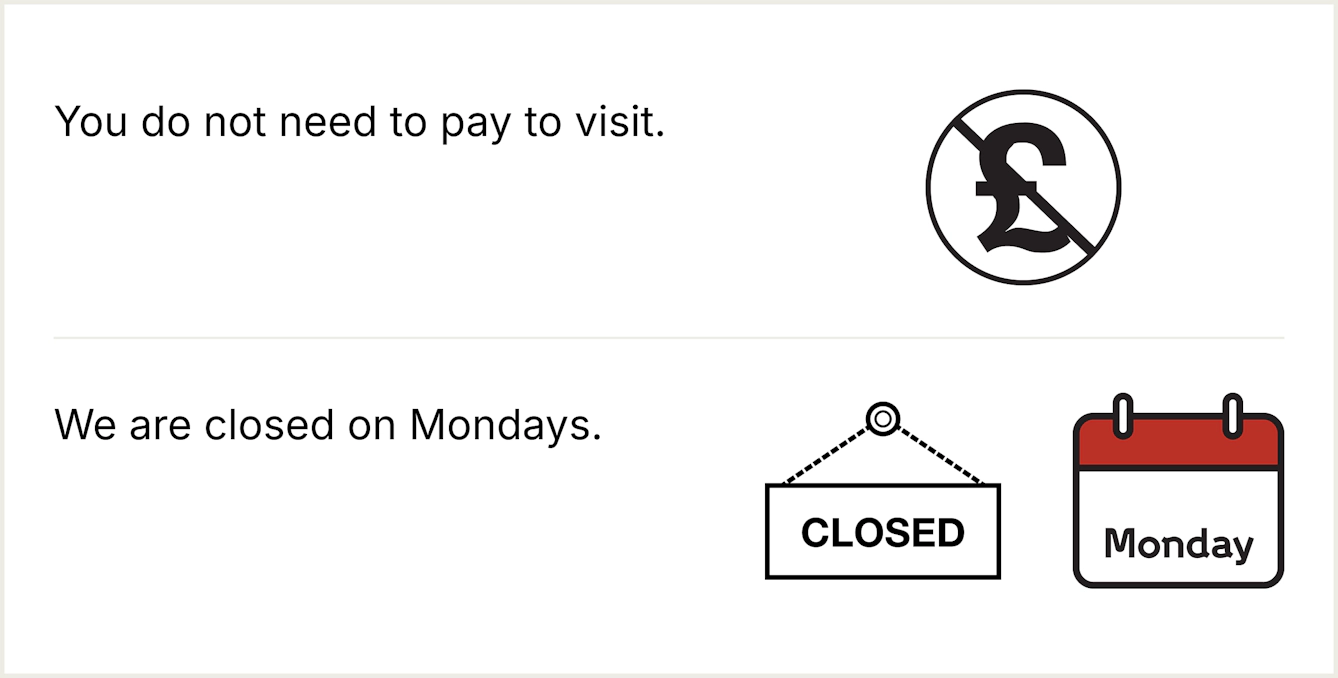
Example of a 'visual story' with illustrations and plain text. The words 'You do not need to pay a visit' are next to an illustration of a pound sign with a cross through it.
Example of a 'visual story'..

Example of a visual story

Assistance animals 

You are very welcome to bring your assistance animals. No other animals can come inside our building.  

To protect our collections and for everyone’s comfort and safety, please make sure your assistance animal:

  • stays under your care and control throughout your visit, ideally remaining on a leash  
  • only eats or drinks in certain spaces in the building – our staff can tell you where it’s OK. We can provide a drinking bowl for your animal; just ask at the information desk on level 0

Accessible toilets

There are accessible toilets on all floors of the building. We have: 

  • self-contained cubicles for all genders
  • single-sex toilets on levels 1 and 2 
  • accessible toilets with baby-changing facilities  
  • a Changing Places toilet on level 0

Baby feeding and changing

Visitors are welcome to breastfeed and bottle-feed babies in all areas of the Wellcome Collection building, including the galleries.

There are baby-changing facilities on every floor. You can find an accessible toilet with baby-changing facilities on level 0.

Hygiene and ventilation

There are: 

  • face masks available from the Information Point if you prefer to wear one 
  • hand sanitiser dispensers throughout the museum and library

Our HVAC systems also provide ventilation throughout and regulate the indoor air quality

Wheelchair and physical access

There is step-free access throughout our building. If your wheelchair or mobility device is 75 cm or wider, access to certain areas of the building may be limited. Contact us if you have a larger device and we can help you plan your visit.  

Borrowing a wheelchair

You can borrow a wheelchair from us during your visit – just ask at the Information Point on level 0. Or call us before you visit if you would like to reserve a wheelchair.    

Queueing 

Sometimes visitors need to queue while waiting for an event. If you have access needs that make queueing difficult, please speak to a member of staff who will help you skip the queue.

Seating

There is seating throughout our exhibitions and portable stools are available if you need to rest.

Exhibitions and events

There is specific accessibility information on individual event and exhibition webpages. Accessible events and discussions are listed on our ‘Access Tours and Discussions’ page.

Read more detailed information about:

Tours

We run a regular programme of tours for visitors with access needs. These include:  

  • audio description with brighter lighting
  • British Sign Language-led  
  • British Sign Language-interpreted

Alternatively, you can request a free, private tour, which is also available in speech-to-text. To arrange a tour, get in touch before you visit.

Digital guides

You can access a variety of digital guides on your own device. Digital guides with audio-described and BSL highlights tours are available for most of our exhibitions. We also offer digital guides with exhibition text for most exhibitions, which you can magnify to your preferred scale.

Audio description, brighter lighting, large print and braille 

Audio description

We regularly run audio-described tours of our exhibitions. You can also ask for a free in-person audio-described tour outside of our scheduled tours.

Digital guides with audio description are available for most of our exhibitions. You can pick up a handset at the start of the exhibition or use your own device. There is specific accessibility information on individual pages for events and exhibitions.

Sessions with brighter lighting and audio-described tours

Our 'Lights Up' sessions are special times in an exhibition with:

  • brighter and more even lighting conditions
  • an audio-described tour of the gallery

Large print and magnifiers 

Each exhibition has large-print guides with wall texts and labels, and you can borrow a magnifying glass or magnifying sheet.

You can also access exhibitions texts as a digital guide on your own device and magnify to your preferred scale.

Braille  

There are braille titles and tactile reproductions of some objects in our permanent exhibition, ‘Being Human’.

BSL, induction loops and transcripts 

British Sign Language (BSL)

We regularly run BSL tours of our exhibitions. You can also ask for a free in-person BSL tour outside of our scheduled tours.

Digital guides with BSL videos are available for most of our exhibitions. There is specific accessibility information on individual pages for events and exhibitions.

Induction loops

There are fixed induction loops at: 

  • the Information Point on level 0  
  • Wellcome Café on level 0  
  • the library enquiry desk on level 2  
  • the Rare Materials Room on level 3  
  • the Reading Room  
  • the venue hire reception on level -1 and many of the rooms available for hire.
  • the Henry Wellcome Auditorium and the Forum

You can also borrow portable induction loops. Contact the Visitor Experience and Engagement team to reserve a portable loop for your visit.    

Transcripts and subtitles

We provide subtitles and transcripts for all audiovisual content in exhibitions. You can access the transcripts using a QR code.

Quiet times and sensory access tools 

Quiet times

Some areas can be busy and loud, especially at the entrance and café. Other areas upstairs are often much quieter. Ask staff if you need help finding a quieter space. 

Weekday mornings are usually the quietest times to visit.

Calmer, more relaxed hours

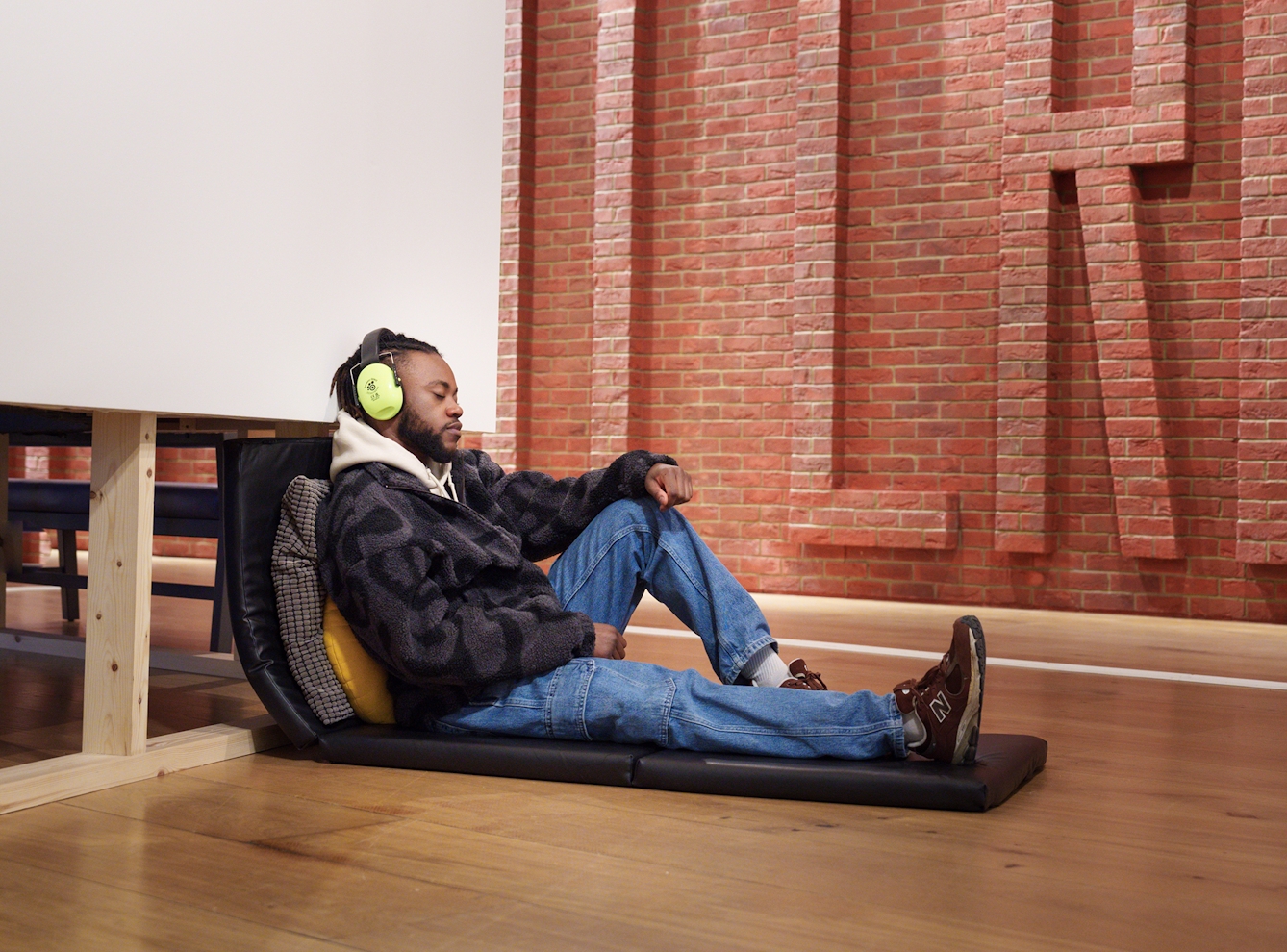
‘1880 THAT’ exhibition at Wellcome Collection, Photography: Steven Pocock. Source: Wellcome Collection. © Christine Sun Kim and Thomas Mader and Wellcome Collection.

Relaxed exhibition openings are designed to be calmer and friendlier for visitors who need a more sensory-friendly environment. There are:

  • fewer visitors 
  • more staff 
  • beanbags and rest spaces 
  • a chill out space 
  • sensory support equipment like ear defenders and fidget toys

Relaxed openings are free but you have to book a ticket. This means there will be a limited number of people at each event. 

We also run a variety of other Relaxed events.

You can find upcoming Relaxed exhibition openings and other Relaxed events on our ‘Events’ page.

Maps that show where there are things like bright screens or loud sounds

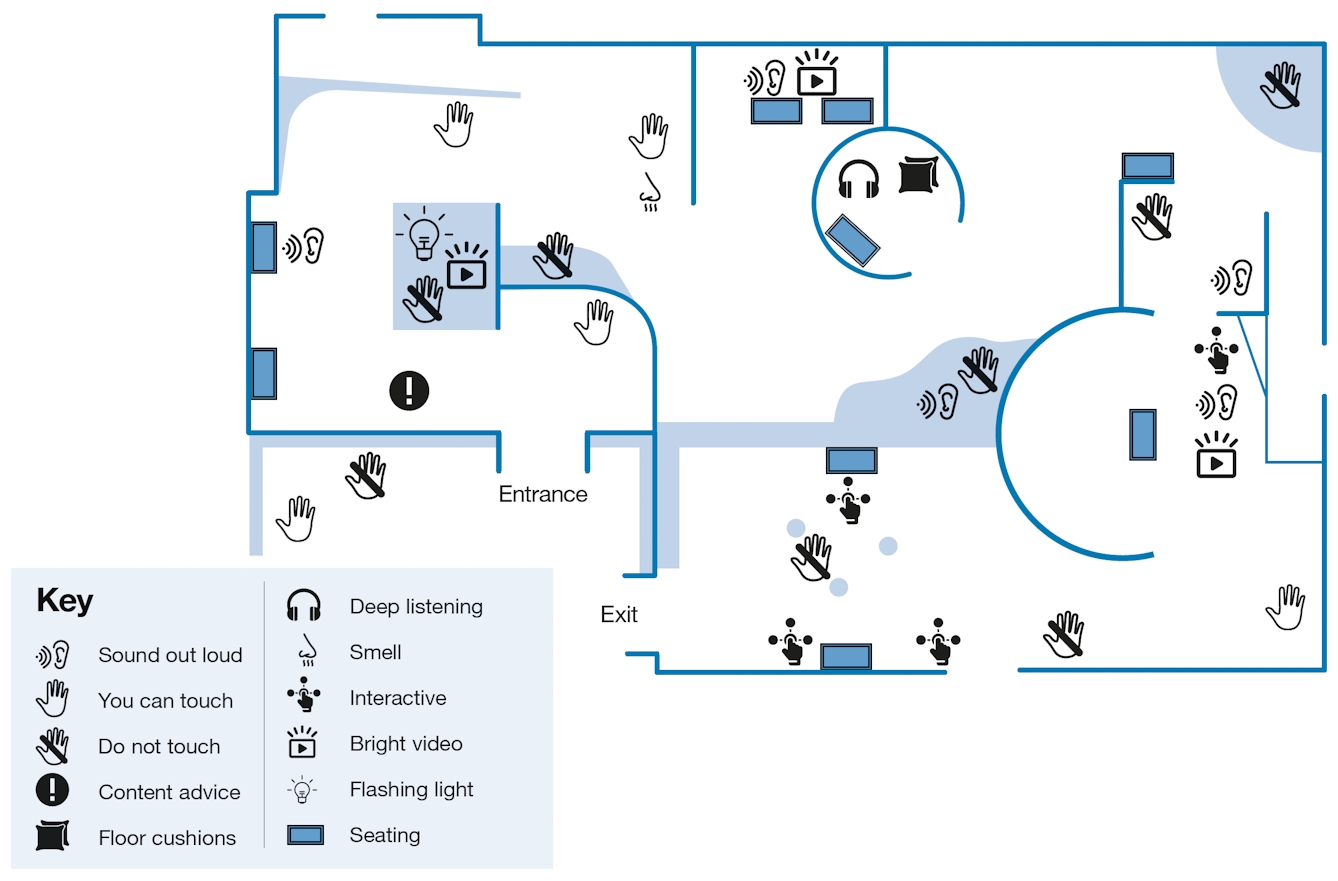
Sensory map of Thirst: In Search of Freshwater exhibition at Wellcome Collection. Source: Wellcome Collection. Attribution-NonCommercial 4.0 International (CC BY-NC 4.0).

We provide sensory maps of our exhibitions so you can find out what it might feel like to be there. Sensory maps include information about where there will be things like: 

  • bright or flickering screens
  • loud sounds
  • a smell
  • floor cushions you can touch and sit on

To find a sensory map, check the visual story for the exhibition you want to visit.

Making the building more comfortable

If it helps make our building more comfortable for you, you can borrow:

  • tinted glasses 
  • tinted visors 
  • ear defenders  
  • weighted lap pads 
  • fidget tools

If you need help finding any of these sensory access tools, please ask a member of staff at the Information Point, in the galleries, or in the library.

Library accessible equipment and study rooms

We have a range of accessible equipment to support your visit to the library.

You can help yourself to some equipment, which is on shelves by the library entrance gates, or ask at the library enquiry desk on level 2.

If you have any individual requirements for equipment not listed on this page, please speak to staff who will be happy to support you.

Physical access

Equipment includes: 

  • electronic height-adjustable tables in Study Room 1 and Rare Materials Room 
  • left and right-handed ‘vertical’ mouse 
  • adjustable chairs and footrests 
  • a bookable accessible study room

If our bookshelves are hard for you to access, we can find and bring the books to your desk.     

Visual access

Equipment includes: 

  • a high-contrast enlarged-text keyboard 
  • handheld magnifiers 
  • a portable fluorescent magnifier with daylight simulation tube 
  • an Aladdin Rainbow Elite book magnifier with a range of colour and contrast controls
  • tinted glasses
  • colour overlays

Audio access

Equipment includes: 

  • fixed and portable induction loops
  • headphones for use with hearing aids as recommended by Action on Hearing Loss (RNID)
  • ear defenders
  • disposable foam ear plugs

Non-silent time

Every Thursday, the Rare Materials Room inside the library is open for non-silent research with requested collection material. This is to accommodate different needs and research methods, such as collaborative, creative and audio-described activities.

For those who still need a silent space during this time, library staff can provide ear defenders. 

Accessible study rooms

Library members can book our accessible study rooms for collections research in the library. Read more information about the study rooms and how to book them.

A height-adjustable table is available in Study Room 1. The computers in Study Room 1 and 2 have software including Microsoft Ease of Access and Read&Write.

Microsoft Ease of Access

This includes:

  • a screen magnifier with a range of colour and cursor controls
  • narration and other visual and auditory tools to customise your experience

Read&Write (formerly TextHelp)

This is a literacy support tool that offers help with: 

  • text-to-speech, text and picture dictionaries 
  • converting selected text into audio files 
  • proof-reading

Call or email us if you have any questions or feedback about accessibility at the Wellcome Collection.  
Visitor Experience and Engagement
+ 4 4. 0 2 0. 7 6 1 1. 2 2 2 2