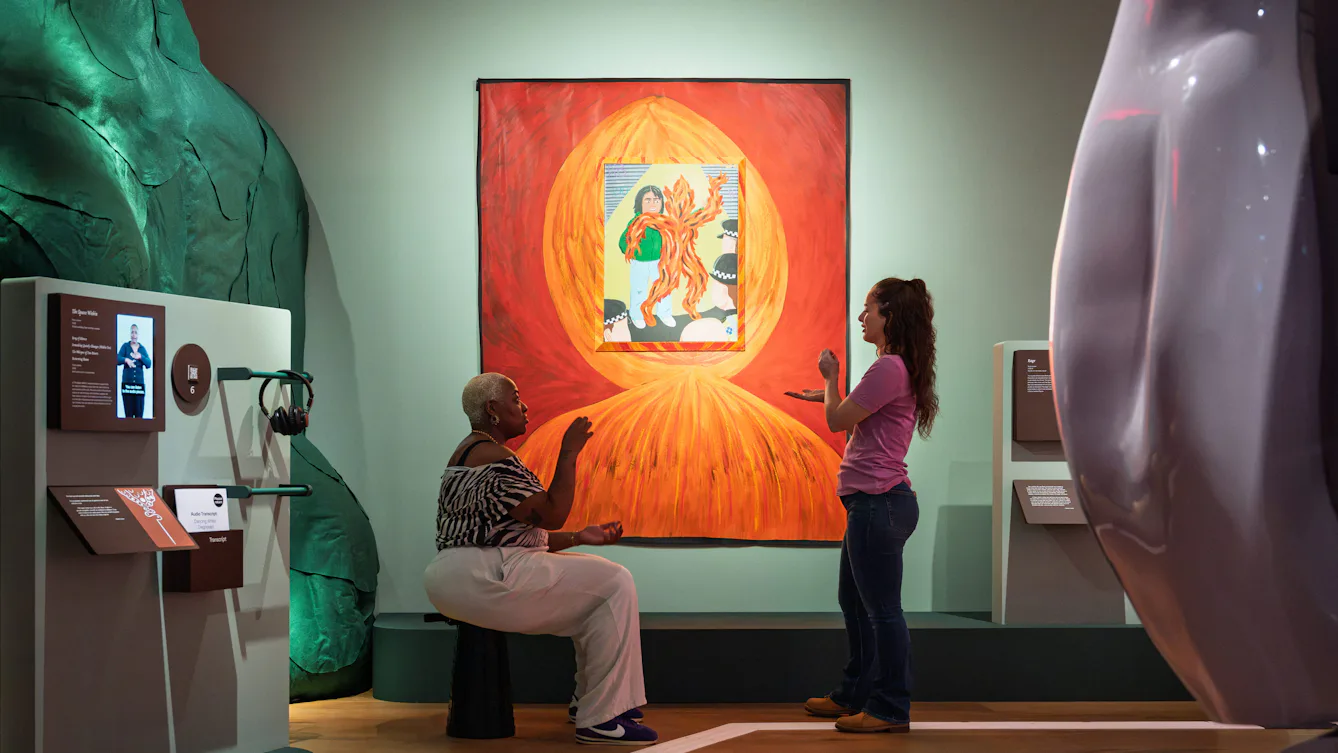
To your left, if you are facing the QR code, is a colourful acrylic painting. It is made up of two canvases, one on top of the other. The smaller one is 85 centimetres wide by a metre tall. Behind it is the larger canvas, about 1.7 metres wide and two metres tall, which appears to be fixed directly to the wall.
The painting on the smaller canvas shows a Black person with locs wearing a moss-green hoodie, pale blue jeans and white trainers. They have an alarmed expression, their eyes wide, and stand with their back to a grey-shuttered closed-up shop that’s sprayed with graffiti. They are framed by a triangle of yellow light cast behind them by a streetlamp.
The heads of four white people take up the lower right quarter of the frame. They are turned away from the viewer and towards the person in the painting. They appear to be uniformed police officers. One wears a neon-yellow high-viz waistcoat. Three of them wear peaked caps with a black-and-white checkered band around the brim. The fourth is capless and bald.
A figure who appears to be made of flames – painted as orange, yellow, red and black streaks – stands between the Black person and the officers, with one arm raised and the other in a protective gesture, as if shielding or protecting the person behind them from the police.
The larger canvas depicts a giant flame, its expanse of red and orange paint surrounding the scene. It’s as if the fire is spilling out beyond the bounds of the smaller canvas.
On the angled label to the right of the artwork, Loewe has created a tactile symbol for you to touch. At the centre of the symbol is a line that coils twice at its centre and then splits into two strands at the top, like the stalk and leaf at the top of an apple. Two more lines curve out around the coil on each side, joining with the central strand at the bottom to make the shape of a heart.
Next to the tactile symbol is an invitation text by Rudy Loewe, which they will now read for you:
“You witness the way those around you are treated as ‘threat’ when they need care. You learn to make yourself small, to tend to your wounds, and turn your rage inwards. It takes years for you to meet healers who say, ‘But of course racism. Of course, homophobia, transphobia, colonialism, ableism, structural violence.' Of course, of course, of course.
“A Rage whirls within you and they tell you that it does not exist, that it need not exist, that you do not exist. There is nothing wrong with you unless you are a threat, in which case you are locked up and/or medicated ‘for your own good’. But that Rage, left restricted and ignored, seeps into your bloodstream like a poison that must be released.
“The energy of the tactile element for this artwork centres on the rage that must be released from the body to heal.”
This is the end of track 5. If you are facing the QR code, then the tactile path continues to your left towards the next artwork.