Hello and welcome to this introduction to ‘Tenderness and Rage’.
My name is Adam Rose, the curator of the exhibition.
‘Tenderness and Rage’ explores histories of HIV, protest and care, from the AIDS epidemic in the UK in the 1980s and 90s to contemporary experiences of HIV in the Global South. Through photography, film and archival material, the exhibition examines how activist groups and volunteer-led organisations have supported and campaigned for the dignity and human rights of people living with HIV.
In the following stops, you will hear the voices and perspectives of activists talking about their connections to four key works in the exhibition.
This is combined with a visual description of the artworks and is followed by basic navigation information.
Members of staff wearing black Wellcome Collection tops are in the gallery at all times. Please do let them know if you need any assistance.
The first room, which focuses on the UK, has three audio stops.
The second room, looking at the wider global experience, has one stop.
Two short speech-based films are accessible through headphones: ‘Dancing whilst diagnosed’ and ‘Emmanuel’.
Inside the exhibition, in front of each stop, there is a white square tile on the floor with raised blisters, like the ones used at traffic crossings.
At each stop, you can access the audio guide either by using the round earcones that are attached by cables to freestanding boxes or the wall, or by scanning the QR code next to the artwork with your phone.
The QR codes are printed on circular discs, the size of a saucer, with a title and number in white lettering.
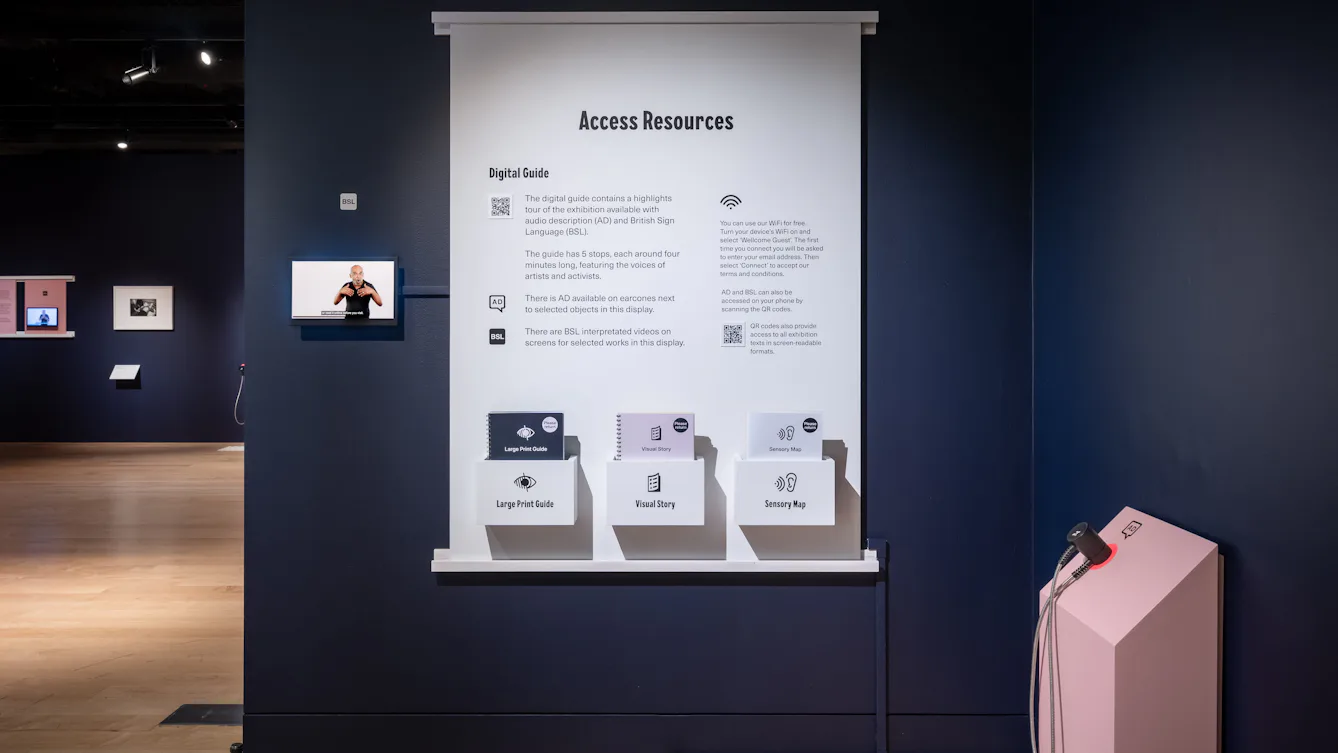
Here, at the access pick-up station, you will find a screen with a British Sign Language (BSL) introduction, and boxes with various printed guides:
• A light pink A4-sized large-print guide includes enlarged versions of all the exhibition texts, a floor map, as well as a list of all the digital guide stops. It has a symbol of an eye with a line through the middle on the cover.
• You will also find a black A4-sized visual story booklet. This provides pre-visit information about the exhibition, using images, symbols and short written explanations. This has a symbol of a book on the cover.
• There is also a dark blue, A4-sized paper map of sensory elements in the exhibition, such as bright lights or sound. This has symbols with a hand and an ear on the cover.
This is the end of stop one.
For stop two, please go through the heavy glass entrance doors and follow the wall to the right. If you wish to pick up a folding seat, you will find them just to the left of the exhibition entrance.