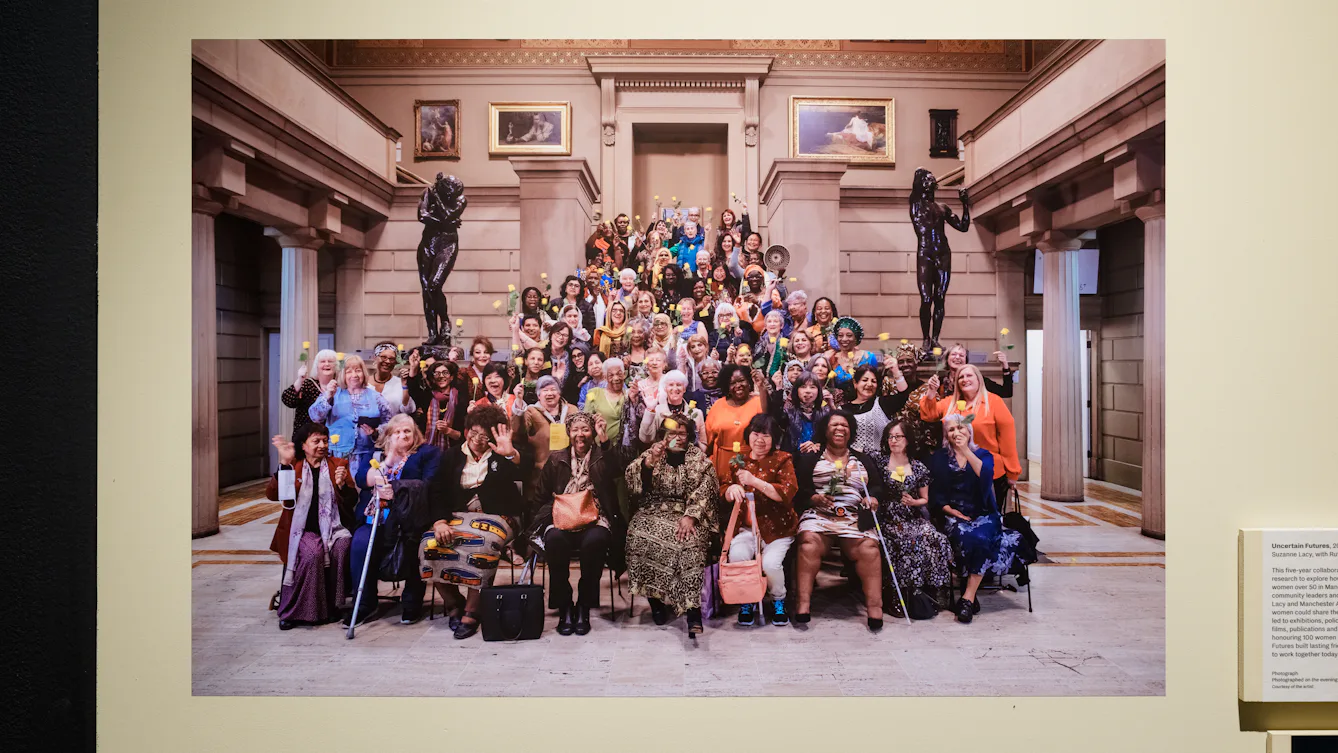
The colour photograph is one metre wide by 700 centimetres high. It captures the group of 100 women gathered on a grand, symmetrical stone staircase in Manchester Art Gallery. They are all close together, filling the steps from the bottom foreground up toward the middle of the frame. The women from diverse heritages are dressed in different styles of colourful clothing with vibrant oranges, reds, blues and patterned traditional head wraps and garments. Almost every woman is holding a single, long-stemmed yellow rose, creating a repeating pattern of bright yellow dots throughout the crowd; the lighting is bright and even illuminating the faces of the women. They all have different expressions. Many of them are smiling or looking directly at the camera.
Hello, my name is Ruth Edson, Senior Learning Manager for Communities and Adults at Manchester Art Gallery, and I was a project lead for ‘Uncertain Futures’. Suzanne’s work is about the fundamentals of democracy, voice, representation, advocacy and empowerment. We wanted to find out more about how women were impacted in their working lives, and what were the inequalities as women age in regards to accessing good work, employment in work and a good retirement. By September 2020, we had officially formed an advisory group made up of 14 women leaders, all over 50, who work with communities across the city.
The photograph on the wall is of the 100 women who were interviewed live in the booth as part of ‘Uncertain Futures’. They shared their experiences of looking for work, being in work, retirement or plans for retirement, and the impact of Covid 19; they have formed the basis for the three-channel film and the research report and the ‘Uncertain Futures’ manifesto. The advisory group felt strongly about creating a manifesto to consolidate the findings and their demands that came directly out of the research. The findings highlight how altered life courses for women can have a detrimental impact on working lives and therefore having a good retirement. For many of the 100 women, it was the first time they’d ever spoken publicly about their experiences. My hope is that visitors who are women over 50 feel heard, recognised and valued, and other visitors, including policymakers and politicians, consider older women when shaping future employment and welfare policies.
My name is Nadia Siddiqui, and I’m the founder and CEO of Women’s Voices, which is a grassroots, women-led, not-for-profit organisation based in Longsight, Manchester. I have been engaged in community work and activism for the last 40 years. In my current role with Women’s Voices, we work with women from global majority communities who face multiple challenges, including poverty, poor housing, language barriers, isolation, poor mental health, discrimination and limited access to services and employment. Our mission is to enable women to achieve empowerment, equality and inclusion, strengthening their voices within the community and wider society. As an older migrant woman myself, I have lived experiences of the inequalities and racism that can persist into later life. I am one of the 14 women on the ‘Uncertain Futures’ Advisory Board, each of us over 50 with a wealth of experience working with global majority communities; our shared goal was to improve the lives of women over 50. Looking at the 100 women photographed behind us, I feel immensely proud to be part of this group. When I look at it, I don’t just see a group of women, I see stories of resilience, migration and survival. Each woman shared her personal journey, stories shaped by migration, resilience, sacrifice and survival. I hope visitors leave with a better understanding of the lived experiences of the 100 women and a greater sense of empathy for the women whose stories are being shared. I would like them to recognise that these untold stories and women’s interviews are real experiences that affect people in our communities every day.
There is a film called ‘Her Uncertain Futures’ connected to this project that is also displayed in this section of the exhibition. To experience this film, while facing Stop 11, turn to your left and make your way towards the wall at the end of the room ahead of you, where there is an open doorway on the left-hand side; you may hear sound bleed coming from there. There is a bench inside the room immediately to your left as you go through the open doorway; this room has out-loud sound and is a darkened space.
This is the end of Stop 11.