405 results filtered with: Green

- Digital Images
- Online
Nanographene oxide interacting with bacteria, TEM
Izzat Suffian, Kuo-Ching Mei, Houmam Kafa & Khuloud T. Al-Jamal
- Digital Images
- Online
Wild-type and Mutant Muscle Sarcomeres, Drosophila larva
Hermann Aberle, University of Munster
- Digital Images
- Online
HIV integration, HIV viral life cycle, illustration
David S. Goodsell, The Scripps Research Institute
- Digital Images
- Online
Visualising the human breath ("Sing"), Artwork
Jayne Wilton
- Digital Images
- Online
Olea europaea L. Oleaceae Olive Distribution: Europe, Middle East. Dioscorides (Beck, 2005) regarded the olive as a panacea, curing all manner of cutaneous afflictions from shingles to sores
Dr Henry Oakeley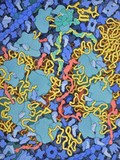
- Digital Images
- Online
HIV translation, HIV viral life cycle, illustration
David S. Goodsell, The Scripps Research Institute
- Digital Images
- Online
Origin of life
Odra Noel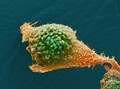
- Digital Images
- Online
Prostate cancer cell, SEM
Anne Weston, Francis Crick Institute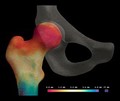
- Digital Images
- Online
Cortical bone mapping of hip from computed tomography
Tom Turmezei, Ken Poole and Graham Treece, University of Cambridge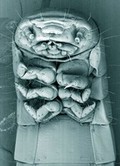
- Digital Images
- Online
Head of a mealworm, SEM
Kevin Mackenzie, University of Aberdeen
- Digital Images
- Online
Woodlouse, SEM
Anne Weston, Francis Crick Institute
- Digital Images
- Online
Brain astrocyte cell taking up carbon nano-needles, SEM
Khuloud T. Al-Jamal, Serene Tay & Michael Cicirko
- Digital Images
- Online
Woodlouse, SEM
Anne Weston, Francis Crick Institute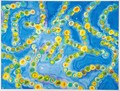
- Digital Images
- Online
Blue-green algae
Odra Noel
- Digital Images
- Online
Rosmarinus officinalis L. Lamiaceae Rosemary. Woody perennial. Distribution: Mediterranean. Quincy (1718) commended the flowers for epilepsy, apoplexy, palsies, uterine obstruction, jaundice, gout, and syringed into the ear with warm water for dislodging wax. It is licensed for use in Traditional Herbal Medicines in the UK (UK Medicines and Healthcare Products Regulatory Agency (MHRA)). Photographed in the Medicinal Garden of the Royal College of Physicians, London.
Dr Henry Oakeley
- Digital Images
- Online
Colour vision
Paul Griggs
- Digital Images
- Online
Habenular nucleus of zebrafish, composition
Ana Faro, Dr Steve Wilson
- Digital Images
- Online
Broccoli floret
Macroscopic Solutions
- Digital Images
- Online
Lung cancer cells
Anne Weston, Francis Crick Institute
- Digital Images
- Online
Misreplication of DNA in human fibroblast nucleus
Ezequiel Miron, University of Oxford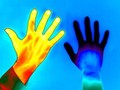
- Digital Images
- Online
Raynaud's Phenomenon
Thermal Vision Research
- Digital Images
- Online
Healthy adult human brain viewed from below, tractography
Henrietta Howells, NatBrainLab
- Digital Images
- Online
Hacquetia epipactis DC Apiaceae. Small herbaceous perennial. No common name except Hacquetia Distribution: Europe. Named for the Austrian physician, Balthasar (or Belsazar) Hacquet (1739/40-1815). He studied medicine in Vienna, was a surgeon in the brutal Seven Years War (1756-1763) – a world-wide war in which up to 1,400,000 people died. Later he was professor at the University of Lemberg (1788-1810). He wrote widely on many scientific disciplines including geology. Parkinson (1640) grouped it with Helleborus and Veratrum, calling it 'Epipactis Matthioli, Matthiolus, his bastard black hellebore' but does not give any uses. It has no medicinal properties. Photographed in the Medicinal Garden of the Royal College of Physicians, London.
Dr Henry Oakeley
- Digital Images
- Online
Origin of life
Odra Noel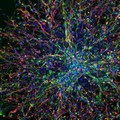
- Digital Images
- Online
Highly invasive human paediatric brain tumour derived cells
Valeria Molinari, Louise Howell, Maria Vinci, Katy Taylor and Chris Jones, Institute of Cancer Research