850 results filtered with: Poisons
- Books
Iacobi Grevini Claromontani Bellovaci Parisiensis medici ... De venenis libri dvo. Gallice primvm ab eo scripti, et à multis hactenus Latini desiderati / et nunc tandem opera et labore Hieremiæ Martij ... in Latinam sermonem ... conuersi. Quibus adiunctus est prætereà eiusdem auctoris de antimonio tractatus [and Nicandri ... theriaca and alexipharmaca] Eodem interprete, vnà cum rerum memorabilium, præcipuè ad operis calcem, Indice.
Jacques GrévinDate: 1571
- Pictures
- Online
Alexander the Great demonstrates his trust in his physician Philip by drinking a medicinal draught prepared by him even after receiving a letter alleging that Philip is trying to poison him. Drawing by or after E. Le Sueur, 16--.
Eustache Le SueurDate: [between 1600 and 1699?]Reference: 643030i- Books
Mūsā ibn Maymūn (Maimonides) : texts and studies. Pt.1 / collected and reprinted by Fuat Sezgin [and others].
Date: 1996
- Books
- Online
A manual of toxicology; in which the symptoms, treatment, and tests of the various poisons, mineral, vegetable, and animal, are concisely stated. To which are added, directions for the recovery of persons in a state of suspended animation / by William Stowe.
Date: 1823- Books
A is for arsenic : the poisons of Agatha Christie / Kathryn Harkup.
Harkup, KathrynDate: 2015- Archives and manuscripts
Gwen Prout stamp collection vol.8 Nobel Prize Medicine 1946-1959
Date: 1974-2008Reference: EPH751:8Part of: Gwen Prout Stamp Collection
- Digital Images
- Online
Echinacea purpurea (L.) Moench Asteraceae. Coneflower. Distribution: North America. Austin (2004) records that the roots were chewed, or used as a tincture for coughs by the Choctaw. Combined with Rhus typhina to treat venereal disease by the Delaware. Very little record of this being used by Native Americans, who used E. angustifolia very widely - Regarded as a panacea and magical herb. This and E. pallida were used to treat snakebite, spider bite, cancer, toothache, burns, sores, wounds, flu and colds. E. purpurea in modern times has been used as an ‘immunostimulant’, but is known to cause a fall in white cell count, and to be purely a placebo. Licensed for use as a Traditional Herbal Medicine, which does not require proof of efficacy, in the UK. Photographed in the Medicinal Garden of the Royal College of Physicians, London.
Dr Henry Oakeley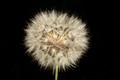
- Digital Images
- Online
Tragopogon pratensis L. Asteraceae Goats beard, Salsify, Jack-go-to-bed-at-noon. Distribution: Europe and North America. This is the Tragopogion luteum or Yellow Goats-beard of Gerard (1633) who recommended them boiled until tender and then buttered as being more delicious than carrots and parsnips and very nutritious for those sick from a long lingering disease. Boiled in wine they were a cure for a 'stitch' in the side. In the USA children collect the milky sap onto a piece of glass and, when dry, chew it as bubble-gum. The name 'Jack-go-to-bed-at-noon' referes to the flowers which close at noon and the spherical radiation of seed plumules which then appear. Salsify is now applied as a name for T. porrifolius and Scorzonera hispanica. Photographed in the Medicinal Garden of the Royal College of Physicians, London.
Dr Henry Oakeley- Books
Identification of drugs and poisons : symposium, Saturday, March 20, 1965, School of Pharmacy, University of London.
Date: 1965- Books
The detection of poisons and strong drugs / Authorized translation from the 3rd enl. German ed., by William H. Warren.
Wilhelm AutenriethDate: 1909 [©1905]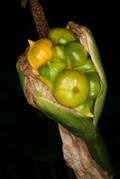
- Digital Images
- Online
Zantedeschia aethiopica (L)Spreng. Calla lily, Arum lily. Half hardy annual. Distribution: South Africa. The genus name commemorates Giovanni Zantedeschi (1773-1846) an Italian physician and botanist. Born in Molina he studied medicine in Verona and Padua. He corresponded with the German botanist, Kurt Sprengel, who named the genus Zantedeschia in his honour in 1826, separating it from Calla, where, as C. aethiopica, it had been previously described by Linnaeus. He had broad interests, including the effect of different parts of the spectrum of light on plant growth, reporting in 1843, that red, orange and yellow light are heliotropically inactive. The botanic museum in Molina is dedicated to his memory. Aethiopica, merely means 'African'. The leaves are used as a warm poultice for headaches in ‘muthi’ medicine. It has become an invasive weed in parts of Australia. It was introduced, as a greenhouse plant, to Europe in the mid-17th century, where the long lasting flowers are popular in flower arranging and for weddings and funerals – a curious combination (Oakeley, 2012). Photographed in the Medicinal Garden of the Royal College of Physicians, London.
Dr Henry Oakeley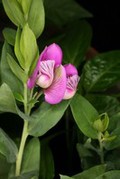
- Digital Images
- Online
Polygala myrtifolia 'Grandiflora'
Dr Henry Oakeley- Books
Tiryāq-i masmūm / jisko ... Muḥammad Ḥabībuddīn Aḥmad Ṣāḥib Sozān taḵẖalluṣ ne ... taʼlīf farmāyā.
Aḥmad, Muḥammad Ḥabībuddīn.Date: 1908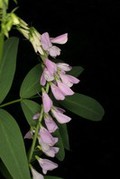
- Digital Images
- Online
Galega officinalis L. Fabaceae. Goat's Rue. Distribution: Central and Southern Europe, Asia Minor. Culpeper (1650) writes that it ‘... resists poison, kills worms, resists the falling sickness [epilepsy], resisteth the pestilence.’ Galega officinalis contains guanidine which reduces blood sugar by decreasing insulin resistance and inhibiting hepatic gluconeogenesis.. Metformin and Phenformin are drugs for type II diabetes that rely on this group of chemicals, known as biguanidines. Its name gala, meaning milk plus ega meaning 'to bring on', refers to its alleged property of increasing milk yield, and has been used in France to increase milk yield in cows. officinalis refers to its use in the offices of the monks, and is a common specific name for medicinal plants before 1600 and adopted by Linnaeus (1753). The fresh plant tastes of pea pods. Photographed in the Medicinal Garden of the Royal College of Physicians, London.
Dr Henry Oakeley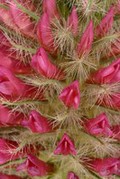
- Digital Images
- Online
Trifolium rubens L. Leguminosae. [Note the Family Leguminosae is preferred over Family Fabaceae as the former allows all the legumes to be in one Family and not three - one Family being the current consensus among botanists]. Red Feather Clover. Distribution: Europe. The white clover, Trifolium repens, is listed as a treatment for arthritis by Linnaeus (1782). This and Trifolium pratense, Red Clover, are the ones most used for pastures. All the clovers have root nodules which fix nitrogen from the air into the soil so have an important role in ensuring soil fertility. Trifolium rubens has the same nitrogen fixing ability, and is used as an ornamental garden plant where it still acts to improve fertility. Photographed in the Medicinal Garden of the Royal College of Physicians, London.
Dr Henry Oakeley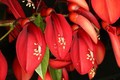
- Digital Images
- Online
Erythrina crista-galli L. Fabaceae. Cockspur coral tree. Distribution: South America. The national tree of Argentina, its flowers are pollinated by perching birds unlike many other species which are pollinated by humming birds. An extract from the bark is used as a powerful soporific, also as a gargle for sore throats and in the treatment of cuts, rheumatism and hepatitis, in Brazil (Mors, 1998). The seed contains the alkaloid beta-erythroidine. Analgesics, antimicrobial and anti inflammatory substances are being sought from the leaves. Curare-like action in rats has been reported from the seeds. Photographed in the Medicinal Garden of the Royal College of Physicians, London.
Dr Henry Oakeley
- Books
- Online
Acute diseases, and their homoeopathic treatment : also, directions for the treatment of injuries received by accidents and from poisons / by J.P. Dake.
J. P. DakeDate: 1859
- Digital Images
- Online
Rosa damascena Mill. Rosaceae Distribution: Garden origin. A hybrid between R. gallica and R. moschata.. Photographed in the Medicinal Garden of the Royal College of Physicians, London.
Dr Henry Oakeley- Books
Memoria sopra il veleno americano detto Ticunas / by the Abbé Fontana, Director of the Cabinet of Natural History belonging to His Royal Highness the Grand Duke of Tuscany ; communicated by John Paradise, Esq., F.R.S.
Fontana, Abbé.Date: 1780
- Ephemera
- Online
[Ivy Leaf Corn Silk].
Date: [1934]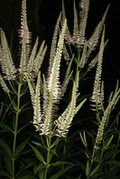
- Digital Images
- Online
Veronicastrum virginicum 'Pink Glow'
Dr Henry Oakeley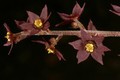
- Digital Images
- Online
Xanthorhiza simplicissima Marshall Ranunculaceae. Yellow root. Distribution: North America, where it was discovered by the plant collector and explorer William Bartram in 1773. Yellow-root. Austin (2004) reports that of the Native Americans, the Cherokee use the crushed plant to make a yellow dye
Dr Henry Oakeley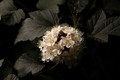
- Digital Images
- Online
Physocarpus opulifolius (L.)Maxim. Roasaceae Distribution: North America. Austin (2004) reported it was used for gynaecological problems by the Iroquois and Menomini
Dr Henry Oakeley- Books
Clinical handbook on economic poisons : emergency information for treating poisoning / Wayland J. Hayes.
Communicable Disease Center (U.S.). Technology BranchDate: 1963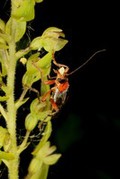
- Digital Images
- Online
Neottia ovata plus Cantharis rufipes beetle
Dr Henry Oakeley