244 results filtered with: Pink
- Digital Images
- Online
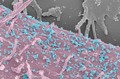
Exosomes on surface of HeLa cell
Dr James Edgar, Cambridge Institute for Medical Research, Cambridge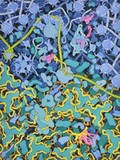
- Digital Images
- Online
HIV transcription, HIV viral life cycle, illustration
David S. Goodsell, The Scripps Research Institute
- Digital Images
- Online
Healthy brain, composite of tractography, MRI and artwork
Gabriel González-Escamilla
- Digital Images
- Online
Paeonia officinalis 'Flore Pleno'
Dr Henry Oakeley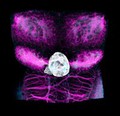
- Digital Images
- Online
Brain development, zebrafish
Ingrid Lekk, Dr Steve Wilson
- Digital Images
- Online
Paeonia officinalis (Peony)
Dr Henry Oakeley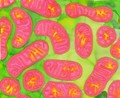
- Digital Images
- Online
Mitochondria In Action
Odra Noel
- Digital Images
- Online
Human brain cancer stem cells, SEM
Izzat Suffian, Pedro Costa, Stephen Pollard, David McCarthy & Khuloud T. Al-Jamal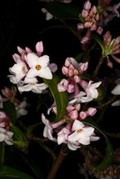
- Digital Images
- Online
Daphne bholua 'Jacqueline Postill'
Dr Henry Oakeley
- Digital Images
- Online
3D reconstruction of chinchilla, composite
Scott Birch
- Digital Images
- Online
Osteocyte in cortical bone, SEM
Kevin Mackenzie, University of Aberdeen
- Digital Images
- Online
Transverse section through mouse soleus muscle
James N. Sleigh
- Digital Images
- Online
Clathrin-coated pit, inner leaflet of the plasma membrane
Daniela A. Sahlender, University of Cambridge
- Digital Images
- Online
Tulipa hybrid
Dr Henry Oakeley
- Digital Images
- Online
Raspberry
Annie Cavanagh and Kate Keene
- Digital Images
- Online
Gloriosa superba L. Colchicaceae Gloriosa lily. Gloriosa rothschildiana is now a synonym. Climbing plant. Distribution: Southern Africa to Asia. National flower of Zimbabwe, state flower of Tamil Nadu. Contains colchicine which is poisonous, teratogenic and used for treating gout, Familial Mediterranean fever and Behcet's disease. Its toxicity limits its use as a anti-cancer agent. Photographed in the Medicinal Garden of the Royal College of Physicians, London.
Dr Henry Oakeley
- Digital Images
- Online
Breast cancer cell spheroid treated with doxorubicin, SEM
Khuloud T. Al-Jamal, David McCarthy & Izzat Suffian
- Digital Images
- Online
Justicia carnea Lindl. Acanthaceae. Brazilian Plume flower, Flamingo flower. Shrimp plant. Tender shrub. Distribution: Atlantic coast of Brazil. Named for James Justice (1698-1753) Scottish horticulturist, lawyer, 'tulip maniac' (Desmond, 1977). Asian species of Justicia are noted to be toxic and contain cytotoxic compounds which inhibit virus replication (Wiart, 2006) Photographed in the Medicinal Garden of the Royal College of Physicians, London.
Dr Henry Oakeley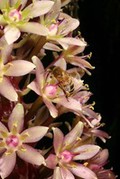
- Digital Images
- Online
Eucomis comosa (Houtt.)H.R.Wehrh. Hyacinthaceae Pineapple flower. From the Greek eu comis meaning 'good hair' referring to the tuft of leaves on top of the flowers. Comosa being Latin for 'with a tuft' referring to the same thing. Used in South African 'muthi' medicine. Enemas of Eucomis autumnalis are used in Africa to treat low backache, to aid postoperative recovery and to speed the healing of fractures. Decoctions are taken for the treatment of everything from hangovers to syphilis. The active ingredients include homisoflavones, which have anti-inflammatory and antispasmodic activity (van Wyk et al, 2000) Photographed in the Medicinal Garden of the Royal College of Physicians, London.
Dr Henry Oakeley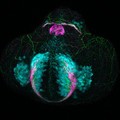
- Digital Images
- Online
Glutamatergic neurons in telencephalon, zebrafish
Kate Turner, Dr Steve Wilson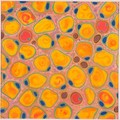
- Digital Images
- Online
'More to love' Adipose tissue
Odra Noel
- Digital Images
- Online
Apoptosis
Odra Noel
- Digital Images
- Online
Plankton; a diatom frustule
Annie Cavanagh
- Digital Images
- Online
Mitochondria in Action
Odra Noel
- Digital Images
- Online
Atropa belladonna L. Solanaceae. Deadly nightshade. Dwale. Morella, Solatrum, Hound's berries, Uva lupina, Cucubalus, Solanum lethale. Atropa derives from Atropos the oldest of the three Fates of Greek mythology who cut the thread of Life (her sisters Clotho and Lachesis spun and measured the thread, respectively). belladonna, literally, means 'beautiful lady' and was the Italian name for it. Folklore has it that Italian ladies put drops from the plant or the fruits in their eyes to make themselves doe-eyed, myopic and beautiful. However, this is not supported by the 16th and 17th century literature, where no mention is ever made of dilated pupils (or any of the effects of parasympathetic blockade). Tournefort (1719) says 'The Italians named this plant Belladonna, which in their language signifies a beautiful woman, because the ladies use it much in the composition of their Fucus [rouge or deceit or cosmetic] or face paint.' Parkinson says that the Italian ladies use the distilled juice as a fucus '... peradventure [perhaps] to take away their high colour and make them looke paler.' I think it more likely that they absorbed atropine through their skin and were slightly 'stoned' and disinhibited, which made them beautiful ladies in the eyes of Italian males. Distribution: Europe, North Africa, western Asia. Culpeper (1650) writes: 'Solanum. Nightshade: very cold and dry, binding … dangerous given inwardly … outwardly it helps the shingles, St Antonie's Fire [erysipelas] and other hot inflammation.' Most of the 16th, 17th and 18th century herbals recommend it topically for breast cancers. Poisonous plants were regarded as 'cold' plants as an excess of them caused death and the body became cold. They were regarded as opposing the hot humour which kept us warm and alive. Poultices of Belladonna leaves are still recommended for muscle strain in cyclists, by herbalists. Gerard (1633) writes that it: 'causeth sleep, troubleth the mind, bringeth madnesse if a few of the berries be inwardly taken, but if more be taken they also kill...'. He was also aware that the alkaloids could be absorbed through the skin for he notes that a poultice of the leaves applied to the forehead, induces sleep, and relieves headache. The whole plant contains the anticholinergic alkaloid atropine, which blocks the peripheral actions of acetylcholine in the parasympathetic nervous system. Atropine is a racemic mixture of d- and l- hyoscyamine. Atropine, dropped into the eyes, blocks the acetylcholine receptors of the pupil so it no longer constricts on exposure to bright light - so enabling an ophthalmologist to examine the retina with an ophthalmoscope. Atropine speeds up the heart rate, reduces salivation and sweating, reduces gut motility, inhibits the vertigo of sea sickness, and is used to block the acetylcholine receptors to prevent the effects of organophosphorous and other nerve gas poisons. It is still has important uses in medicine. Atropine poisoning takes three or for days to wear off, and the hallucinations experienced by its use are described as unpleasant. We have to be content with 'madness', 'frenzie' and 'idle and vain imaginations' in the early herbals to describe the hallucinations of atropine and related alkaloids as the word 'hallucination' in the sense of a perception for which there is no external stimulus, was not used in English until 1646 (Sir T. Browne, 1646). It is a restricted herbal medicine which can only be sold in premises which are registered pharmacies and by or under the supervision of a pharmacist (UK Medicines and Healthcare Products Regulatory Agency (MHRA)). Photographed in the Medicinal Garden of the Royal College of Physicians, London.
Dr Henry Oakeley