850 results filtered with: Poisons
- Books
Introduction to toxicology / John Timbrell.
John A. TimbrellDate: 2002
- Digital Images
- Online
Sempervivum tectorum L. Crassulaceae Houseleek, Senegreene Distribution: Europe. Sempervivum means 'live forever', tectorum means 'roof', and was apparently grown on house roofs to protect against lightning. Lyte (1578 distinguishes Stonecrops (Sedum) from Sengreene (Sempervivum) for he advises the latter, alone or mixed with barley meal, applied topically to burns, scalds, St Anthony's fire [erysipelas] , ulcers and sores, will cure them and sore eyes. Apropos of stonecrops (Sedum), he describes the redness and blistering that the sap has on bare skin, and how it is good for poisons for if taken with vinegar by mouth it causes vomiting, but only safe to do so in strong people. He seems fairly confused as to which is which. Not approved by the European Medicines Agency for Traditional Herbal Medicinal use. Photographed in the Medicinal Garden of the Royal College of Physicians, London.
Dr Henry Oakeley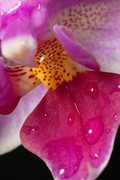
- Digital Images
- Online
Phalaenopsis, Orchidaceae

- Archives and manuscripts
- Online
M0010119: Address page of a letter from Richard Brocklesby to Martin Folkes, 1747
Date: 05 August 1947Reference: WT/D/1/20/1/89/23Part of: Wellcome Trust Corporate Archive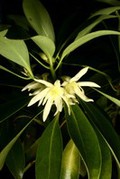
- Digital Images
- Online
Illicium anisatum L. Illiciaceae Japanese Star Anise. Distribution Japan. This was also called Illicium religiosum and the fruits are toxic. Effects of taking Illicium anisatum tea include epilepsy, vomiting, shakiness and rapid eye movements (US Food and Drug Administration report, 2003). Lindley (1838) and Bentley (1861) thought that I. anisatum was used in cooking, but they were describing the uses of I. verum which is used as a spice in Asia. Illicium anisatum syn. religiosum is 'used to make incense in Japanese and Chinese temples and was called Skimi by Kaempfer. This derives from the Japanese word 'shi-kimi'. The seed pods of both species contain shikimic acid (the name being derived from the Japanese) from which Tamiflu, the antiviral drug was synthesised. Photographed in the Medicinal Garden of the Royal College of Physicians, London.
Dr Henry Oakeley
- Digital Images
- Online
Scadoxus multiflorus Raf. Amaryllidaceae. Blood Flower, Poison root, Fireball Lily. Distribution: Sub-Saharan Africa. The genus name is a concatenation of the Greek words, Sciadion meaning a parasol or umbel, and doxa meaning 'glorious'
Dr Henry Oakeley
- Pictures
- Online
Queen Eleanor sucking the poison from King Edward's arm. Coloured stipple etching by Wynne Ryland, 1780, after A. Kauffman.
Angelica KauffmannDate: 1 March 1780Reference: 18578i- Archives and manuscripts
Gwen Prout stamp collection vol.172 Toxins
Date: 1966-2014Reference: EPH751:172Part of: Gwen Prout Stamp Collection
- Digital Images
- Online
Acer palmatum 'Bloodgood'
Dr Henry Oakeley
- Books
- Online
De la cure des maladies produites par l'abus des minéraux / Ouvrage traduit sur l'original latin publié en 1781 à Amsterdam. À Bruxelles.
Caëls, Theodore Pierre, 1739-1819.Date: 1787
- Digital Images
- Online
Tropaeolum cv
Dr Henry Oakeley
- Digital Images
- Online
Punica granatum L. Lythraceae Pomegranate, granatum malum, balustines. Distribution: E. Mediterranean to Himalayas. The Pomegranate is in the centre of the Arms of the Royal College of Physicians, perhaps for its use in cooling, and therefore for fevers. However it was the sour pomegranate that would have been used as Dioscorides says the sweet ones are unfit for use in agues. Culpeper (1650) makes no mention of the fruit, but says of the flowers ‘... they stop fluxes and the Terms in women.’ In the Complete Herbal and English Physician (1826) says the fruit ‘... has the same general qualities as other acid fruits.’ Of the flowers he says (among other properties) that ‘A strong infusion of these cures ulcers in the mouth and throat, and fastens loose teeth.’ Gerard (1633) says that the cravings of pregnant women can be abolished with the juice, and perhaps it was scurvy which was being treated effectively when he reports that the juice was very effective against splitting of blood and for loose teeth. The dwarf form of this species, Punica granatum var. nana with fruits no more than 3cm across. Pomegranate bark can only be sold by registered pharmacies in the UK and used to be used as a vermifuge, with the secondary use that the tincture made from it doubled as a permanent ink. In South Africa the fruit rind is used for diarrhoea and stomach ache, and the bark as a vermifuge, but undesirable side effects make this dangerous. It is reported to be effective against fevers, as a diuretic, to lower blood sugar and to be both antibacterial and antiviral (van Wyk, 2000). Photographed in the Medicinal Garden of the Royal College of Physicians, London.
Dr Henry Oakeley- Books
Studien zur Geschichte der Begriffe "Heilmittel" und "Gift." : Urzeit. Homer, Corpus Hippocraticum / [Walter Artelt].
Walter ArteltDate: 1968
- Digital Images
- Online
Centaurea hypoleuca 'John Coutts'
Dr Henry Oakeley
- Digital Images
- Online
Teucrium scorodonia 'Crispum Marginatum' L. Lamiaceae Distribution: Europe Teucrium is named after king Teucer (who lived in the era between 1400 and 1000 BC) the first King of Troy. Dioscorides named a medicinal herb after Teucer, and Linnaeus consolidated this in 1753. Probably the Scordium or Water Germander. It was given very similar properties. Photographed in the Medicinal Garden of the Royal College of Physicians, London.
Dr Henry Oakeley
- Digital Images
- Online
Ricinus communis L. Euphorbiaceae Castor oil plant. Palma Christi. Distribution: Mediterranean, E Africa, India. The seeds themselves are pretty, brown, bean-like usually with gold filigree markings on them, and the interior of the seed is the source of castor oil. The outer coat of the seed is the source of the poison ricin, famous (infamous) for the umbrella murder of Georgi Markov on Waterloo Bridge in 1978. The KGB are alleged to have killed Georgi Markov, a dissident Bulgarian journalist, with a pellet containing 0.28mgm of ricin fired into his leg using a specially adapted air gun in an umbrella. While his symptoms were those of ricin poisoning, no ricin was ever found in the pellet that was extracted from his leg. Two seeds, chewed and ingested are said to be fatal, but most people vomit and get rid of the toxin. Ducks are resistant to ricin, and need to ingest more than 80 to be fatal! In Peru the leaves are used as a tea for stomach ache, although they contain small amounts of ricin. It is called Palma Christi in early herbals because of the five pointed leaves, which schematically represent a hand. It is a monotypic genus in the spurge family. Photographed in the Medicinal Garden of the Royal College of Physicians, London.
Dr Henry Oakeley
- Books
- Online
The poisonous snakes of India : for the use of the officials and others residing in the Indian Empire / compiled by Joseph Ewart.
Ewart, Joseph (Sir)Date: 1878
- Digital Images
- Online
Myrtus communis L. Myrtaceae Myrtle Distribution: Europe. Dioscorides (Beck, 2005) recommends the fruit for treating haemoptysis (‘spitting blood’) and cystitis, and, if boiled, he said it made a fine wine. In various forms it was used as a hair dye, for sore eyes, anal and uterine prolapse, dandruff and shingles, all sorts of inflammations, scorpion bites and even sweaty armpits. Our plant has white berries, but he regarded those with black berries (they become black later in the season) as being more effective. Lyte (1576) adds that the juice of the berries kept the hair black and stopped it falling out, and prevented intoxication. He notes that it only flowered in hot summers in England, but it is reliable in flower now, either due to global warming or selection of suitable clones. According to Lyte, it is named after Merlyne, a fair maiden of Athens in ancient Greece, who judged the athletic games. Slain by a disgruntled competitor, the goddess Minerva brought her back as the myrtle tree in perpetual memory. The myrtle tree is also an ancient Jewish symbol for peace and justice. Myrtle wine is still made in Tuscany and now even in China. Photographed in the Medicinal Garden of the Royal College of Physicians, London.
Dr Henry Oakeley- Books
Ondergang in bedwelming : drugs en giften in het West-Romeinse Rijk / A.M.G.Rutten.
Rutten, A. M. G.Date: 1997
- Digital Images
- Online
Rohdea japonica Roth Convallariaceae Distribution: Japan. It is a monotypic genus known as omoto in Japan, meaning ‘evergreen’. It is regarded as a symbol of long life and good fortune
Dr Henry Oakeley- Books
Arabische Giftbücher : III Die Gifte im Kanon des Avicenna / von Julius Ruska.
Julius RuskaDate: 1996
- Digital Images
- Online
Thunbergia alata Sims Acanthaceae. Black-eyed Susan. Tender, perennial herbaceous climbing plant. Distribution: East Africa. Named for Carl Peter (Pehr or Per) Thunberg (1743-1828), doctor, botanist, student of Linnaeus who collected plants in Japan, Sri Lanka and South Africa. He published Flora Japonica (1784)
Dr Henry Oakeley
- Pictures
- Online
Alexander the Great demonstrating his trust in his physician Philip of Acarnania by drinking a medicinal draught prepared by him despite allegations that it was a poison. Mezzotint by V. Green, 1772, after B. West, the elder.
Benjamin WestDate: 1 January 1772Reference: 22175i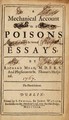
- Books
- Online
A mechanical account of poisons in several essays / By Richard Mead.
Richard MeadDate: 1729
- Digital Images
- Online
Rubus spectabilis 'Olympic Double'
Dr Henry Oakeley