405 results filtered with: Green

- Digital Images
- Online
Lung cancer cells treated with nano sized drug carriers
Khuloud T. Al-Jamal & Izzat Suffian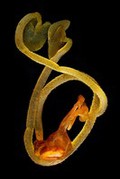
- Digital Images
- Online
Chia (Salvia hispanica) seedlings
Macroscopic Solutions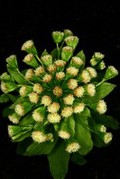
- Digital Images
- Online
Petasites hybridus (L.)G.Gaertn., B.Mey. & Scherb. Asteraceae. Butterbur, Bog rhubarb. Distribution: Europe, NW Asia. Culpeper (1650) writes: “The roots are ... exceeding good in violent and pestilential fevers, they provoke the terms, expel poison, and kill worms.” Modern herbalists recommend it for a wide range of therapies, but it contains pyrrolizidine alkaloids, which are hepatotoxic and cause liver cancers. Nevertheless, in a trial aimed at reducing frequency of migraine attacks, a standardised commercial preparation was well tolerated, and was effective at higher doses, but placebo in this trial reduced migraines by over 50% in 49% of the patients (Neurology 2004
Dr Henry Oakeley
- Digital Images
- Online
Raynaud's Phenomenon
Thermal Vision Research
- Digital Images
- Online
Human heart (aortic valve) tissue displaying calcification
Sergio Bertazzo, Department of Materials, Imperial College London
- Digital Images
- Online
Varicose Veins, Legs. Female. Illustrated with thermography
Thermal Vision Research, Wellcome Collection
- Digital Images
- Online
Glutamatergic neurons in the zebrafish forebrain
Kate Turner, Dr Steve Wilson
- Digital Images
- Online
Neuromuscular junctions and blood vessels
James N. Sleigh
- Digital Images
- Online
Nigella sativa L. Ranunculaceae Love-in-the-mist, Black Cumin, Nutmeg flower, Roman Coriander. Distribution: SW Asia. Culpeper (1650) writes: ‘Nigella seeds, boyled in oil, and the forehead anointed with it, ease pains in the head, take away leprosie, itch, scurf, and helps scald-heads, inwardly taken they expel worms, they provoke urine and the terms, help difficulty of breathing: the smoke of them (being burned) drives away serpents and venomous beasts.’ The seeds are used as a spice, but as might be expected as a member of the family Ranunculaceae, the buttercups, the plant contains a highly poisonous glycoside, in this case called melanthin. The amount of toxicity present in spices is clearly insufficient to cause problems when used as such. Photographed in the Medicinal Garden of the Royal College of Physicians, London.
Dr Henry Oakeley
- Digital Images
- Online
Raynaud's Phenomenon
Thermal Vision Research
- Digital Images
- Online
Human skin section, histology
Kevin Mackenzie, University of Aberdeen
- Digital Images
- Online
Bacterial microbiome mapping, bioartistic experiment
François-Joseph Lapointe, Université de Montréal
- Digital Images
- Online
Hoverfly mouth part
Kevin Mackenzie, University of Aberdeen
- Digital Images
- Online
Bacterial microbiome mapping, bioartistic experiment
François-Joseph Lapointe, Université de Montréal
- Digital Images
- Online
Bee pupa, SEM
Newcastle EM Research Service, Newcastle University
- Digital Images
- Online
DNA sequence of CCR5 Delta 32 gene mutation
Emei Ma, P/C Guy McLoughlin
- Digital Images
- Online
Raynaud's Phenomenon
Thermal Vision Research
- Digital Images
- Online
St George and the dragon - T lymphocyte killing a cancer cell
Odra Noel
- Digital Images
- Online
Diatom frustule, SEM
Anne Weston, Francis Crick Institute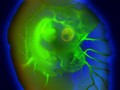
- Digital Images
- Online
6-day old chick embryo viewed under a stereo microscope, LM
Khuloud T. Al-Jamal, Serene Tay & Michael Cicirko
- Digital Images
- Online
Cellular architecture of normal human skin imaged by whole mount tissue microscopy. Human skin has a rich network of white blood cells (specifically dendritic cells, T cells and macrophages) which form sheaths around blood vessels. In this image, T cells (stained for CD3; red) dendritic cells (stained for MHC class II; green) and macrophages (stained for LYVE-1; blue with some cells showing a tinge of green) can be seen. Cell nuclei have been stained with DAPI (grey). This normal cellular architecture is grossly disrupted in diseased skin (see related images). X20 magnification. Scale bar (white) represents 100 micrometres.
Dr. Xiao-nong Wang, Human Dendritic Cell Laboratory, Newcastle University
- Digital Images
- Online
Feathery hairs on the top of a plant seed, SEM
Kevin Mackenzie, University of Aberdeen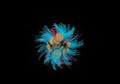
- Digital Images
- Online
Bacterial microbiome mapping, bioartistic experiment
François-Joseph Lapointe, Université de Montréal
- Digital Images
- Online
Origin of life
Odra Noel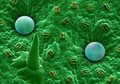
- Digital Images
- Online
Surface of a mint leaf
Annie Cavanagh