Growing up in Sudan, Jumana Eltgani was used to the cycle of elation when the water system burst into action, followed by the despair of dry days. Her family’s zeer – a clay vessel which stores fresh water – was a lifeline to all who needed a drink. Today, as war rages, that spirit of sharing shows her neighbourhoods’ resilience.

Everyone Gives, Everyone Receives, Artwork: Yasmin Elnour for Wellcome Collection. Attribution-NonCommercial-NoDerivatives 4.0 International (CC BY-NC-ND 4.0).
On the west bank of the River Nile is the neighbourhood I grew up in and, until recently, called home: El-Thawra. It’s a large, densely populated residential area within Omdurman – one of Sudan’s three capital cities – where running water was never guaranteed. Still, generosity flowed freely, even when water did not.
From childhood into my adult years, interruptions to our water supply were almost daily – so common they basically became invisible, just another part of life. We all adapted and leaned on each other: that’s what community did.
But in 2023, war broke out in my home country between the Sudanese Armed Forces (SAF) and the paramilitary group the Rapid Support Forces (RSF), leading to extreme violence, famine and claims of a genocide. Since then, thousands of people – including my family and community – have been deliberately left without water, not just for days, but for weeks and sometimes months.
Sudan is no stranger to conflict; many regions have endured long and painful cycles of violence over the years. The current war is another chapter in this ongoing tragedy, marked by its own forms of devastation and disruption to people’s lives. Yet in the darkest moments, Sudanese people refuse to give in.
Childhood days without water
A year before the 2023 war, UNICEF reported that 17.3 million people in Sudan lacked access to basic drinking-water services; a crisis that impacted our household.
As children, during the long, dry hours when the water stopped, we’d leave the taps in our house open, listening out for that hopeful sound – “tuk, tuk, tuk” – that meant the water was flowing again.
When the taps finally ran after hours of silence, the whole neighbourhood came alive. My siblings, cousins and I all lived under one roof, and our house would erupt with joy. We even had a song for those moments: “The electricity is back, fill the buckets before it cuts again,” we’d sing in Arabic, our voices joining the happy chorus rising from house to house.
Because people’s front doors were always open, and the walls were so close, you could hear people in many nearby homes shouting the same words in Arabic: “The water has come! The water has come!” In moments like that, it felt as if all the houses in the area were connected, like we were one big family.
The Water Has Come, Everything is Okay, Artwork: Yasmin Elnour for Wellcome Collection. Attribution-NonCommercial-NoDerivatives 4.0 International (CC BY-NC-ND 4.0).
"When the taps finally ran after hours of silence, the whole neighbourhood came alive."
The return of water signalled the start of a familiar family routine: time to fill the barrels. Blue for the bathroom and toilet, yellow for cleaning dishes in the kitchen, and pink for cooking and drinking. That last one was sacred; no one touched it without my mother’s permission.
If the water hadn’t come by night-time, someone in the house was assigned to stay awake and listen for its return. It was a serious duty, and if that person fell asleep and the water passed without filling the barrels, the next day would be a challenge.
In my neighbourhood, water was supplied by a well-based system that relied on electric pumps. Electricity never stayed on all day, so when the power cut out, the pumps stopped working.
The infrastructure was also old and prone to breakdowns, and spare parts were in short supply. All of this meant our water supply was unpredictable: some days the pumps worked, some days they didn’t.
We always found a way, but it meant using water sparingly: maybe asking someone to bathe with less, skipping a laundry load, or saving the washing-up until later. We relied on one another, sharing and stretching what we had.
Sudan’s class divides
Sudan’s long-standing water problems are rooted in its colonial history. Much of the country’s infrastructure was built during colonial occupation by British and Egyptian powers, but these developments were limited and primarily served the interests of the colonial administration rather than the Sudanese people.
After independence, upgrading and expanding these essential systems remained insufficient, leaving many of us with outdated treatment plants, pipelines and wells. As a result, there were frequent shortages.
Whenever the water finally arrived, it would expose another harsh truth: clean water was a privilege, not a guarantee. The water that flowed from our taps was often cloudy and dirty. This was what we drank, cooked with, and relied on to live.
Families with greater financial stability could install and maintain water filters. For others, the choice was not so simple. In our home, a filter wasn’t a priority, not because we didn’t understand its value, but because life brought other urgent costs: school fees, transport, food.
Yet even these hardships were a kind of privilege: at least we had pipes, taps, and the chance to sing when the water returned. In many parts of Sudan, families had no running water at all, and women and girls in some regions walked hours each day to fetch it. We counted ourselves fortunate to have it.
On the worst days, when the colour of our water made its impurities impossible to ignore, my mother would reach for the shab (known also as alum): a mineral she’d drop into the jug to bind and settle the dirt, leaving the water a little clearer, if not actually clean. “Is this water or lemon juice?” we would joke, looking at the cloudy water.
In this environment, my mother and grandmother worked incredibly hard to make sure food and water was always available – not just for our family, but for everyone in our community. Water was always something we shared. And a vital part of our daily efforts to make this possible was our zeer.
What’s a zeer?
A zeer, sometimes referred to as “the poor people’s refrigerator”, is a traditional clay pot that Sudanese people have used for centuries to store drinking water.
Across Sudan, many households rely on the zeer to keep water cool, safe and ready to share. Some families also place fruits or vegetables beneath zeers to keep food in the shade during the hottest days.
You can almost always find a zeer tucked under a tree. Some are placed communally in the streets so anyone passing by can drink; ours stood just outside our front door, beneath the wide shade of a neem tree.
Our family’s zeer was there for people: we always kept water in it for anyone to drink. It was a small act of hospitality to our neighbours, workers nearby, and strangers, especially when the taps failed.
In the early 2000s, one of my clearest memories is of my grandmother, who I remember as the keeper of the zeer. A strong, calmly powerful woman, she took full responsibility for making sure our zeer was always clean and filled. She would carefully wash the inside of the clay pot, not as a routine, but as an act of respect for anyone who might pass by feeling thirsty.
For her, offering water was not just kindness; it was duty. If she noticed the water level dropping, she would quietly refill it herself. Through the zeer, my grandmother extended care beyond our family, making sure that in a city where water so often failed, dignity did not.
My mother carried that same spirit of care: our house was by the main road, and when she’d look out the front door, she’d often notice people stood waiting for transport in the heat. Without hesitation, she’d offer them food and water. It was a simple gesture, but in those moments, water was life, comfort, and relief.
The Zeer Keeper, Artwork: Yasmin Elnour for Wellcome Collection. Attribution-NonCommercial-NoDerivatives 4.0 International (CC BY-NC-ND 4.0).
"Through the zeer, my grandmother extended care beyond our family, making sure that in a city where water so often failed, dignity did not."
What my mother and grandmother did reflects a broader Sudanese practice of generosity. I remember so well during the 2018 uprising, when we marched through neighbourhoods across Khartoum, families stepped outside with cups and jugs, offering water to anyone passing by.
Resisting colonial narratives
Our zeer wasn’t used for drinking inside the house; it stood outdoors, offering people a refreshing pause in the heat.
The clay itself acts as a natural filter: over time, dirt and impurities in the water settle at the bottom of a zeer, producing what we call the nogaa in Sudanese Arabic: a clearer layer of water at the top. Researchers explain this as the porous clay allowing water to seep through micropores, leaving behind heavier particles. But for us, this was everyday knowledge that had been passed down generations.
The zeer was of interest to the researchers at the Wellcome Tropical Research Laboratories, which opened in Khartoum in 1903. Researchers believed(view in catalogue) that the zeer was a breeding place for mosquitoes and published notices in Arabic and English advising Sudanese families to empty and clean their zeers at least twice a week.
A few years later, researchers conducted an experiment(view in catalogue) to determine how to get the best filtering from a zeer. Although Sudanese workers were employed at the laboratories, their knowledge and skills seem to have been neglected by the predominantly white European researchers who directed the laboratories' activities.
The research undertaken in the laboratories also influenced public health policies in Khartoum and Sudan, including an order(view in catalogue) to elevate the zeer above the ground and to use a specific cover. Anyone found to have an uncovered zeer containing mosquito larvae would be prosecuted.
Although these interventions were framed as public health measures, they illustrate how colonial-era researchers sought to regulate and standardise a long-standing cultural practice. Rather than engaging with the zeer as a form of indigenous knowledge rooted in care, hospitality, and everyday expertise, colonial authorities redefined it through scientific and legal frameworks, asserting control over its use. This process reflects a broader pattern of colonial governance, in which local practices were not erased, but reconfigured and disciplined under colonial authority.
Water weaponisation
Although the water cuts during my childhood years were difficult, they were always temporary. And when the barrels were finally filled again, a sense of security would settle over our house.
That moment of fullness brought a special kind of peace. Seeing water stacked and ready felt like the calm that comes after cleaning the house, when everything is in its place, the floor is swept, the air scented with bukhoor (a fragrant incense burned in Sudanese homes). I’d sit with my mother in the living room, the light soft and dim, chatting as we both drank cups of tea. It was the sensation of order restored, a brief pause in the uncertainty, when you could exhale and know you were safe – at least until the next water cut.
Today, that sense of peace is gone: since the war began, water has been weaponised. The RSF in particular have been accused of targeting Sudan’s water system as a deliberate military tactic so that people either die or cannot return to their land.
Reports suggest they have seized control of reservoirs, poisoned water sources and soil, destroyed treatment plants and pipelines, and cut water access to major urban centres and displacement camps. They have also been accused of looting pumps and cables, and have reportedly made an estimated 1,250 wells across Khartoum alone inoperative.
There is a huge humanitarian emergency in Sudan – the collapse of water systems has triggered famine, cholera outbreaks and mass displacement, exacerbating an already fragile and dire public health situation.
This means my people are being forced to rely on whatever water they can find – even when it’s unsafe.
The end of conflict and a return to peace doesn't just mean the absence of guns; it means holding onto our right to safety and to a life where the sound of running water matters more than the sound of war.
The Descent, Artwork: Yasmin Elnour for Wellcome Collection. Attribution-NonCommercial-NoDerivatives 4.0 International (CC BY-NC-ND 4.0).
"The collapse of water systems has triggered famine, cholera outbreaks and mass displacement."
The search for water
Since April 2023 to November 2025, about 13 million people, including me, have been displaced – this is around a third of our population.
When the war broke out, I had to suddenly leave my home and move to another area just to catch the bus, and from there, I left Sudan and travelled to Cairo. In those first few weeks I didn’t know what my life would look like. I was disoriented, waiting for a sense of stability that never came.
As people back home search desperately for water, I try to bear witness to what they’re living through, so that distance doesn’t turn their reality invisible to me.
My uncle, who remains in our family home, has shared many stories with me over the phone, when the network connection holds long enough for us to speak.
He told me how our neighbourhood was entirely without running water for more than four months in late 2023 and into early 2024. Even after that, the water would return for a few days and then disappear again for days throughout 2024.
Whenever word spread that water might be found in a distant neighbourhood, people would set out immediately – on tuk-tuks or donkey carts, and some even travelling up to five kilometres on foot under the relentless sun – driven by the faint promise of relief.
In sheer desperation, my uncle and a handful of neighbours would load a large barrel into the back of an open car and drive up to ten kilometres a day in search of water.
At one point, the only water my uncle could find was stored in old beer barrels. It was salty, unclean and barely drinkable. Yet it was all they had, and they brought it back to share with their families and neighbours, refusing to let anyone go without.
Organising a tanker
At different points during the current war, the only relief sometimes comes from large tankers that can bring water into neighbourhoods.
But as my aunt and uncle explained, arranging for a tanker is no simple task. It requires money, organisation and connections – resources many families simply don’t have.
Yet hope arrived for them both in the form of a neighbour – a young woman who took it upon herself to organise these deliveries for the area. She knew who to call, and when the water finally arrived, all the neighbours gathered with whatever containers they owned – from small jugs to larger barrels.
Not everyone could afford to buy water from the tanker, but those who could, shared what they had. They didn’t just keep it for themselves.
Then, in a moment that changed everything, my uncle brought out our blue, yellow, and pink barrels that had once supported only our own home. He filled them from the tanker and reassured the neighbours: “You don’t need permission. When the door is open, just come in and take water,” he said.
Just as when my mother and grandmother shared what we had, our home once again was a lifeline for our community.
Digital networks of care
In the face of such relentless hardship, what stands out most is the unwavering solidarity among Sudanese people.
Among those who embody this spirit is Samia, a woman I have learned so much from – a human-rights activist with whom I’ve had many conversations about the war.
From the earliest days of the conflict, Samia was among the first to raise her voice, founding the Women Against War campaign just three days after fighting erupted in April 2023.
She recounted those initial days in Khartoum’s Arkaweet neighbourhood, occupied by the RSF, when there was no electricity or water. Young men scoured abandoned houses for any remaining water, and when that failed, they resorted to collecting condensation from air-conditioning units – the only water available. Samia herself drank that condensation. It shows the desperation so many have faced.
Yet, even in such dire circumstances, Samia continued to campaign for peace. Though thirsty, she never surrendered her voice or determination to see the war end.
She became part of WhatsApp groups connecting doctors, pharmacists and activists. These digital networks have become lifelines, allowing people to coordinate urgent medical care and share information when formal systems have collapsed.
Sudanese people survive through generosity, resilience, and a refusal to let thirst erase our humanity.
The war has brought systematic sexual violence against women and girls, and one day, Samia received a frantic call from a mother, terrified that her daughter had been raped after RSF members entered their home at night. The activists responded immediately, reaching out to doctors and finding a midwife who could reach the family.
When the midwife arrived, she discovered the girl had not been raped, but was bleeding after bravely fighting back against the soldiers. With no medical supplies, the midwife did what she could, following the “rape protocol” as best as possible, using only water and salt. The rape protocol is a set of emergency medical steps designed to prevent infection, provide psychological support, and collect evidence after sexual assault. In Sudan’s current crisis, it is often improvised with whatever resources are at hand.
Knowing the RSF would likely return, the activists quickly arranged for the family’s evacuation.
This is how people are surviving: through quick, collective action, coordinated in real time over WhatsApp, and driven by a determination to protect one another in the face of starvation, violence and fear.
Community spirit in times of scarcity
The stories I carry here show how, as formal systems collapse, people come together. To me, that is what it means to be Sudanese.
Today, in war, water has become harder to find than ever before. Yet even in this absence, the same truth endures: Sudanese people survive through generosity, resilience, and a refusal to let thirst erase our humanity. Water has always been our most fragile resource, but also our strongest bond.
When I think back to Omdurman, to my grandmother’s zeer and my mother’s pink, yellow and blue barrels, I realise they were a symbol of care. These are the ways we hold each other through scarcity. In this way, the zeer stands not only as a vessel for water, but as a symbol of cultural endurance in the face of colonial disruption and war.
To offer a cup, to share a barrel, to keep the zeer filled, these are acts of love and resistance. And it is through that spirit, carried from my grandmother to my mother, to my uncle, my friends, and so many others, that we continue to move forward.
About the artwork
Yasmin’s illustrations honour what endures when infrastructure collapses: neighbours sharing what little they have; children singing as water returns; a grandmother’s daily ritual at the zeer; and our survival when water becomes a weapon.
To create these pieces, Yasmin wove together Jumana’s testimony, colonial-era photographs (some from Wellcome Collection), AI-generated figures, and archival textures. This layering allowed her to hold multiple histories at once - childhood memories, colonial neglect and today’s current crisis.
Yasmin’s heavy manipulation of source material symbolises that raw documentation alone isn’t enough; Sudanese stories deserve to be transformed into something empowering, not exploitative. As water infrastructure and wells are deliberately destroyed in Khartoum, her artwork insists that care and solidarity survive.
About the contributors
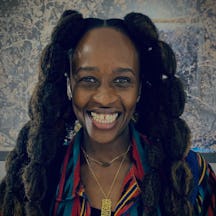
Jumana Eltgani
Author
Jumana is a Sudanese feminist and gender justice advocate, working for peace in Sudan. Her practice is grounded in community, connection and care. She's inspired by the Ancient African philosophy of Ubuntu, which means working collectively for a more just future. Jumana also loves singing as a way to connect with people and tell stories.

Yasmin Elnour
Artist
Yasmin Elnour is a Sudanese artist and designer whose practice moves between architecture, image, film, fashion, and research. Her work traces how histories of movement, adaptation, and colonial interruption have shaped the ways people see, live, and remember. Drawing from archives, artefacts, and oral histories, she creates visual languages that honour continuity and transformation, with the aim to educate, empower and reconnect.

Vanesha Kirita Singh
(she/her)
Commissioning editor
Vanesha is a Digital Editor at Wellcome Collection, specialising in storytelling that centres lived experience and social justice. Her practice is shaped by decolonial and anti‑imperial politics, rooted in a deep commitment to collective liberation. She works to create caring, supportive spaces for writers and artists, and strives to empower those who are misrepresented and excluded from mainstream discourse. Vanesha is particularly drawn to storytelling that explores solidarity and resistance. Her personal research focuses on Caribbean histories, especially the system of indentureship and its ongoing legacies.