Sabrina Tirvengadum’s sign language lesson took an unexpected turn when, asked to sign her skin colour, she chose ‘Brown’ – only for her tutor to insist she must describe herself as ‘Black’ in BSL. The experience prompted Sabrina to explore why sign language failed to capture her identity.

I am Brown, Artwork: Sabrina Tirvengadum for Wellcome Collection. Attribution-NonCommercial-NoDerivatives 4.0 International (CC BY-NC-ND 4.0).
I shaped my dominant hand into a claw and pressed it against the outside of my opposite elbow. I slowly drew my hand along my forearm, towards my wrist, and mouthed the word “brown” into the webcam.
It was 2020, in lockdown, and my tutor was watching me closely over Zoom. My face lit up as I pointed to myself and smiled back to him: “I am Brown,” I’d said, in British Sign Language (BSL).
My tutor quickly gestured back. He opened and closed his first two fingers against his thumb, then pointed at me and swept his hand down his face while mouthing: “No. You are Black.”
I froze. My jaw clenched. I repeated the movement of the claw-hand on my arm with force: “I am Brown,” I repeated.
Brown, Artwork: Sabrina Tirvengadum for Wellcome Collection. Attribution-NonCommercial-NoDerivatives 4.0 International (CC BY-NC-ND 4.0).
“‘I am Brown’, I’d said, in British Sign Language (BSL).”
His hand swept down his cheek again. “Black,” he said.
The silence between us was heavy and suddenly, my one-to-one BSL lesson no longer felt like a safe space where I could be my authentic self.
The sign for “brown”
Just moments earlier, I was excited to be practising new vocabulary. We were describing colours and characteristics, and my tutor had shown me how to sign “brown” as a colour for objects. But for skin-tone options, he taught me there was only the same sign for “black” and “white” skin colour, though you needed to mouth the respective word for each.
He’d then asked me to describe myself, and I instinctively signed “I am Brown” for my skin colour. But his immediate “no” and insistence that I could only be Black left me speechless and frustrated, as if my identity was being squeezed into a box that wasn’t right for me.
Black, Artwork: Sabrina Tirvengadum for Wellcome Collection. Attribution-NonCommercial-NoDerivatives 4.0 International (CC BY-NC-ND 4.0).
“My tutor quickly gestured back. 'No. You are Black.'”
Although we moved the conversation on, I was left confused. As a student, there can be an unspoken pressure to accept what a teacher says, especially when you’re learning a new language. But I’d always identified as a Brown person. That’s what I see when I look in the mirror.
The pressure to fit in
The hurt doesn’t come from the word ‘Black’, but from being told who I am. My tutor may not have meant any harm. Or maybe he is the grammar police. But in that moment, I don’t think he realised he was defining me.
It reminded me of how often my brown skin had been questioned throughout my life. Colourism is a real issue and much of it stems from colonial histories that idealised lighter skin as a symbol of power, status and beauty.
My friends and family used to express how important they felt it was to have a fairer complexion. I saw people using skin-lightening products like Fair & Lovely, picking a shade of foundation that was lighter than their skin tone, and keeping out of the sun, despite needing vitamin D. People negatively commented on my tan during the summer, and I’ve heard people say terrible things about others in my community simply because of their ‘darker’ complexion.
Growing up in England, I often felt pressure to fit into white British culture. So, at home, we spoke English instead of Mauritian Creole. In my teenage years, I quietly distanced myself from my heritage and tried not to stand out.
Within my community, people sometimes hide parts of themselves to avoid judgement and stay safe, but for me, this urge to blend in wasn’t limited to my cultural identity.
I was born with hearing loss, and because my disability is unseen, I could hide that part of me, too, by not wearing a hearing aid. That often meant people saw me as rude for ignoring them when, in reality, I just hadn’t heard them.
Life without hearing aids
I remember sitting in a children’s hearing clinic, being asked if I wanted hearing aids. I said no – not because I didn’t need them but because I didn’t want to stand out.
Choosing not to wear hearing aids meant I had to develop my own strategies to navigate daily life. I often avoided certain situations like speaking to someone nearby or answering the phone, and instead relied on texting and sending messages to communicate. At times, I’d pretend to follow conversations, or let myself be seen as quiet and reserved, even though I’m naturally extroverted.
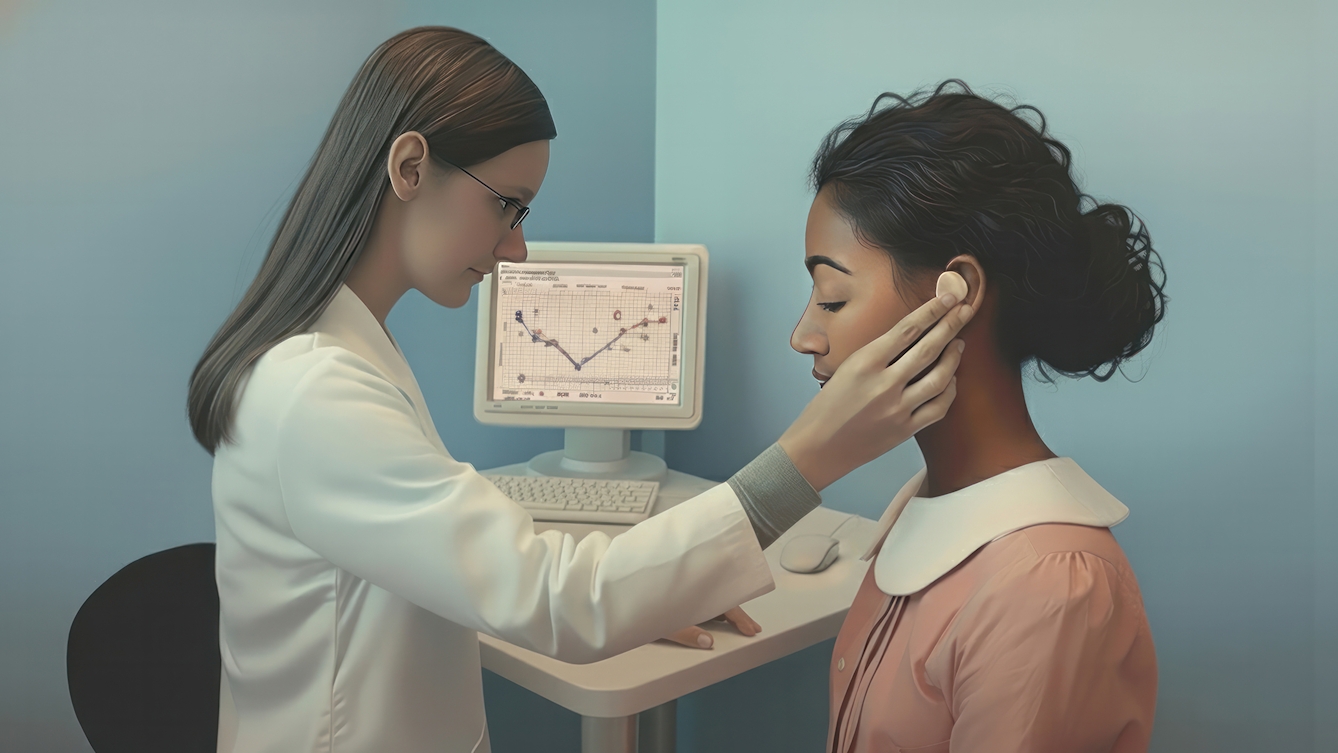
Audiology, Artwork: Sabrina Tirvengadum for Wellcome Collection. Attribution-NonCommercial-NoDerivatives 4.0 International (CC BY-NC-ND 4.0).
"I remember sitting in a children’s hearing clinic, being asked if I wanted hearing aids."
By the time I reached college in 2000, I realised a hearing aid was essential for navigating the world, even though I could lip-read. When I went for my regular audiology check-up, I was offered only large, inner-ear aids in a white skin tone. They looked out of place against my skin and didn’t fit properly. The audiologist apologised for not having a brown option. I said nothing.
It took another twenty years for me to begin a personal journey and truly embrace the many parts of myself that aren’t immediately visible to others. I had to navigate my many intersecting identities – British, Mauritian, Indian, Tamil, Asian, African, woman, disabled, deaf and Brown – in the hopes of finding a sense of comfort and genuine belonging. It wasn’t easy.
In 2023, I finally got hearing aids that suited me. This time, I chose the 'black velvet' colour, which blends in with my hair rather than being noticeable. It was a way to claim visibility on my own terms.
I am deaf
My perspective also shifted one day at work, when I came across a d/Deaf poetry event and booked tickets. When I mentioned it to a colleague, they asked what ‘d/Deaf’ meant. I realised I wasn’t sure, so we looked it up together. That’s when I learned I could identify as ‘small d’ deaf.
People who identify as ‘deaf’ with a lower-case ‘d’ have hearing loss but may not use sign language or be involved in the Deaf community, whereas ‘Deaf’ with a capital ‘D’ often refers to those who are part of the Deaf community and use sign language as their main language.
Until then, I’d never known there was a more accurate way to describe my experience.
When I told people, “I have hearing loss,” nothing changed in how they spoke to me. But when I started saying, “I am deaf,” I noticed people became more aware and tried to communicate more clearly with me.
In embracing my deaf identity, I realised I wanted to connect with the Deaf community, and that’s why I began learning BSL. I attended a few taster sessions before deciding to take private lessons with a Deaf tutor. For my first BSL lesson, I met my white, male tutor at a local café and I really enjoyed it. Then the pandemic hit, and the world turned upside down…
Blackness and BSL
I continued my BSL lessons over Zoom while the world shifted in profound ways. It was a time of deep reflection. The murder of George Floyd in May 2020 sparked global protests and conversations about racism. As I explored my deaf identity, I was also confronting the realities of racial injustice. It was against this backdrop that I found myself sitting in my bedroom on a Zoom call with my tutor, being told that I am Black.
After the incident, I searched for answers to explain why my BSL teacher focused on “black” and “white” for skin colour, with “brown” reserved only for objects or hair colour. I scoured the internet for answers but found nothing. I reached out to friends, hoping someone might know more, and even checked on Twitter. Still, no one could give me a clear answer.
Five years later, while sharing my experience during an artist talk at my exhibition, someone in the audience offered their perspective.
The audience member explained that during the civil rights movement in the UK, especially from the 1960s to the 1980s, Black and Brown communities often identified collectively as Black to build solidarity and present a united front against racism. This was known as political Blackness. She believed this strategic choice influenced language use, including in BSL, where the sign for “black” became a catch-all for people of various non-white backgrounds.
For the first time, someone had given me a possible explanation which helped me let go of some of the upset I’d been carrying: maybe there isn't a sign for “brown” skin in BSL because the language simply reflects the past, at a time when non-white people were grouped together as “Black.”
On top of this, because sign language has been systematically marginalised, there have been fewer opportunities for its vocabulary to adapt and expand to better represent individual identities.
BSL’s marginalisation and ongoing evolution
Sign language itself has been systematically suppressed. For much of its history, starting in 1880, sign language was banned from classrooms, sign language teachers were fired and d/Deaf culture was excluded from mainstream society until their limited return in the late 1970s. It wasn’t until the late twentieth century that BSL began to be recognised as a legitimate language.
This marginalisation seriously reduced the numbers of potential d/Deaf leaders, damaged d/Deaf communities and hampered the language’s development, limiting its ability to evolve and reflect the full diversity of its users.
BSL, like all languages, is constantly adapting and growing, and needs time to better reflect the diversity of those who use it.
In 2003, the UK government acknowledged BSL’s existence and affirmed it as a language in its own right. However, this was a political statement and didn’t create any legally enforceable rights or obligations. It was only with the passing of the BSL Act in 2022 that BSL received full legal recognition, placing obligations on the government to promote and support the language.
I was part of the BSL Rally in London. It was a beautiful day; I wore my red woolly hat, surrounded by a crowd full of cheers and energy to campaign for the passing of the BSL Bill. I wanted to stand in solidarity with the Deaf community, hoping that one day BSL would be recognised as an official language.
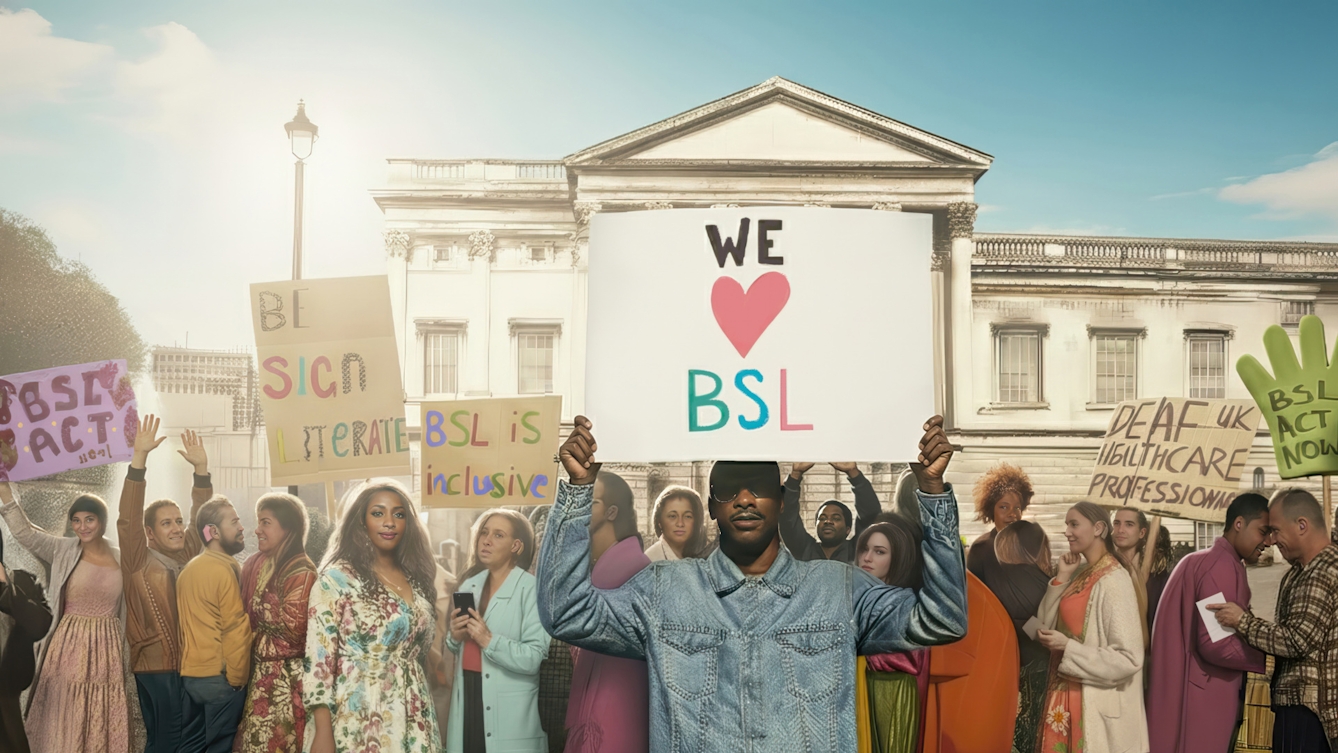
The rally, Artwork: Sabrina Tirvengadum for Wellcome Collection. Attribution-NonCommercial-NoDerivatives 4.0 International (CC BY-NC-ND 4.0).
"It was only with the passing of the BSL Act in 2022 that BSL received full legal recognition."
Since the passing of the BSL Act in 2022, there’s been an expansion in both BSL’s vocabulary and the range of topics it covers: community members are reviewing and updating signs that are considered offensive or racialised and have introduced hundreds of new signs to better represent the LGBTQ+ community, as well as concepts for computing, technology, environmental and biodiversity.
I’ve realised that BSL, like all languages, is constantly adapting and growing, and needs time to better reflect the diversity of those who use it.
This evolution became especially clear to me at the beginning of 2025, when I asked a BSL interpreter if there is now a recognised sign for “Brown” to describe my skin colour. Their response was affirming: I could use the colour sign for “Brown” to describe my identity. This moment was significant – not just for me personally, but as a reflection of how BSL is beginning to accommodate a wider spectrum of identities and experiences.
The history of BSL is a testament to the resilience and adaptability of language, and my personal journey with it has shown me how important it is to make space for change and progress.
Since that experience with my tutor, I haven’t returned to BSL lessons, but I hope to pick them up again. That lesson was still a turning point – it helped me realise I love my Brown skin, even if it took me a while to get here. And now I can confidently sign in BSL: “I am Brown.”
About the artwork
Sabrina’s creative process is rooted in personal photographs, archival material, AI-generated imagery, and digital painting. Usually, she begins with a photo or a drawing and feeds it into the AI, going back and forth between tools and techniques until it feels right. For instance, the protest signs held by people above come directly from the BSL Rally in London, March 2022, which Sabrina attended.
Sabrina does not see AI as a shortcut, but as a kind of collaborator. It doesn’t always give her what she wants, and that unpredictability has become part of how she creates. It opens up space to reinterpret history, memory, and truth. This collaboration with AI has become a meaningful part of Sabrina’s creative process, helping her reimagine fragments of the past and explore new visual possibilities.
About the contributors
Sabrina Tirvengadum
Author
Sabrina Tirvengadum (b. 1984) is a deaf British Mauritian visual artist based in East London. They work across collage, generative AI, graphic design, film and photography. Sabrina is the founder of WAH (We're All Human), a platform that promotes inclusivity in digital spaces. Their art explores themes of identity and colonial legacies, inspired by family history.

Vanesha Kirita Singh
(she/her)
Commissioning editor
Vanesha is a Digital Editor at Wellcome Collection, specialising in storytelling that centres lived experience and social justice. Her practice is shaped by decolonial and anti‑imperial politics, rooted in a deep commitment to collective liberation. She works to create caring, supportive spaces for writers and artists, and strives to empower those who are misrepresented and excluded from mainstream discourse. Vanesha is particularly drawn to storytelling that explores solidarity and resistance. Her personal research focuses on Caribbean histories, especially the system of indentureship and its ongoing legacies.