In the ICU, the most advanced science and technology meet the human art of caregiving. Elinor Cleghorn explores the history of intensive care, and how her brush with death taught her care’s true meaning.

A Touch of Tenderness, Artwork: Haozhe Li. © Wellcome Collection. Attribution-NonCommercial 4.0 International (CC BY-NC 4.0).
“Elinor, can you hear me? You’re at St Thomas’ Hospital, in London. You’re safe. I’m a nurse.”
The nurse’s voice was the first thing I heard when I began to wake up. For six days, I had been lying in a bed in one of St Thomas’ intensive care units (ICUs) in a medically induced coma. ICUs are specialist wards where patients whose vital organs have been pushed to their limits by injury or illness are brought, in the hope that they can be restored to health.
Here, lives are saved and sustained using the most advanced medical technologies, procedures and knowledge, alongside attentive, holistic care. For a patient whose life hangs in the balance, what is made possible in an ICU can, in the best cases, feel nothing short of miraculous.
In spring 2024, I was one such patient. When I was admitted to St Thomas’, I was whisper-close to death. Two weeks later, I was transferred back to my local hospital in Sussex, knowing I would make a full recovery. During my time in intensive care, I learned the extent of what contemporary medicine can achieve. I also experienced the power of human caregiving to protect and preserve life.
Without that care, I wouldn’t be writing this today.
Journey to the ICU
I began to feel unwell after flying home from a mini-break with my oldest friend. Memories of spritzes on late-spring beaches faded as pain swelled in my muscles and fatigue consumed me. When I began struggling to breathe, my husband phoned 999. My oxygen levels were worryingly low, and I was rushed by ambulance to the ICU at my local hospital with suspected sepsis resulting from pneumonia.
The infection spiralled out of control. Inflammatory fluid as unyielding as cement engulfed my lungs. I was anaesthetised and placed on a ventilator, but it wasn’t enough. My body wasn’t taking in the oxygen it needed to survive. A temporary life support system called ECMO (extracorporeal membrane oxygenation) was my best hope and last resort. ECMO can take over the function of failing lungs ‘extracorporeally’, meaning outside the body.
While I slumbered under a blanket of sedatives and painkillers, my blood was drained through a cannula tunnelled under the skin in my groin and into my femoral vein. From there, it was pumped into a machine where it was filled with oxygen, cleared of carbon dioxide, and warmed, before being returned to my body through another cannula in the opposite femoral vein.
This circulatory choreography would continue for as short a spell as possible, until I was well enough to begin breathing without assistance.
The miracle of ECMO
ECMO was developed during the 1960s at the University of California, Irvine School of Medicine, by a research team led by the pioneering American surgeon Robert H Bartlett, who died in October last year. Today, his revolutionary intervention is the highest level of life support.
Bartlett and his team conceived of ECMO as a longer-term form of cardiopulmonary bypass – the technology that circulates and oxygenates a patient’s blood during open-heart surgery. Acting as a “bridge to recovery”, the machine serves as an artificial lung or heart, allowing patients to rest while their illness is treated. It was first used successfully on an adult and a baby with severe respiratory failure in 1971 and 1976 respectively.
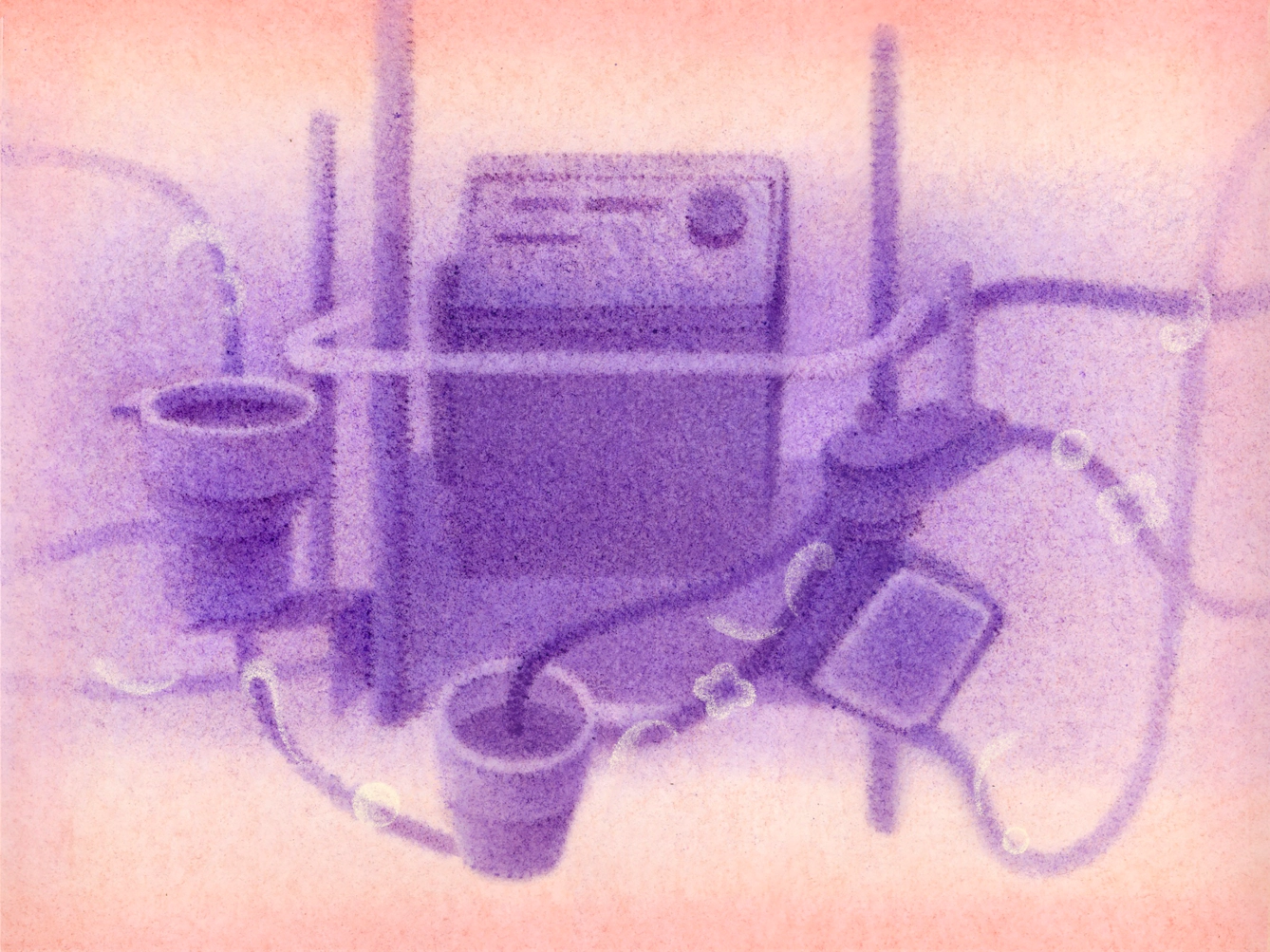
The Miracle of ECMO, Artwork: Haozhe Li. © Wellcome Collection. Attribution-NonCommercial 4.0 International (CC BY-NC 4.0).
“While I slumbered under a blanket of sedatives and painkillers, my blood was drained, filled with oxygen, cleared of carbon dioxide and warmed, before being returned to my body, in circulatory choreography.”
ECMO proved vital during the Covid-19 pandemic, helping to save hundreds of lives in the UK and thousands more worldwide. But it is hugely expensive, resource-intensive and can only be administered by specially trained doctors and nurses. Just seven hospitals in England, and one in Scotland, are ECMO centres – one of them is St Thomas’ Hospital.
ECMO also carries serious risks, including bleeding, blood clots, seizures and strokes, which become more likely the longer a person remains on it. The in-hospital survival rate for an ECMO patient suffering from respiratory failure is around 70%. Only patients whose conditions are potentially reversible, who are anticipated to survive it, and who would die without it, meet the NHS’s necessarily selective eligibility criteria.
I was eligible, and by sheer luck of timing, availability and geography, was put on ECMO before it was too late.
The work of treating
For the first days I spent at St Thomas’, death was postponed but life was suspended. I had to be temporarily paralysed so my lungs could be fully taken over. My kidneys were failing, so I was on dialysis. My high and irregular heart rate was shocked back into rhythm with defibrillator paddles.
I was on antibiotics and steroids to quell the infection, and medication to control my blood pressure and maintain homeostasis. A feeding tube ran up my nose and into my stomach, and intravenous lines were threaded through my neck.
After three days, my doctors were cautiously optimistic that I had a decent chance not only of survival, but of recovery. After six days, they were confident that I could be weaned off ECMO and continue my intensive care conscious and aware, with supplementary oxygen.
ECMO was the protective pause that afforded my body, and the people trying to heal it, time. With every mechanical breath and beat, my lungs gradually regained function, and the havoc wrought by the infection was quelled. I survived because of ECMO, and the knowledge and decision-making skills of the intensivists who determined my courses of treatment. But I owe my life to the nursing staff who did the daily – hourly – work of treating.
All patients in ICUs are watched over, around the clock, by one and sometimes two highly specialised critical care nurses. During their shifts, they track pulse rates, blood pressure and oxygen levels on monitoring systems, administer and adjust multiple medications, operate technologies such as sensors and ventilators, set up intravenous lines through which patients are hydrated and medicated, draw blood samples and perform diagnostic tests, update patient notes, keep families and loved ones informed, and countless other duties.
Their vigilance is crucial, as is their responsiveness when patients’ conditions change or plummet. But alongside all their clinical responsibilities, ICU nurses are their patients’ shields, their advocates; and they do everything they can to sustain their comfort and personhood.
Dignity and personhood
The nurse who was with me when I stirred into consciousness was part of a team that hadn’t left my bedside since I was admitted to the ICU. I couldn’t see anything. I was too weak to move, and with the breathing tube in my mouth I couldn’t speak. I had no idea how and why I had ended up at St Thomas’.
Although I was too sedated to panic, the experience of waking up in the ICU was intensely strange. I felt as if I were being pulled to the surface through layers of thick black darkness. But the nurse’s voice, immediately familiar, comforted me. She had spoken to me many times – this was just the first time I was conscious of it.
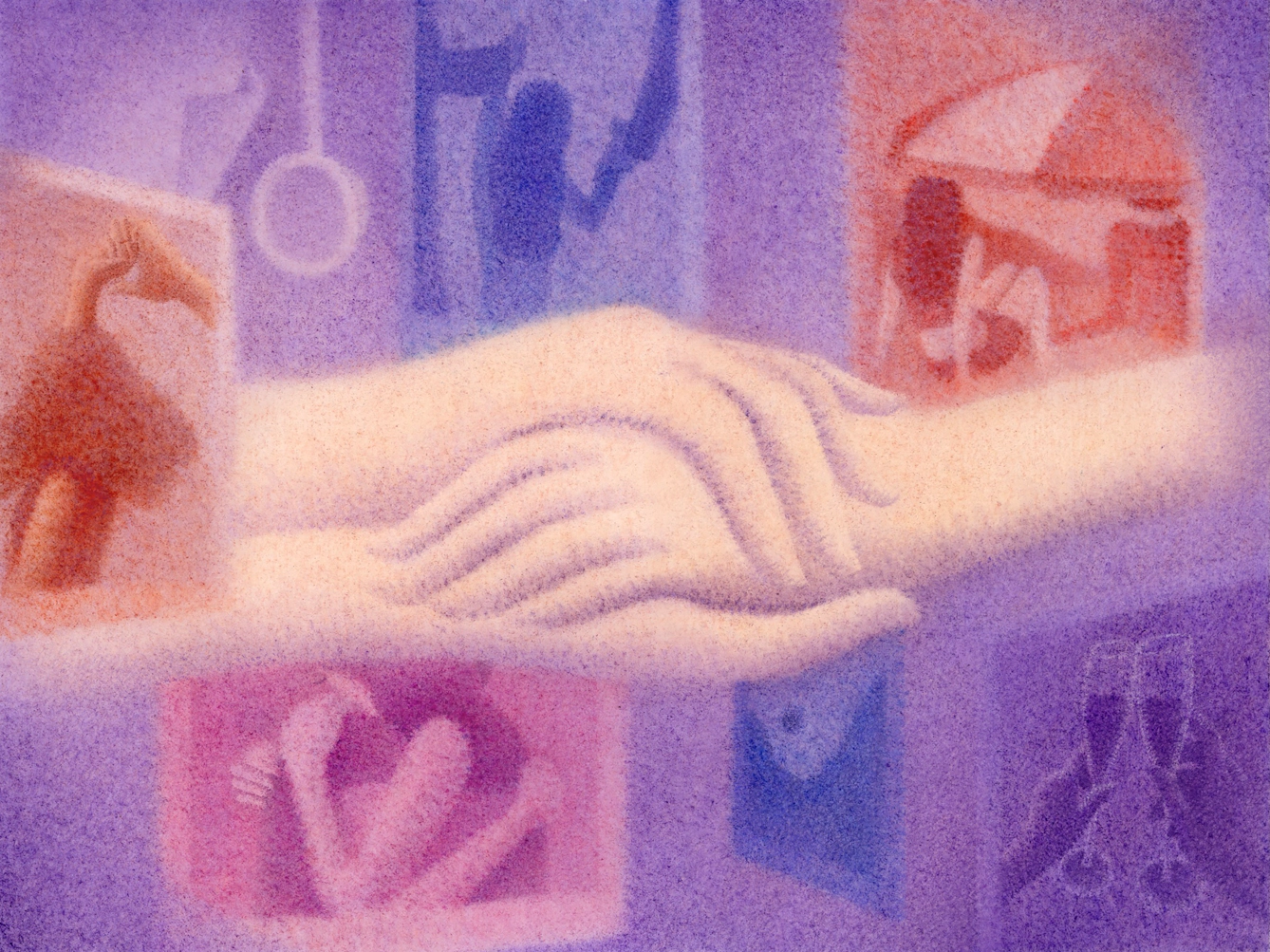
Voices Through the Silence, Artwork: Haozhe Li. © Wellcome Collection. Attribution-NonCommercial 4.0 International (CC BY-NC 4.0).
“Stuck up around my bed were Polaroid prints of my children and my husband, my family and friends, our holidays and celebrations. While I was comatose, the nurses still explained what was happening and chatted to me.”
Hearing is thought to be the last sense lost, and research suggests that many comatose patients can register and understand sounds and speech. ICU nurses always talk to patients, reassuringly and with respect, regardless of whether they can respond.
They find out about who their patients are from talking to their visitors and looking at the photographs that relatives are encouraged to bring in. Stuck up around my bed were Polaroid prints of my children and my husband, my family and friends, our holidays and celebrations. While I was comatose, the nurses still explained what was happening and chatted to me.
They also kept a diary, as they do for all unconscious patients, describing how they had cared for me during their shifts, detailing the tests done and medicines administered, noting when my family had been there to hold my hand. The first entry in my diary, written by the lead ECMO nurse, reads: “I bet you’re wondering what you’re doing all the way in London…everyone is here to support you and help you get better.”
For ICU nurses, helping a patient get better is as much about preserving their humanity as eradicating their illness. They bathed and cleaned me, brushed my teeth, moisturised my skin and lips, moved my limbs, adjusted my position and took care of my hair. The next thing I heard my nurse say, after she spoke my name and explained that I was in St Thomas’, was, “Shall we wash her hair?”
The nurses have a cupboard on the ward filled with combs, brushes and haircare products, many of which have been donated. In 2022, Ginny Wanjiro, an intensive care sister at Guy’s and St Thomas’ NHS Foundation Trust, launched an initiative to train ICU nursing staff in how to care for all the different kinds of hair of the hospital’s ethnically diverse patients. The gratitude expressed by patients and their families for this initiative has been enormous.
Having my hair washed as I was first waking up in ICU was the most generous gesture of care I have ever known. As my nurse poured warm water over my scalp and massaged in shampoo, I recalled the exact sensation of my mother washing my hair over the side of the bath when I was little.
I later learned that when I was admitted, a nurse unravelled the tangled mop I’d thrown into a bun when I started feeling ill. After combing and cleansing, conditioning and drying, she tied my hair into a neat French braid. I wasn’t conscious of her intricate attention. But amid the invasive procedures I was being subjected to, the dignity she and her colleagues afforded me as they tended to my hair was as essential as any medicine.
ICU can be a disorienting place, with its bright lights and ever-bleeping monitors, strange noises and constant activity. After I regained consciousness, the effects of the medication on my senses and thoughts were terrifying. Up to 70% of ICU patients experience confusion, anxiety, fear, delusions, and hallucinations, and this condition – known as ICU delirium – can be traumatic and sometimes dangerous. Some patients can even believe they are being harmed or tortured. I experienced bewildering auditory and visual hallucinations.
One night, beset by waking terrors, I was more scared than I have ever been. My breathing tube had been removed by then and I could speak, albeit faintly. While my nurse was taking a blood sample, I told him how I was feeling. In his culture, he explained, speaking about a nightmare lessens its power. He did more than reassure me that I was safe; he acknowledged that my fears were real to me, encouraged me to describe what I saw, and listened.
The first ICU
Intensive care has always been where the most advanced medicine, cutting-edge technology and the art of care meet. It began in its modern form in 1952, at the Blegdam Hospital in Copenhagen, during a ferocious epidemic of polio. The only mechanical ventilators in use then were the iron lung, a cylindrical tank that completely encloses the patient’s body from the neck down, and the cuirass ventilator, a shell sealed around just the torso. Both used negative air pressure to stimulate breathing by forcing a patient’s chest to expand.
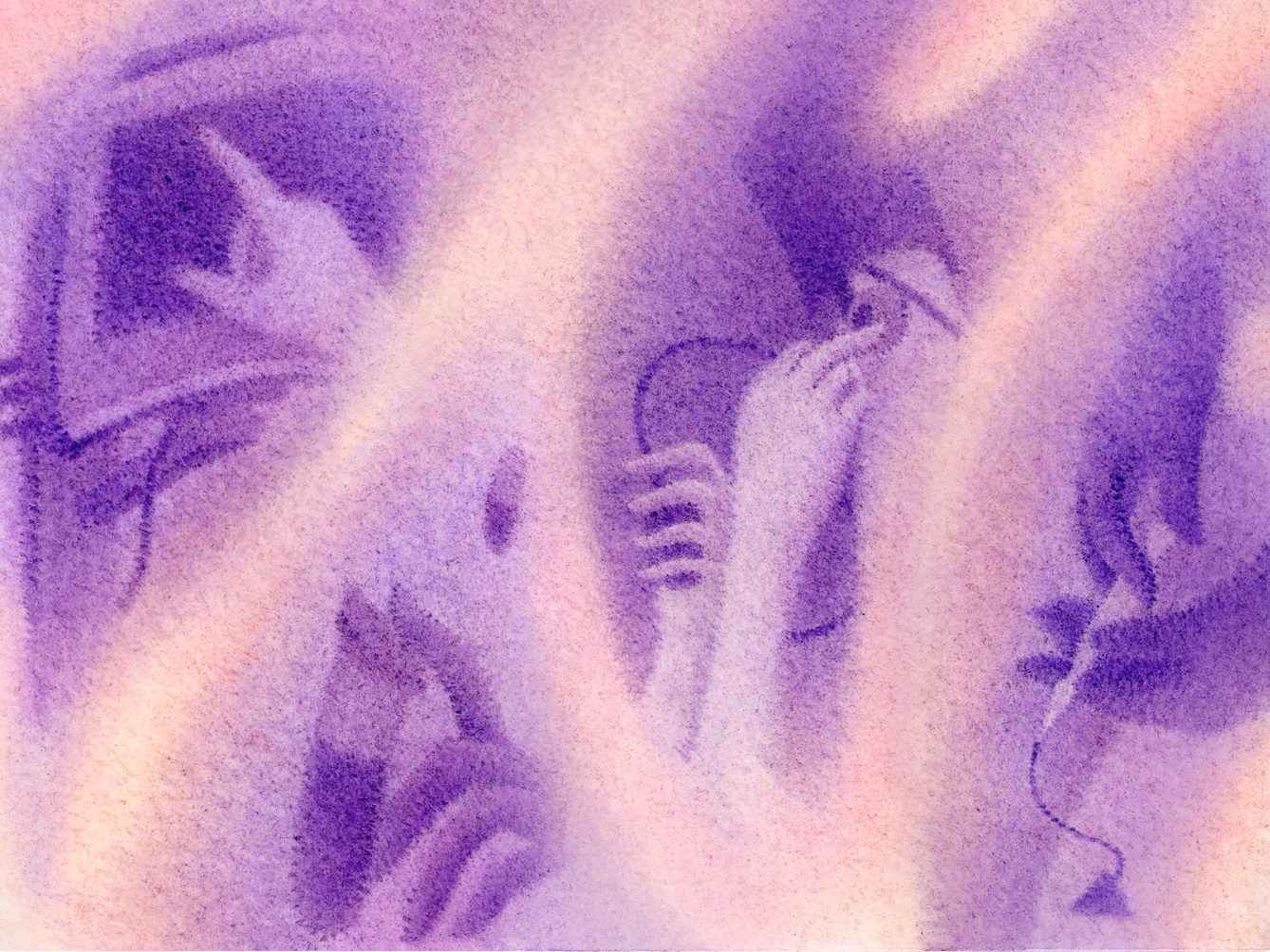
The Constant Watch, Artwork: Haozhe Li. © Wellcome Collection. Attribution-NonCommercial 4.0 International (CC BY-NC 4.0).
“The wonder of intensive care medicine, then and now, was not only in the marshalling of innovative technologies to take over the function of failing organs, but in the constant attendance provided by expert caregivers.”
Hundreds of patients, many of them children, were admitted to Blegdam with respiratory failure from July to December 1952. But the hospital only had one iron lung and six shells – nowhere near enough to support the numbers of patients being admitted each day.
Bjorn Ibsen, an anaesthetist who had studied the emerging – and at the time controversial – method of positive-pressure ventilation in the US, suggested that patients could be helped by filling their lungs with oxygen from hand-pumped bags. He also suggested that air could enter the body via another novel method – the tracheostomy – where a breathing tube is inserted through a small incision near the patient’s larynx.
Medical students were paid by the hour to assist doctors with the mammoth hand-ventilating task, and during their shifts they read their child patients’ books, played games with them and comforted them. Over the first three months, Ibsen’s system saved around 100 lives. The concept of ICU, where multiple seriously ill people are supported on a dedicated ward, 24 hours a day, with cutting-edge medical interventions, was born. At St Thomas’, the UK’s first ICU, the Mead Ward, opened in 1966.
The wonder of intensive care medicine, then and now, was not only in the marshalling of innovative technologies to take over the function of failing organs, but in the constant attendance provided by expert caregivers. In this sense, the roots of intensive care can be traced back further than 1952, to the mid-19th century, when nursing began to be recognised as an essential and skilled medical profession.
During the Crimean War, in the 1850s, Florence Nightingale instigated the principle of intensive care nursing when she ensured that the beds of the most severely wounded and unwell soldiers were positioned nearest to the nurses’ station, so they could be closely observed.
For centuries before the invention of modern nursing, the hard work of caring for people too unwell to care for themselves was associated not with expertise and knowledge but with religious charity and domestic duty, and it was overwhelmingly the work of women.
The capacity to watch over a person whose life was in stasis, and attend to them intimately, was taken for granted as part of a woman’s innate impulse to nurture others, as ingrained in her feminine nature as mothering. But nurses, as we know today, are not mothers, angels or saints. They are professionals who have spent years studying and training.
The true meaning of care
In the future of intensive care lies the radical potential of medical technology. But the most radical aspect of this speciality is its ethos of caregiving: as ICU nurses show, to care for a patient at the brink, one must meet them not as a broken body or a failing organ, but as a person waiting and hoping to live again.
To give care means to dignify life, especially in its fragility and uncertainty. In the ICU, where the fragility, uncertainty and value of life are magnified, the heights of what dedicated, skilled and properly resourced caregiving can accomplish are made more visible.
I never imagined I would end up in ICU. No-one wants to end up there. But what I and other ICU survivors have been touched by is the true meaning of care, which is the very essence of ethical medical practice. If we can imagine a utopian future for medicine, its model would be the ICU, where the holistic care of each unwell person is the cornerstone of life support.
About the contributors
Elinor Cleghorn
Author
Dr Elinor Cleghorn is a feminist cultural historian. Her first book, ‘Unwell Women: A Journey Through Medicine and Myth in a Man-Made World’, was published in 2021 and has since been translated worldwide. Her second book, ‘A Woman’s Work: Reclaiming the Radical History of Mothering’, has just been released in the UK and US.
Haozhe Li
Illustrator
Haozhe Li is an illustrator based in Atlanta. She completed her MFA in Illustration at the Fashion Institute of Technology in 2023. She explores different media, integrating traditional painting techniques into modern illustration, with a current focus on pastel. Her work combines abstract and figurative art, aiming to express clear intentions while inviting viewers to form their own interpretations. Influenced by Éric Rohmer, she carries the grainy, sensorial intimacy of analogue film into her visual metaphors of the poetic everyday. She has received awards from the Society of Illustrators, American Illustration, and the World Illustration Awards.

Nicola Williams
(she/her)
Commissioning editor
Nicola is a digital editor at Wellcome Collection with a particular interest in the history of ideas.