Like millions of people across West Africa, Tracy Egbele’s family has no access to safe tap water, and buys plastic-packaged water instead. Here she highlights the serious problems facing this fragile system, and the daily health risks people are forced to take as a result.

Water No Get Enemy, Artwork: Alexis Chivir-ter Tsegba for Wellcome Collection. Attribution-NonCommercial-NoDerivatives 4.0 International (CC BY-NC-ND 4.0).
Water is often called a gift of nature – a life-sustaining resource that’s freely available from the natural environment. But how free is it? Whether it’s sold in bottles or in sachets, the water I drink is becoming more expensive, and more worryingly, it isn’t always pure.
I live in Delta State. Here, like in other parts of Nigeria, it’s very common to see men, women and children on the roads and in traffic, balancing bowls and small coolers on their heads or shoulders, selling water sealed in square-shaped, transparent plastic sachets. Brand names decorate these sachets, often printed in blue ink.
This is what we Nigerians call “pure water”. On dry early mornings, I’ll drink a pure water sachet to hydrate me for the day. On hot afternoons, pure water cools me down.
For as long as I can remember, pure water has been the safest and most affordable way to drink. It is more than a convenience: it’s a lifeline.
The environmental toll of our daily need for pure water is plain to see in the plastic pollution which is all around Delta State: discarded sachets clog gutters and litter our roads and streets.
But over the last year, everything has changed. Contamination has begun appearing even in trusted brands of pure water, and multiple factory strikes have sent prices soaring.
Pure water is our only option
I’m from a family of six, living in a modest compound in a semi-urban part of Effurun, Delta State. Like most of our neighbours, we depend almost entirely on these sachets for drinking water.
Pure water is often sold in a bag that contains 20 plastic sachets, which now costs ₦500–600 (about 25–30p). For years, people have known that not all pure water brands are safe. There have been stories, research and warnings about unregistered or small vendors selling untreated water. To stay safe, many families, including mine, have always bought from trusted brands.
While bottled water is considered the safest – filtered, treated and regulated – it’s far less affordable. At ₦300–500 (15–25p) for 75 cl, it’s a luxury compared to a ₦50 (under 3p) 50cl sachet. For a large family like ours, switching to bottled water would mean spending an extra ₦30,000 a week – that’s approximately £15, money better spent on other essentials like food or transport.
Most compounds have access to water through wells and boreholes, since Delta State is rich in rivers and waterways. But unfortunately, many are left uncovered and easily contaminated by insects.
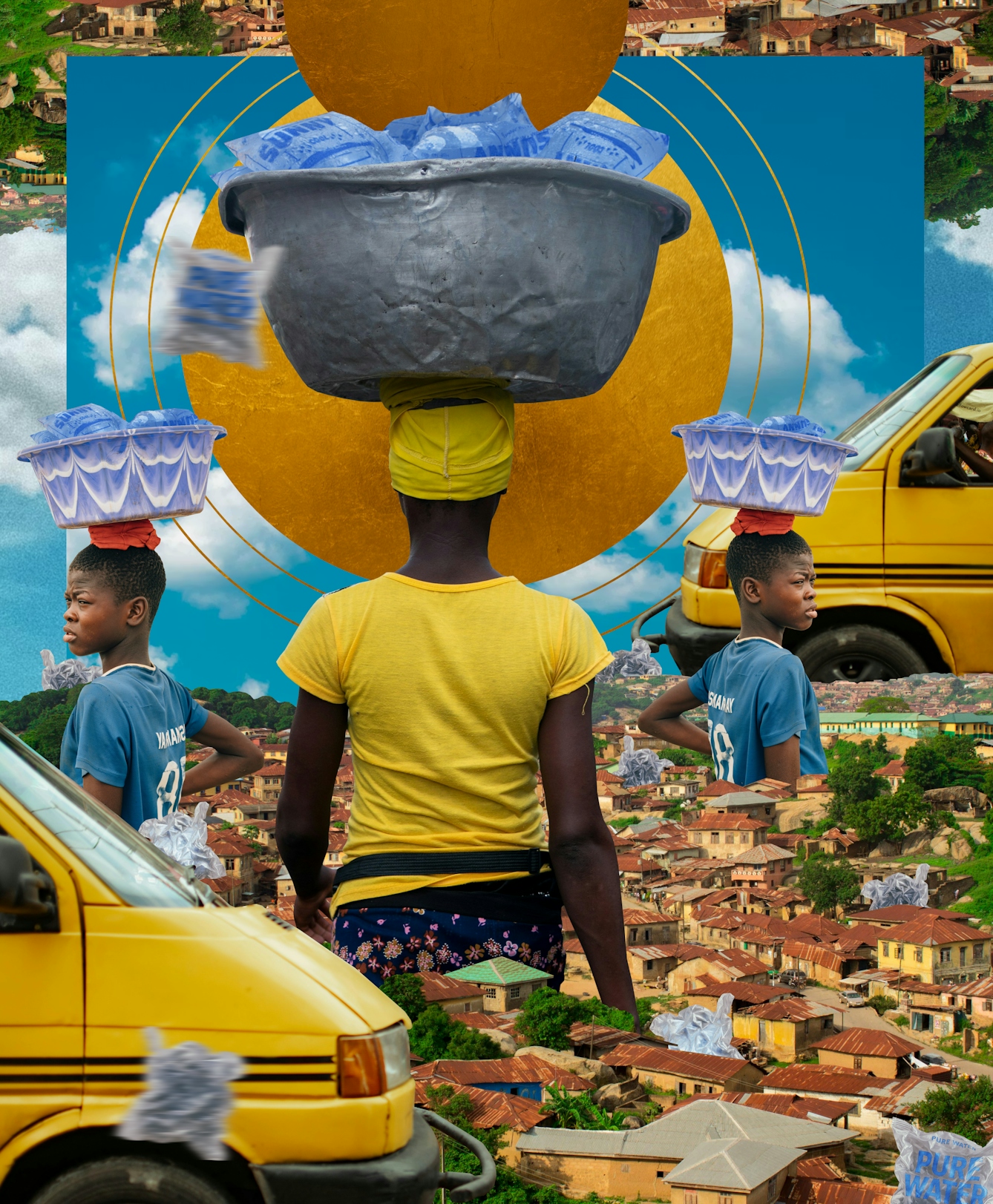
The Cost of Pure Water, Artwork: Alexis Chivir-ter Tsegba for Wellcome Collection. Attribution-NonCommercial-NoDerivatives 4.0 International (CC BY-NC-ND 4.0).
“It’s very common to see men, women and children on the roads and in traffic, balancing bowls and small coolers on their heads or shoulders, selling water.”
Our tap water comes from a borehole – it smells of damp soil. When we moved here in April 2023, a neighbour assured us it was “very clean”. Trusting their word, we drank it – until all six of us fell ill with cholera. A nurse traced the outbreak back to our tap.
We learned the hard way that many local boreholes are simply too risky to drink from, since drinking unsafe water brings the risk of diseases like typhoid, cholera and dysentery. For us, pure water isn’t just a choice – it’s our only option.
Welcoming the water truck
In our neighbourhood, nearly everyone drinks pure water. At least twice a month, a familiar sound breaks the afternoon calm: the honk of the pure water truck as it pulls up beside our compound.
Doors swing open, gates are unlocked, and people emerge from every flat – some people counting out cash, others ready with their phones for a quick transfer. We gather at the compound gate, where the seller stands at the back of his truck, asking how many bags each household wants. “Ten bags,” my father always says.
One by one, bags of sachets are offloaded and placed on the cement floor, resting against our gate and the compound fence. Then everyone carries their share inside.
It’s a small but lively ritual, repeated in nearly every compound in the area. The truck moves from gate to gate, yard to yard, serving hundreds. Watching the truck make its rounds, you realise just how much we rely on sachet water.
But these days, that reliance feels increasingly fraught with danger.
Drinking contaminated water
I can clearly remember the day I bought a bag of pure water, planning to make its 20 sachets last me the next two days. As usual, I opened the bag and pulled out a sachet. But, on a whim, I did something I’d never done before: I held the sachet up to the light and peered inside.
That’s when I saw it – a strange white object floating in the water. It was small, slender, and utterly out of place in something meant to be pure. I couldn’t stop thinking about what might have happened if I hadn’t checked. I’d always heard stories about contaminated sachets, but this was the first time I’d seen it for myself – and from a brand I’d always trusted!
“Dirty no dey kill Africa man” is a well-known Nigerian Pidgin phrase often used to express the belief that Africans are especially resilient – or even immune – to the effects of unhygienic conditions.
After that incident, I made sure my family always checked their sachets before drinking. One day we’d bought bags of water from the same trusted and popular brand as we usually did. My sister, reassured by our routine, drank her sachet without noticing anything unusual. But two days later, she began experiencing stomach pains and diarrhoea. By late evening, she was hospitalised. It was later confirmed she had been made ill by the water.
Watching her lie in the hospital bed, weak and surrounded by nurses, was terrifying. How could something as basic and necessary as drinking water be so risky? How could a brand I trusted be this negligent and expose its customers to danger? I was scared and angry. My sister’s ordeal made me wonder how many others had suffered in the same way.
“Dirty no dey kill Africa man” is a well-known Nigerian Pidgin phrase often used to express the belief that Africans are especially resilient – or even immune – to the effects of unhygienic conditions. Literally, it means “dirt doesn’t kill an African person”. It’s a saying that surfaces whenever someone is about to do something risky or unsanitary, like drinking from a sachet water brand with a questionable reputation. For many, it’s a way to shrug off concerns and justify habits that might not be safe.
After encountering contaminated pure water not once, but twice, I realised how dangerous this mindset can be. The phrase, once a badge of resilience, now feels like a dangerous myth.
Shocking factory conditions
Sadly, my sister and I are not alone. Across the country, people are falling ill after drinking pure water, especially from certain brands.
Sachet water can become unsafe in several ways. Some vendors produce water in unhygienic environments, so there’s no guarantee of safety.
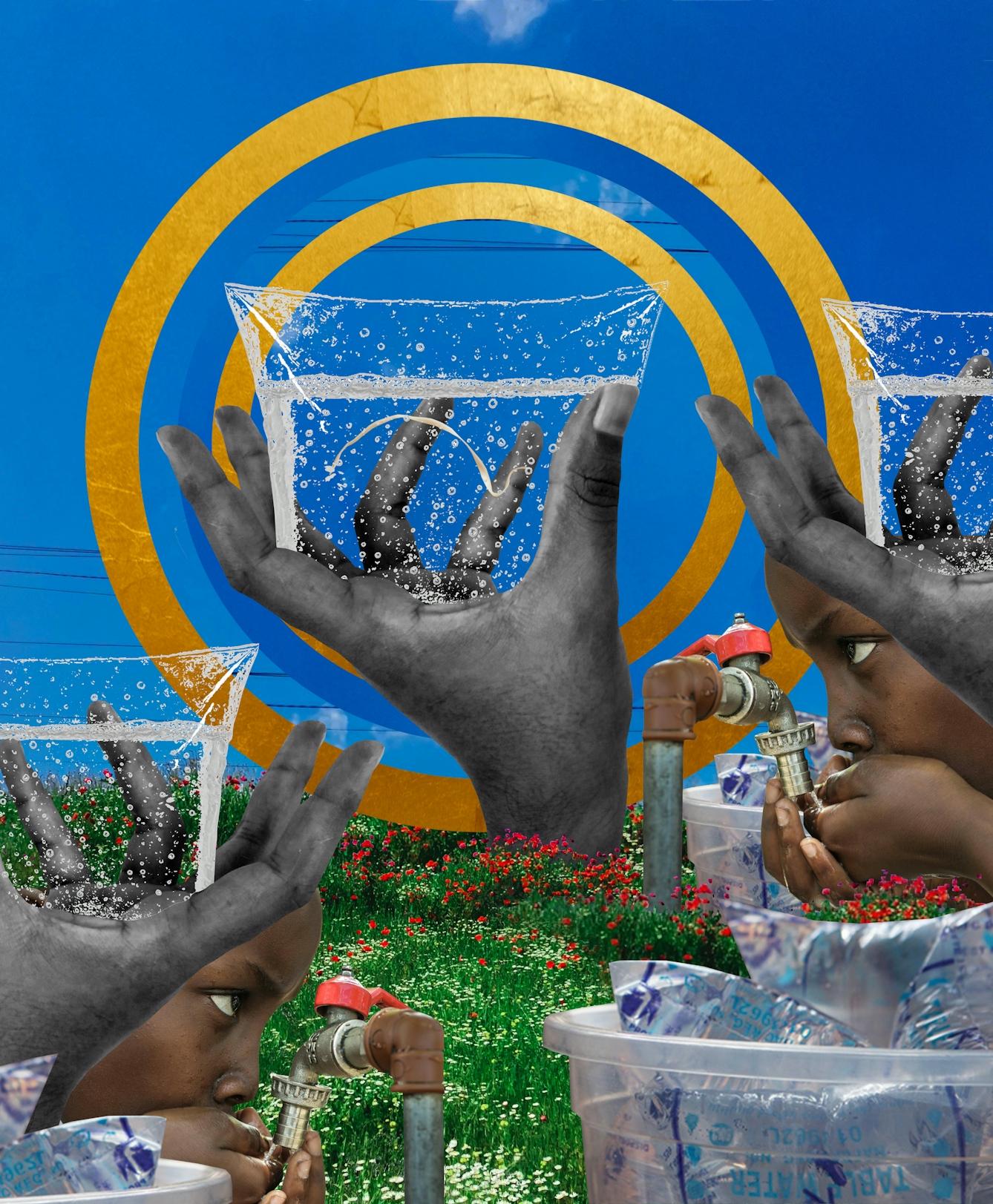
How pure is pure, Artwork: Alexis Chivir-ter Tsegba for Wellcome Collection. Attribution-NonCommercial-NoDerivatives 4.0 International (CC BY-NC-ND 4.0).
"That’s when I saw it – a strange white object floating in the water."
Even when the water itself is properly treated, poor handling and storage can still introduce risks. For example, some companies store sealed sachets on bare floors before packaging, and vendors often expose sachets to heat, sunlight, dust, or damp conditions. These practices can lead to bacterial growth inside the sachets. If sachets are left in the heat for too long, chemicals from the plastic can leach into the water, making it even less safe to drink.
To understand how widespread the problem is, I spoke directly to those on the front lines. In July 2025, a store owner in Delta State told me: “I do not want to call any brand's name, but I know some of them, that when customers drink them, they will start stooling and vomiting, and sometimes result in serious typhoid. When I notice those kinds of complaints, I stop buying from those brands.”
Investigations into small-scale water factories consistently reveal troubling conditions: dirty containers, unfiltered water and poor hygiene are all too common. Numerous reports, interviews and TikTok videos highlight these issues.
When sachet producers strike
After seeing the dangers that lurk even in trusted sachets, I thought I understood the risks we faced. But just as we became even more vigilant about what we drank, a new crisis emerged: the very availability of water was suddenly in doubt.
Within a single year, pure water factory workers across Delta State went on strike – three times – plunging us into a slow-burning emergency.
The first strike, in March 2024, lasted for three days, and was because of the economic pressures businesses were facing. It served as a warning, and was then followed by another strike in October 2024, sparked by a sharp rise in fuel prices. As one factory supervisor explained, “Pure water factories need constant electricity to work, but since that is not possible, they rely on fuel. But because the price of fuel was increased, companies could not keep up with the price, so they went on strike.” For two weeks, production came to a standstill, he told me.
A few months later, another blow landed: a third strike, this time lasting a week, driven by the soaring cost of plastic packaging – an essential material for sachet water. With costs spiralling, many factories simply could not afford to keep operating.
These events did more than disrupt daily routines – they triggered real panic. While my family was fortunate, thanks to my father’s habit of stocking up on sachet water, many of our neighbours were not. Scarcity forced people into desperate choices. I watched as residents in our compound went from flat to flat, hoping someone could spare even a single sachet. One neighbour confided to my dad that, with no other options, he had to drink our compound’s tap water at night, fully aware of the risks. Others bought whatever sachets they could find, regardless of quality or safety.
The local shopkeeper described how some, including herself, resorted to “boiling tap water” before drinking it. These makeshift solutions were a stark reminder of our vulnerability.
As supplies dwindled, the price of pure water soared and has yet to return to previous levels.
“A bag of pure water used to be ₦100, then it moved to ₦150 and later ₦200. Now, one bag of pure water is ₦500. Some companies sell for ₦600,” the shopkeeper explained. “Although people complain, they are still buying it. The current prices are not fair; many people cannot afford them, but they are still trying because we cannot do without water. Also, we now buy less than we used to,” she added.
The reality now is a perfect storm: repeated factory strikes, shrinking supplies, soaring prices, and the ever-present threat of contamination.
What made these strikes so alarming was their frequency. In the previous decade, I can recall only three other occasions when pure water factories went on strike. Now, with two strikes in a single year, it feels as if something fundamental has shifted, making it impossible to ignore how fragile our access to safe water truly is.
The cost of survival
Growing up, I was taught that water is life. But these past years have shown me that the water we once trusted can just as easily bring illness, or worse, take life itself. The reality now is a perfect storm: repeated factory strikes, shrinking supplies, soaring prices, and the ever-present threat of contamination. It’s turned something as basic as drinking water into a daily calculation fraught with doubt and fear.
Each sachet I open becomes part of our plastic waste problem – a persistent reminder of the price we pay just to survive. That price sits heavily with me, knowing that what sustains us is also harming the place we call home. But what makes this compromise even more bitter is the realisation that the environmental sacrifice isn’t even buying us real safety.
I’d love to see greater investment in reliable water systems and quality boreholes, alongside stricter regulation and quality control for sachet water, to improve safety. Introducing biodegradable packaging could also reduce environmental harm.
The pure water strikes have taught me just how vulnerable we are when our most basic needs depend on fragile systems. It’s easy to waste and take clean water for granted until you’re rationing it or falling sick from it. What we really need isn’t just more “pure water”, but a way to make water truly pure and accessible for all of us.
About the contributors

Tracy Egbele
Author
Tracy Egbele is a writer from Nigeria exploring health, the environment, food and social relationships. She's interested in how everyday experiences shape personal and collective life, and what it means to live in contemporary Nigeria.

Alexis Chivir-ter Tsegba
(she/they)
Artist
Alexis Chivir-ter Tsegba is an award-winning visual artist whose practice is grounded in digital collage and illustration and extends across video, sculpture and installation. She is a versatile designer with a broad range of experience working commercially across industries, including music, film, textiles, branding, publishing, healthcare, and non-profit organisations. In 2022, she was recognised by the Victoria and Albert Illustration Awards for her contributions to illustrated journalism, and her works have been exhibited internationally.

Vanesha Kirita Singh
(she/her)
Commissioning editor
Vanesha is a Digital Editor at Wellcome Collection, specialising in storytelling that centres lived experience and social justice. Her practice is shaped by decolonial and anti‑imperial politics, rooted in a deep commitment to collective liberation. She works to create caring, supportive spaces for writers and artists, and strives to empower those who are misrepresented and excluded from mainstream discourse. Vanesha is particularly drawn to storytelling that explores solidarity and resistance. Her personal research focuses on Caribbean histories, especially the system of indentureship and its ongoing legacies.