Drinking water was risky in the Middle Ages. But that didn’t stop people from drinking it – warily, enthusiastically, and sometimes with disgusting consequences. Historian Katherine Harvey explores the sometimes strange beliefs medieval people had about water, and how they informed their methods for staying healthy.

In spite of the risks, medieval people did drink water, Artwork: Klara Jan for Wellcome Collection. Attribution-NonCommercial-NoDerivatives 4.0 International (CC BY-NC-ND 4.0).
The 13th-century Icelandic Saga, ‘Morkinskinna’, chronicles the history of the kings of medieval Norway. But it also tells the story of a wealthy Icelandic woman named Ingibjorg, who drank some spring water and, soon afterwards, fell ill: her belly swelled up so that she looked pregnant, and she suffered bouts of fever, thirst and intense pain. Eventually, a family friend suggested that, because the spring was located in “an area much infested by worms”, she had likely “swallowed some little worm that ha[d] grown in her belly”. To recover, she must deprive herself of drink before visiting a waterfall, so that the thirsty little creature could crawl out of her mouth.
Ingibjorg was extremely unlucky, but her story was not unique. In 12th-century Yorkshire, Aelred of Rievaulx retrieved a tiny frog, unwittingly swallowed in a drink of water, from a sick man’s mouth. The patient vomited up “glutinous humours and pus horrible beyond measure” for the rest of the day, after which he was completely cured.
Safety precautions
As these examples show, medieval people knew that drinking water could be dangerous. And so, although they knew nothing of the dangers posed by bacteria, they treated it with caution – especially when they had to drink from an unfamiliar source. If the quality of a water supply was in doubt, there were helpful tests that could be performed to check it was safe. For example, according to an encyclopedia by Bartholomew the Englishman that was popular in Europe, an egg could be used to determine whether water was fresh (it would sink) or brackish (slightly salty – it would float). Alternatively, the better of two waters could be identified by soaking a linen cloth in each, with the one that dried fastest being the best.
The effectiveness of these methods is questionable, but boiling – which seems to have been common practice, especially in elite households – could certainly help to make dangerous water safe. The 14th-century Valencian physician Peter Fagarola warned his sons, who were studying in Toulouse, that both the local wells and the River Garonne produced ‘bad’ water which must be boiled. Similarly, a late 15th-century Flemish guide recommended that the rainwater, which urban-dwellers collected in tubs and cisterns, should be boiled “because it undoes the putrefaction” (decay).
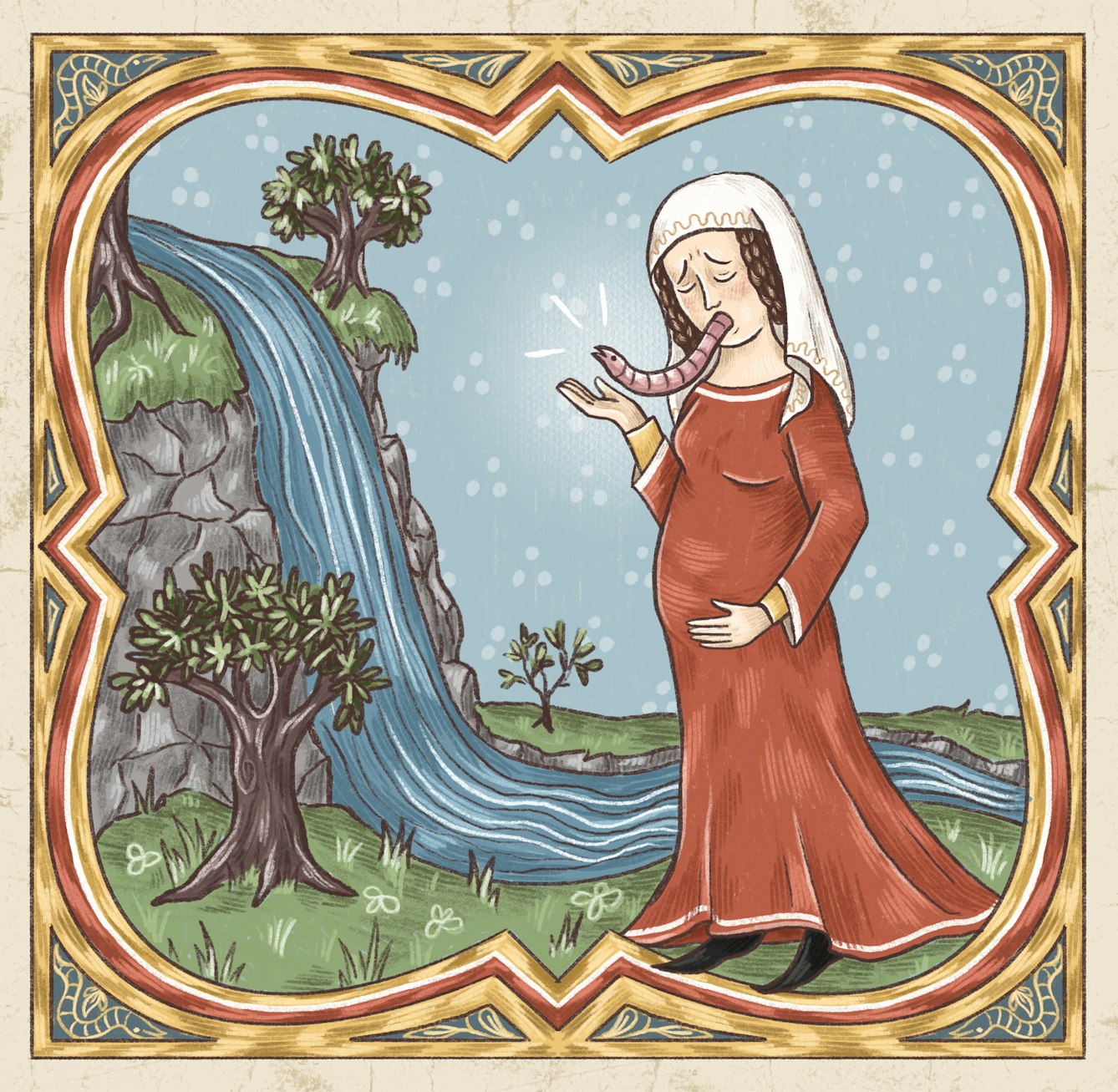
A thirsty little creature, Artwork: Klara Jan for Wellcome Collection. Attribution-NonCommercial-NoDerivatives 4.0 International (CC BY-NC-ND 4.0).
“To recover, she must deprive herself of drink before visiting a waterfall, so that the thirsty little creature could crawl out of her mouth.”
Concerns about water safety were particularly common among travellers, to the extent that the English physician John de Gaddesden suggested avoiding it altogether. He worried that unfamiliar waters would upset the stomach and cause overeating. Other experts suggested boiling water, straining it through a cloth, or adding vinegar, wine or theriac (a popular medieval cure-all that contained multiple ingredients, including opium) to make it ‘safer’. But only the wealthiest travellers would have been able to follow the advice given by Geoffrey Caldwell, a 15th-century Londoner who wrote a travel guide based on his experiences in the Holy Land. He suggested that his readers should buy barrels of water and wine to take with them.
Temperature was also a risk-factor, as many people believed that drinking cold liquids in hot weather could prove fatal(view in catalogue). This practice was thought to have killed both the Northamptonshire peasant Nicholas Bernard (d. 1358), whose inquest found that he died after drinking cold stream water while mowing a meadow on a very hot August day, and Anthony, a healthy youth from Parma who drank some very cold water while travelling on a scorching hot day. According to the physician Antonio Benivieni(view in catalogue), this young man died because “the extreme coldness of the drink had attacked his heart severely”.
Wine over water
Water was rarely the drink of choice for the wealthy, whose ‘delicate constitutions’ could handle only the finest food and drink. Michele Savonarola, an Italian court physician writing in the 1450s, considered water to be the “vilest of all beverages” – that is, a low-status drink that only the working classes could stomach.
Most people believed that they would be better off with alcoholic drinks, which they thought not only quenched thirst but were also highly nutritious. Beer and ale were an integral part of the common diet, but wine was believed to be the healthiest drink of all. In terms of the medical theory of the time, it warmed and moistened the body, improving both physical and mental health, and was strongly recommended by doctors. In a later work on pregnancy, Savonarola suggested that water was “not good for the foetus” and could even affect the sex of the baby. He recommended that mothers-to-be drink wine instead of water, if they were hopeful for a boy.
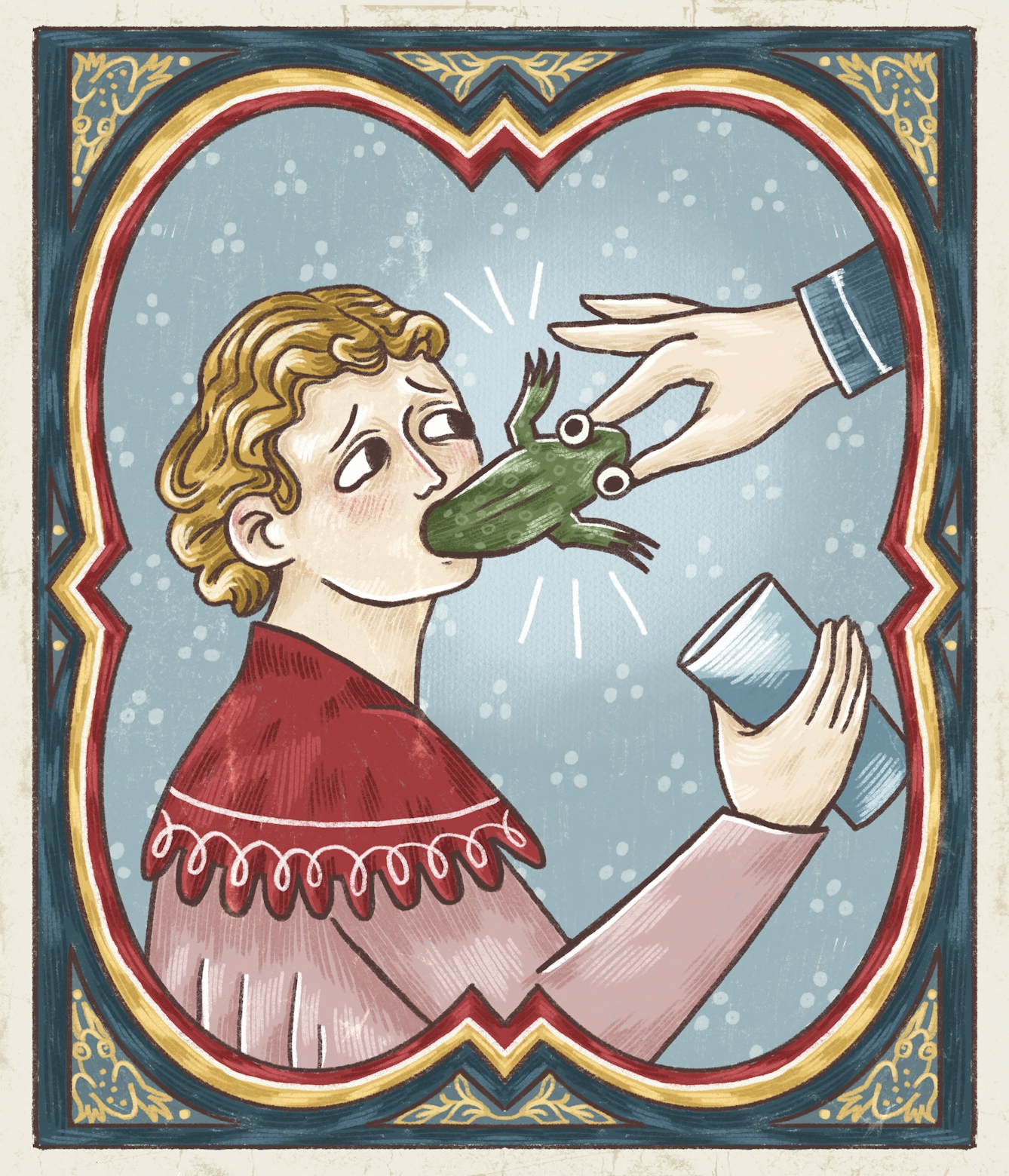
A tiny frog swallowed in a drink of water, Artwork: Klara Jan for Wellcome Collection. Attribution-NonCommercial-NoDerivatives 4.0 International (CC BY-NC-ND 4.0).
“In 12th-century Yorkshire, Aelred of Rievaulx retrieved a tiny frog, unwittingly swallowed in a drink of water, from a sick man’s mouth.”
Water enthusiasts
And yet, in spite of the risks, medieval people did drink water. Many consumed it with wine, which was often heavily diluted, while others actively preferred water. Saintly bishops such as Wulfstan of Worcester (d. 1095) and Hugh of Lincoln (d. 1200), who renounced worldly comforts for the sake of the soul, were much admired for choosing to drink pure water instead of the fine wines served at their table.
But while these holy men drank water as a form of self-denial, some people saw water as a healthy option. King Duarte of Portugal (r. 1433–8) was a particularly enthusiastic advocate. He had observed that women and Muslims avoided wine and instead drank water, and that they seemed to avoid illness and live longer than wine-drinkers. The poet Petrarch (1304–74) was another enthusiast: he recalled that he had drunk water for the whole of his childhood and adolescence, and found it helpful when he was ill.
Water systems
Medieval people considered a clean water supply to be a key feature of the healthy home. According to one 15th-century Flemish guide to healthy living, the ideal house would have a reliable supply of “pure, sweet, running water, that in winter quickly turns cold and in summer swiftly warms, flowing past green pastures and fields”. Water which was in any way enclosed, or even “too much deprived of air by many trees”, must be avoided, because of the risk to the inhabitants’ health.
Outside of such utopias, most people relied on communal facilities. Many urban medieval settlements developed complex water and sanitation systems to meet residents’ needs. In 13th-century Ypres, for example, a network of reservoirs, pipes and cisterns brought in water from outside the city, while wastewater from workshops, bathhouses and latrines was flushed straight into the fast-flowing Ieperlee canal via designated sewers. At around the same time, Montpellier’s civic authorities constructed several fountains, with associated pipe and gutter systems. These seem to have been well maintained, and there were strict rules about things which could not be washed in the drinking trough – including bedsheets, fish and feet.
Ideas about water have changed radically over the centuries, so that we no longer fear cold drinks or choose wine as the healthier option. But it seems that we have always understood that safe, clean drinking water is essential for life.
About the contributors

Katherine Harvey
Author
Dr Katherine Harvey is a medieval historian based at Birkbeck, University of London. She is the author of ‘The Fires of Lust: Sex in the Middle Ages’ (2021), a Sunday Times Paperback of the Week, and ‘The Medieval Guide to Healthy Living’ (2026). Her writing has appeared in publications including BBC History Magazine, History Today, The Sunday Times, The Times Literary Supplement, and The Atlantic.

Klara Jan
Artist
Klara Jan is an illustrator from Slovenia. She finished her MA in illustration with an emphasis on scientific illustration, but in recent years she’s been exploring the visual language of medieval manuscripts, translated for modern audiences and modern themes.