When the end of a life draws near, the reassuring presence of hospice and palliative care workers can help families make sense of what is happening. Through the stories of six professionals, photographer Anna Gordon reflects on misconceptions about dying, the difficult conversations families avoid, and the quiet, deeply human moments that shape our final days.

There are many ways to die. Suddenly and traumatically, with little or no warning. Or as the result of a terminal illness, a lifelong condition or the effects of ageing on our bodies.
Where there’s warning and time, it’s possible that this moment will be skilfully and compassionately attended by one or more of the UK’s palliative care professionals. It’s only when a friend or relative or even we ourselves enter this final stage of life, that these individuals appear and shepherd us through a process that in modern-day life, we’re perhaps more removed from than ever before.
To bring these reluctant conversations about how we die into the open, I spent time with six hospice care workers from around England. I made photographs of their working days and listened to their personal reflections and experiences of end-of-life care.
Their words explore the importance of comfort over medical intervention, the emotional and practical challenges families face, and the value of open conversations about death and dying. Together they show the important role dignity and choice play in creating meaningful moments during the final stages of life.
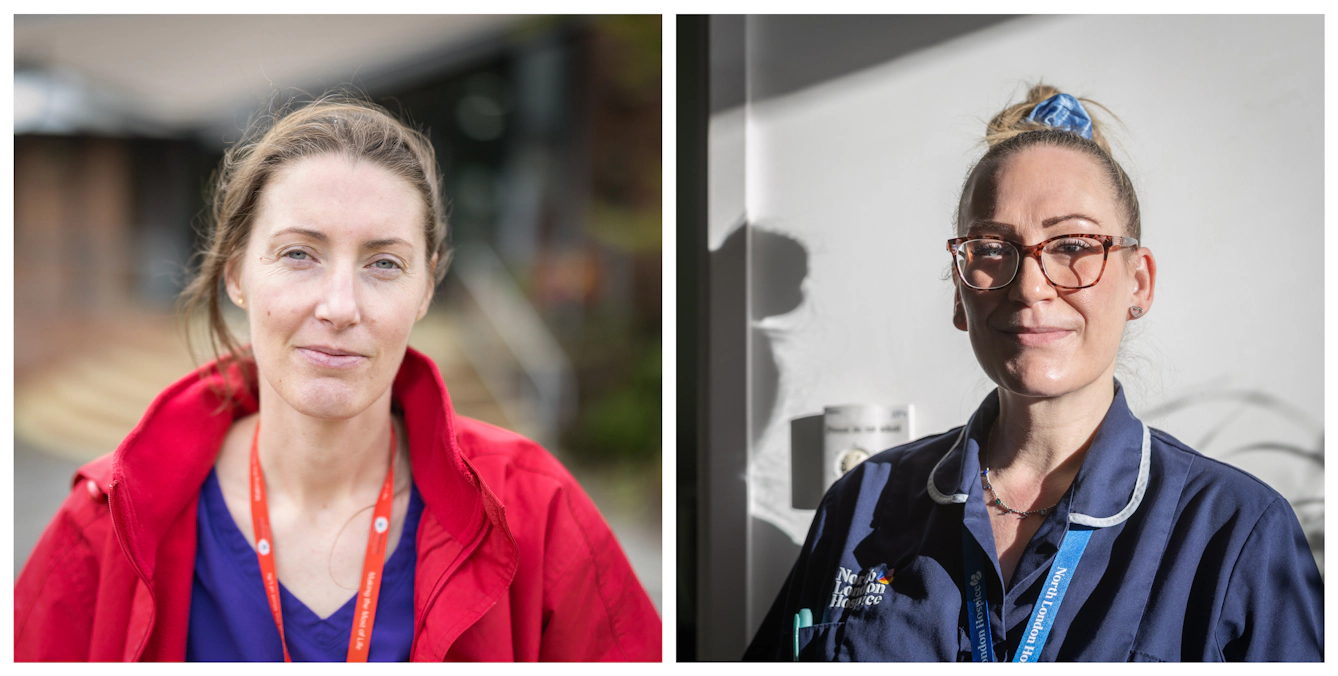
Left: Corinne Collier, Head of Community Supportive Care at Hospice at Home, East Lancashire. Right: Sarah Wilsher, Community Associate Clinical Nurse Specialist at North London Hospice. © Anna Gordon for Wellcome Collection.
Left: Corinne Collier, Head of Community Supportive Care at Hospice at Home, East Lancashire. Right: Sarah Wilsher, Community Associate Clinical Nurse Specialist at North London Hospice.
Misconceptions
There are many myths and misconceptions about hospice care. Most of us have a reasonably good idea of the stages and processes of birth. Death has its own stages and processes too, but in general we’re not so familiar with them.
“Before I worked in palliative care,” remembers Sarah Wilsher, a Clinical Nurse Specialist working in the North London Hospice, “my nan was in hospital, in intensive care and she was very unwell. I remember sitting with her, just wanting to shovel food into her mouth.
"Now as a professional I see this same desire with relatives who want to feed their loved one, to keep them going. When actually… when the body starts to die, it doesn’t need sustenance, it doesn’t need water. It needs comfort and pleasure.”
Corinne Collier, Head of Community Supportive Care in East Lancashire, feels that much of the misunderstandings surrounding death aren’t helped by the depictions of death and dying portrayed in films and TV dramas.
"Overly dramatic and unrealistic, they leave an impression of fear on the viewer. This can be people’s first and only exposure to death until they experience the death of a close friend or relative; subconsciously, that is what they expect to happen.
“In real life the act of dying is usually a very peaceful transition, not like you often see on TV,” explains Corinne. "It’s true that sometimes things go differently, and then it’s our job to be there, to keep things calm and do the best we can for everyone involved.”
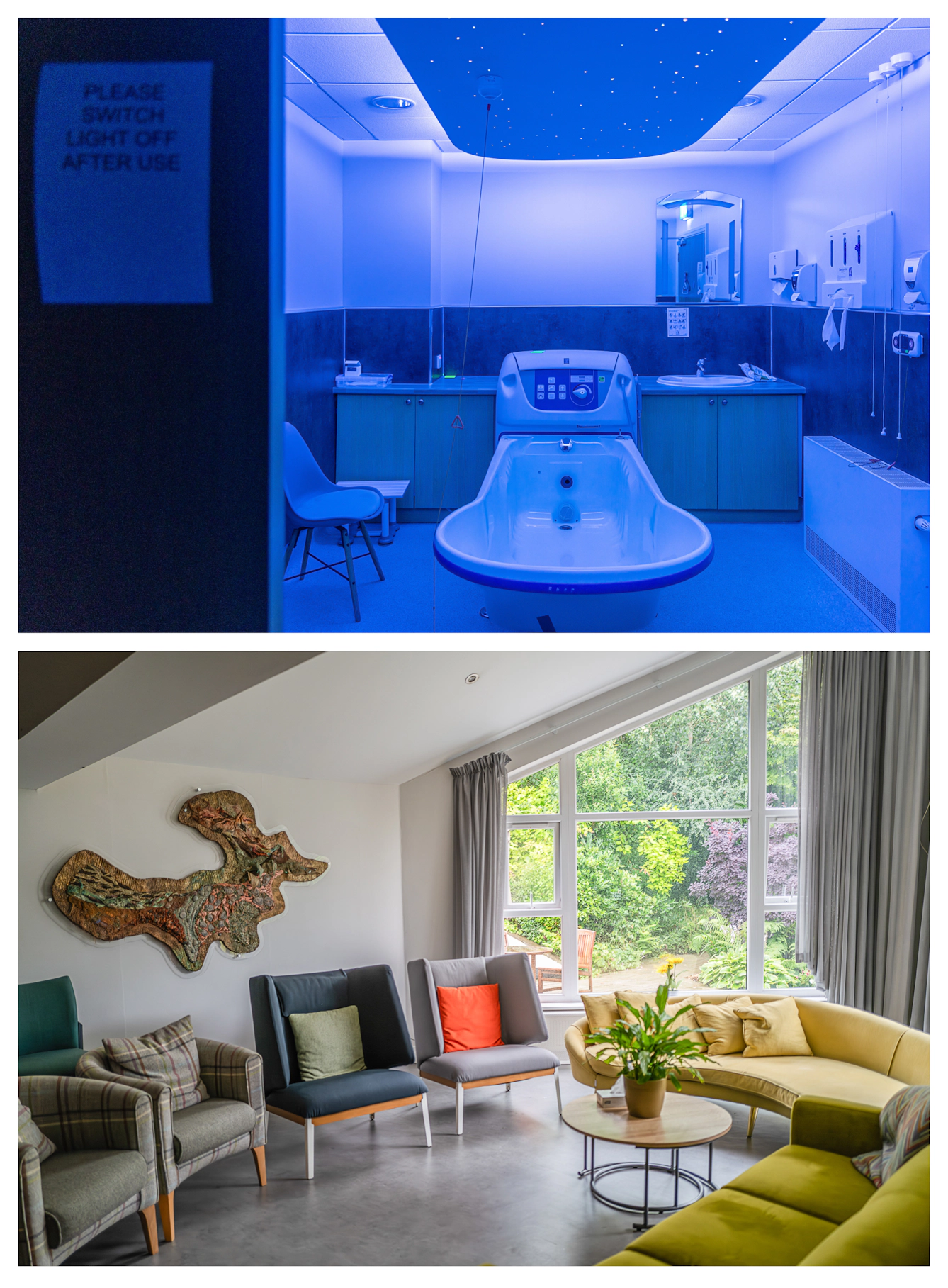
The bathing room (top), which provides a therapeutic service for patients, and the in-patient lounge (bottom) where families can talk and relax, at the East Lancashire Hospice. © Anna Gordon for Wellcome Collection.
The bathing room (top), which provides a therapeutic service for patients, and the in-patient lounge (bottom) where families can talk and relax, at the East Lancashire Hospice.
Hospice care isn’t only for elderly patients and they aren’t depressing places. “We’re not all wandering around crying. We’re not all dressed in black. It’s not all miserable,” says Wendy Freeman, an Enhanced Care Home Educator at the Isabel Hospice in Hertfordshire.
At the East Lancashire Hospice, there’s a dedicated bathing room where patients can have an assisted bath, surrounded by calming blue ambient lights.
“It is a common myth that hospices are sad and sombre environments.” Corinne says. “But you should come to the hospice, because there is so much laughter. There is so much joy. And everybody’s job is just about making people’s quality of life as good as possible for that patient and their family.”
Damian, who’s 35 and has chordoma, a rare type of bone cancer, spent six weeks at the hospice. “When I first got there, I didn’t really know what to expect. The staff were like, ‘If you have a games console, bring it in. If you’ve got a pet, you can have your pet visit. Re-arrange your room however you want it.’ They were so accommodating. They made that room a home away from home for the time I was there, and it was just unreal.”
After his stay at the hospice, the staff managed Damian’s transition to be cared for back in his own home. Much of hospice care work is community-based, supporting patients living with terminal or life-limiting conditions at home. They are also a support and counsel for the friends and families that surround the patient.
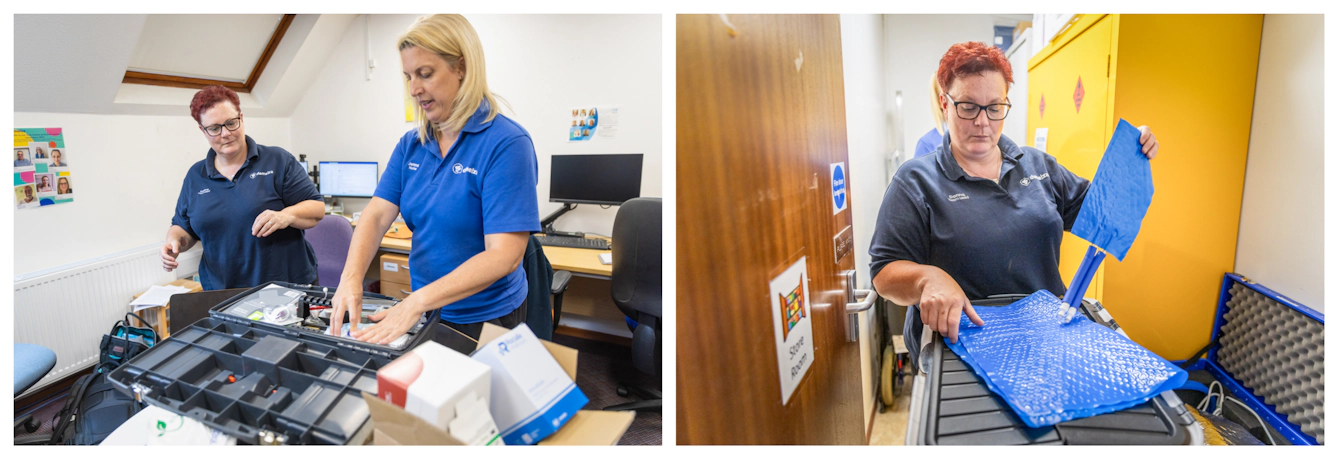
Donna Mole and Jenna Heritage, paediatric palliative care nurses at Demelza Children's Hospice in Sussex, prepare for a home visit. © Anna Gordon for Wellcome Collection.
Donna Mole and Jenna Heritage, paediatric palliative care nurses at Demelza Children's Hospice in Sussex, prepare for a home visit, including checking the End of Life medical box (left) and packing the Cuddle Cot (right). The Cuddle Cot is a cooling device placed under a child's body after death, allowing parents to spend more time with their child.
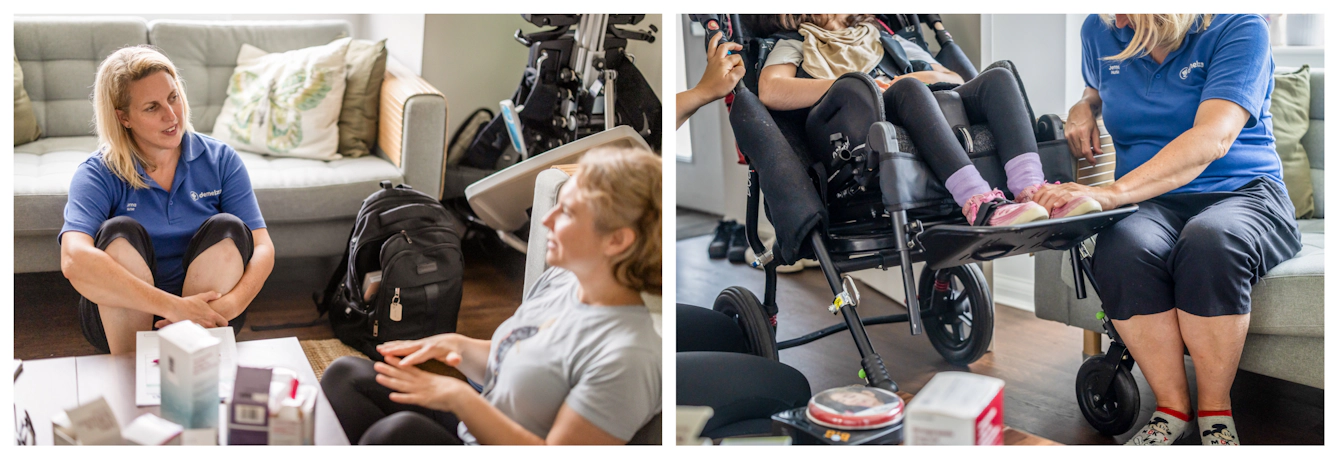
Jenna on a home visit to support Neslihan and her daughter. © Anna Gordon for Wellcome Collection.
Jenna on a home visit to support Neslihan and her daughter.
Preparations, memory-making and wish-fulfilment
For individuals and families where there is time to choose hospice care, whether in the home or in a dedicated hospice, all the nurses encourage difficult but honest conversations to take place early. Patients can discuss where they would like to die, who they’d like around them and any last wishes.
Wendy explains: “Some people have a belief that if you talk about it, it’s going to speed it up, which isn’t true. Talking about it helps get all these things into the open and understood, so that you can then do the best for the person. It gives you the time to be the husband, the wife, the child, rather than taking on all these worries and trying to solve them all at the last minute, which you are never going to do.”
“Memory-making is a good conversation starter, when people find it difficult to talk,” says Corinne.
Damian agrees: “The hospice team really opened a lot of doors for me, especially focusing on the children. They gave me two memory boxes, where I’m going to put letters and birthday cards. They even gave me two teddy bears which I can record a voice note into, things I’d never have thought of.”
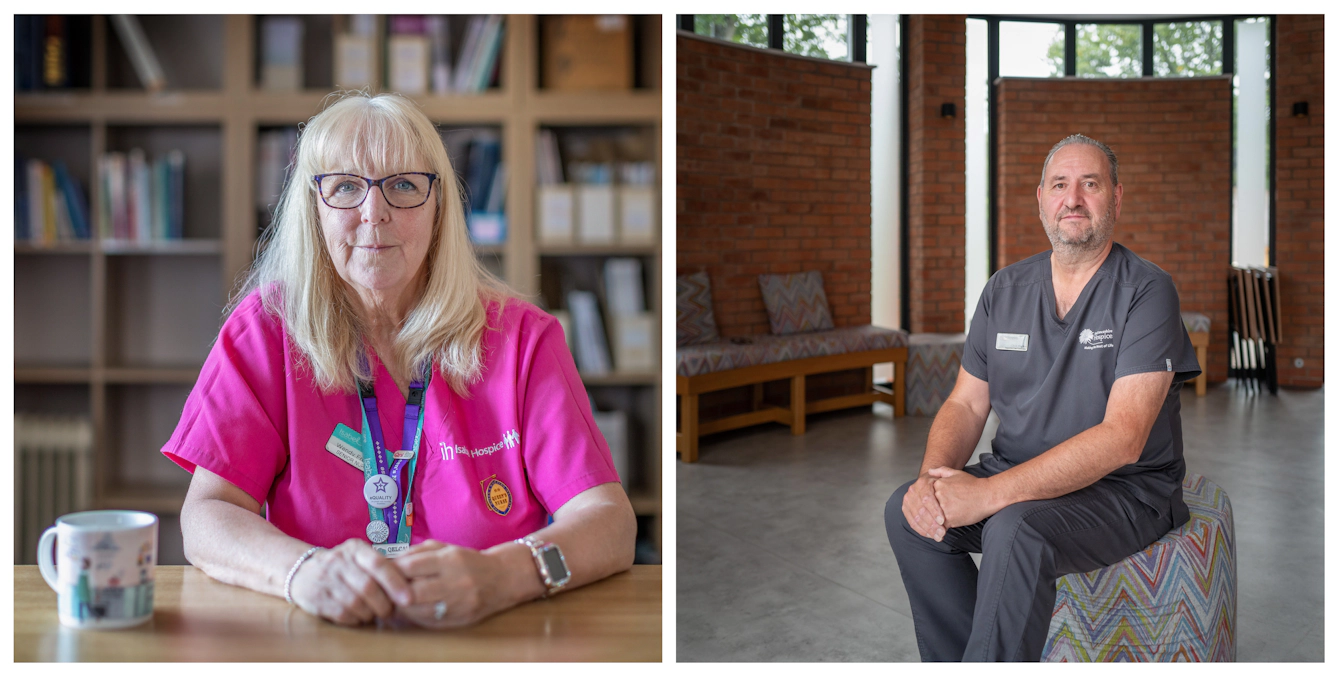
Left: Wendy Freeman, Hospice Enhanced Care Home Educator at the East and North Herts Isabel Hospice. Right: Chris Hughes, Team leader at the East Lancashire Hospice. © Anna Gordon for Wellcome Collection.
Left: Wendy Freeman, Hospice Enhanced Care Home Educator at the East and North Herts Isabel Hospice. Right: Chris Hughes, Team leader at the East Lancashire Hospice.
“Nothing is ever too much trouble for our patients,” Corinne adds. “It might not be something that we’ve ever done before, but if somebody asks for it, we’ll do our absolute best to make it happen. If that means getting a horse into the hospice or hosting a wedding, if we can do it, we will. Whatever people want.”
Jenna Heritage, a Palliative Care Nurse at Demelza Hospice Care for Children in Sussex, remembers one of her young patients: “I asked him, ‘What would be on your bucket list?’ He said, ‘To meet Lewis Hamilton.’ So, I came back to the office and said, ‘Does anyone know Lewis Hamilton?’ and our fundraiser at the time said, ‘It’s funny that you should say that, Jenna.’
"Next thing, we took this young boy to the British Racing Drivers’ Club Annual Awards ceremony, and he had a 15-minute audience with Lewis Hamilton who was lovely. The boy died two weeks later. It must be 15 years ago, now. Sometimes it can be as massive as that, or it can be as tiny as getting them home for an hour before they die.”
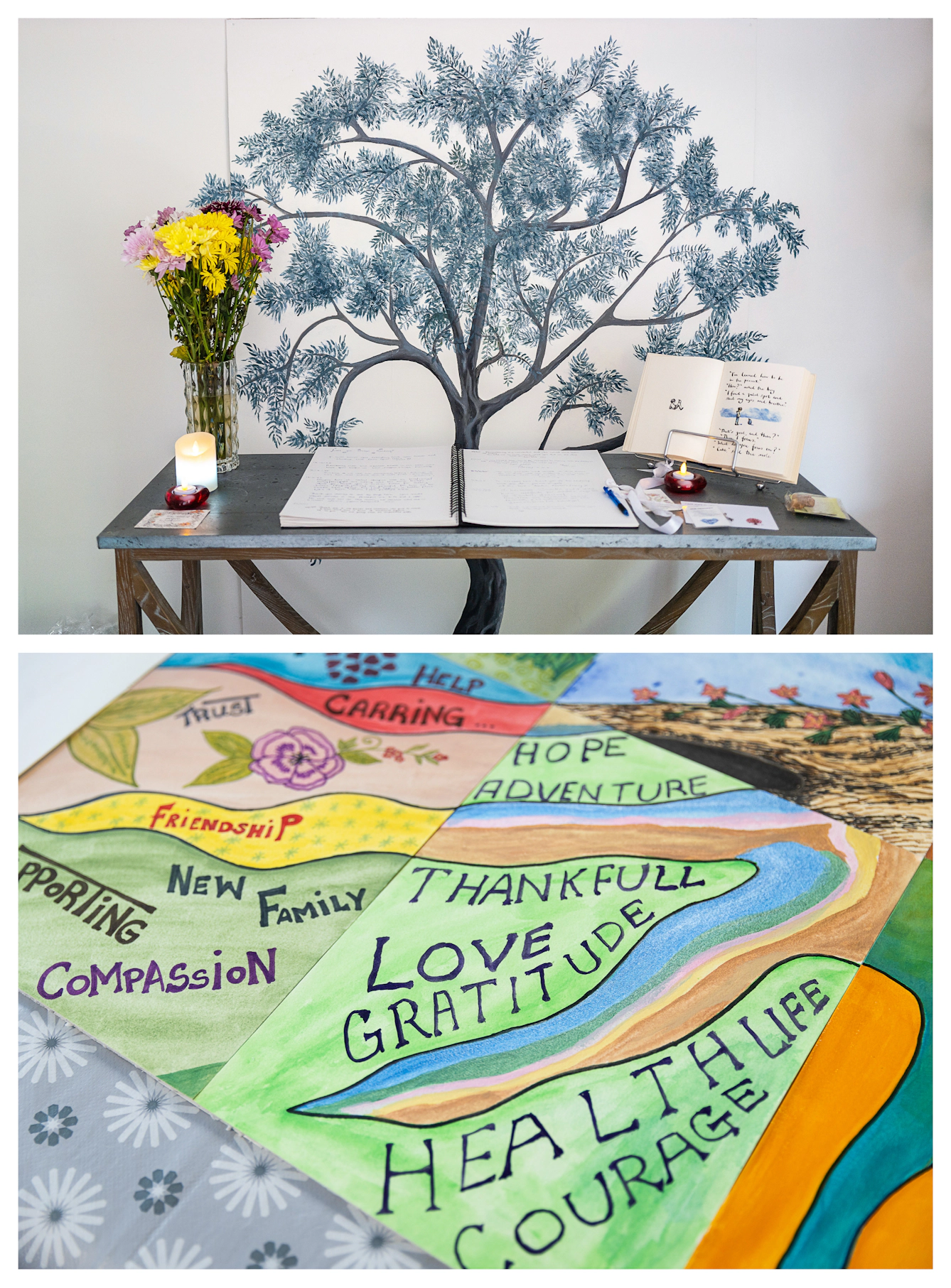
Top: The commemoration table at East and North Herts Isabel Hospice. Bottom: Tree of life, made by patients and the wider community at East Lancashire Hospice. © Anna Gordon for Wellcome Collection.
Top: The commemoration table at East and North Herts Isabel Hospice. Bottom: Tree of life, made by patients and the wider community at East Lancashire Hospice.
Living with death
Many different types of people work in the hospice and palliative care sector, from different backgrounds. All have varying ways of coping with the emotional pressures the work brings.
Chris Hughes works for East Lancashire Hospice as a Team Leader, having previously worked in construction for 40 years. “I remember sitting in an HS2 meeting during Covid and thinking, ‘There must be more to life than this.’ I’d spent 40-odd years fighting for the corporate dollar, which I thought was the most important thing in life. In changing jobs I’ve completely flipped that on its head. It’s people that are the most important thing to me now.”
Wendy describes how she felt when she first started working in hospice care: “I obviously did take things home with me, much more than I do now. But with experience, I now turn the music on in my car, open the windows, sing along all the way home.”
Donna Mole, a paediatric palliative care nurse also working at Demelza Hospice Care for Children admits: “I’m that woman who jumps in the sea at six in the morning all year round. I remember one time, I’d had an end-of-life case. It was quite stressful. I think I left the patient’s family home at about two in the morning. In my mind I was on auto-pilot driving home. Until suddenly I pulled up in the car park on the beach.
"Surprised, I thought to myself, ‘Okay, maybe I needed to come here.’ So I just sat on the beach for an hour at two o’clock in the morning and just chilled. Then I went home. And it was alright.”
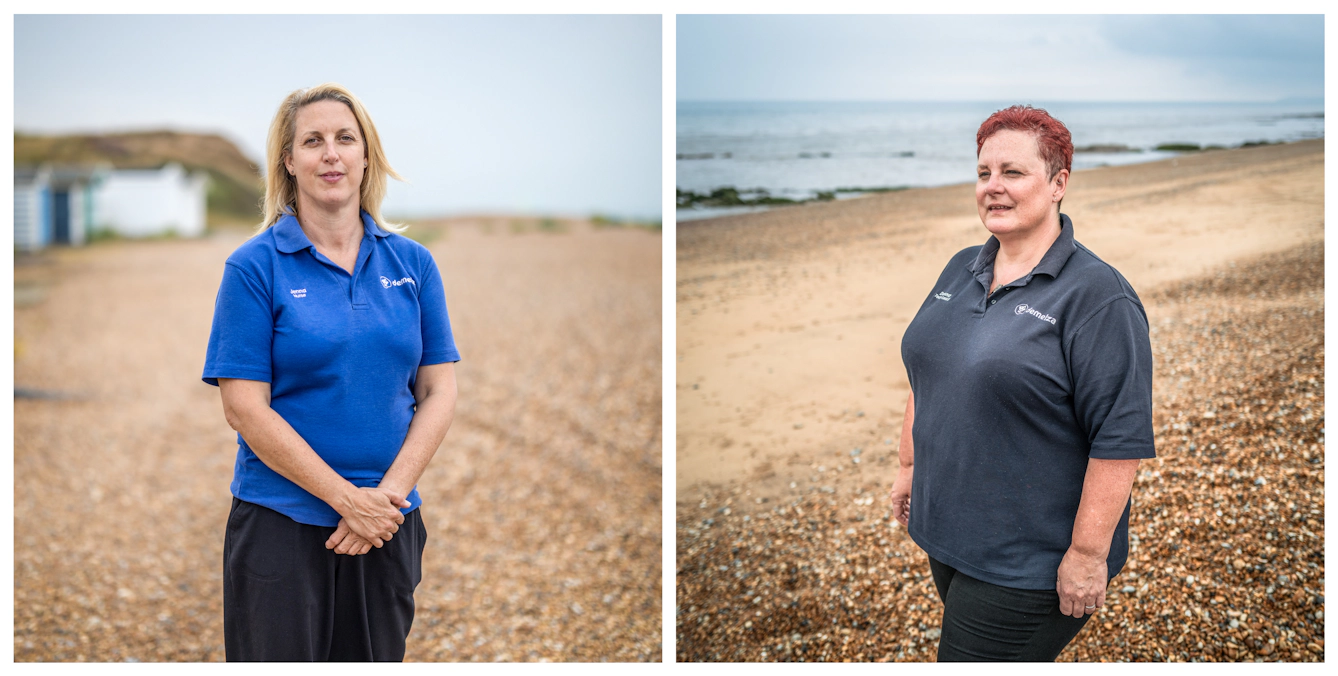
Jenna Heritage (left) and Donna Mole (right), paediatric palliative care nurses at Demelza Children’s Hospice, East Sussex. © Anna Gordon for Wellcome Collection.
Jenna Heritage (left) and Donna Mole (right), paediatric palliative care nurses at Demelza Children’s Hospice, East Sussex.
For Sarah the work has changed how she views life. “We are all human, we are all going to die. And it’s about living those days, having those extra cuddles, staying in bed those extra five minutes if you get them. It's all those ‘just one more's', because there will be a time where there isn’t any more.
"I would want to be open and honest to my children especially. To help them to recognise that when it’s my time, that's when you need to cuddle me the most. That’s when you put my favourite perfume on my wrist and you read me a bedtime story. Those are the most important things.”
There at the end
As the final stage of life approaches, the professionalism, experience and profound care of the palliative care nurses gently come to the fore.
“We don't focus much on the death,” says Sarah. “We focus on the bit before, which is maximising the quality of that life. We manage symptoms, breathlessness, pain, constipation and anxiety. And we will manage that to the best of our ability, so you're feeling more like yourself.
“The majority of people that have a cancer, for example, will become weaker and spend more time in bed. Their mobility will start to reduce. They might notice food doesn't taste the same as it did. They might not be eating and drinking quite as much. The weakness just keeps increasing and increasing until they get to a point where they are in bed and can't open their eyes anymore. Their breathing might be shallow, but it might also be rapid and quick.
“Sustenance is not going to change what is happening. By feeding you could actually cause more harm. Whereas if you do nothing, that’s actually gentler, safer and it’s a better end for that person. It’s at this time when things that they like – flavoured lip glosses, smells, something that promotes a smile – are all so important.”
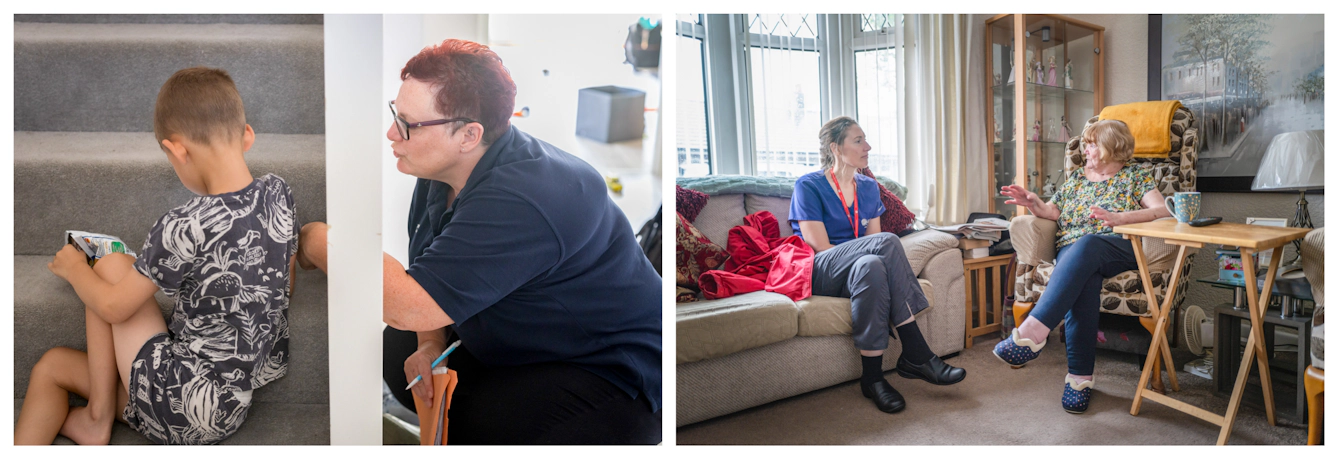
Left: Donna on a home visit. Right: Corinne chatting with Kay who cares for her husband who has Alzheimers. © Anna Gordon for Wellcome Collection.
Left: Donna on a home visit. Right: Corinne chatting with Kay who cares for her husband who has Alzheimer's.
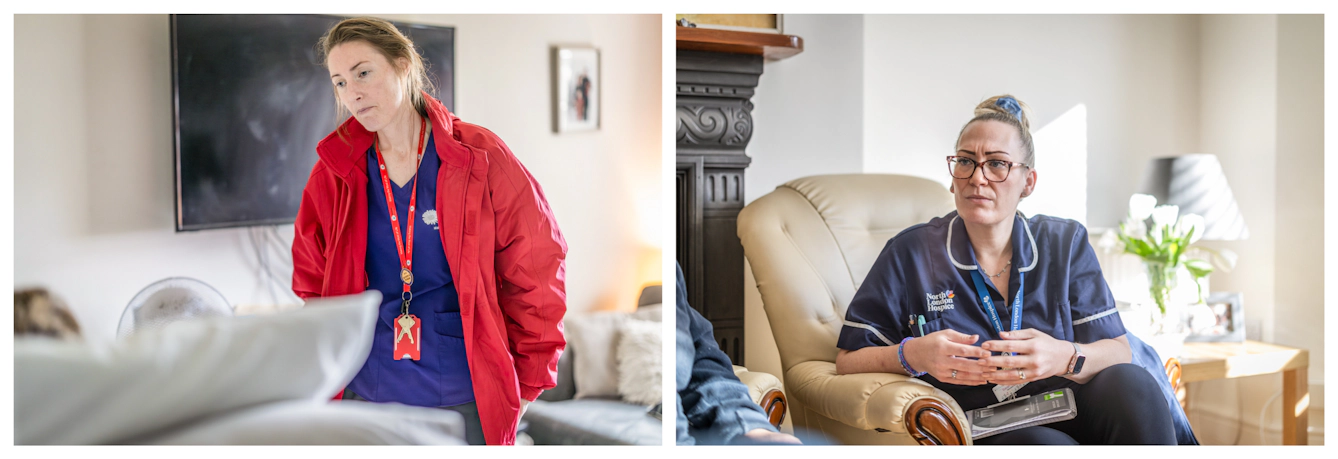
Left: Corinne at home with Damian who has Chordoma, a rare type of bone cancer. Right: Sarah chatting to the family of a patient during a home visit. © Anna Gordon for Wellcome Collection.
Left: Corinne at home with Damian who has chordoma, a rare type of bone cancer. Right: Sarah chatting to the family of a patient during a home visit.
Jenna understands that: “Everyone’s big fear is that they are going to die in pain. I know that’s often what people will say. They just want it to be as peaceful and calm as it can be. Not everyone will be able to have a ‘good’ death.
"But where possible, if people have open and honest conversations early on, engage and accept what is happening to them, then more people will be able to die peacefully and calmly and try to get as much enjoyment as possible during the end of their lives.”
Sarah describes how she sees her role during this time: “Being able to make that journey: it’s almost like crossing a river. On one side, you don't want to talk about it. You want to ignore everything that’s going on. On the other side, you’ve got this weightless kind of feeling.
"And the palliative care team, almost swim you, walk you across the river. Right from having those difficult conversations and finding out what’s important to you, to finally getting to the other side where everything is in place for you to die well, to die the way that you want to die.”
This is what that looks like for Corinne: “You’ll see families that are around their loved one that are in the last minutes of life, with smiles on their faces because everybody’s happy that person is where they want to be, and got what they wanted, has been listened to and been cared for and has had their dignity maintained throughout.
"Those last months, last days, last hours. That’s beautiful to see.”
About the photographer
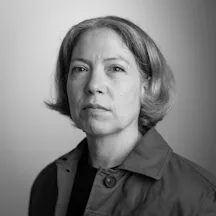
Anna Gordon
Anna Gordon is a UK-based photographer with more than 25 years professional experience working in editorial and humanitarian storytelling. In addition to her photographic practice, Anna speaks on ethics, representation and diversity within the photography industry. She has delivered a series of talks at Regent’s University London, sharing insights from her career and advocating for more inclusive and responsible visual storytelling.