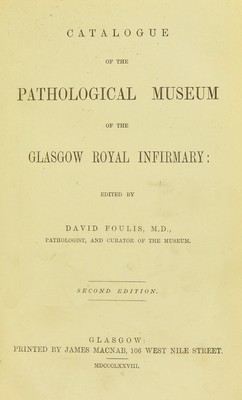
Catalogue of the Pathological Museum of the Glasgow Royal Infirmary / edited by David Foulis.
- Date:
- 1878
Licence: Public Domain Mark
Credit: Catalogue of the Pathological Museum of the Glasgow Royal Infirmary / edited by David Foulis. Source: Wellcome Collection.
Provider: This material has been provided by The University of Glasgow Library. The original may be consulted at The University of Glasgow Library.
44/360
![29. Commiimted fracture of tibia, fibula, and astragalus, dried and varnished. 30. Fracture of radius and ulna at the lower third. 31. Fracture of radius and ulna—the bones haAdng assumed a curved fonn. The accident happened by the arm passing between two rollers of a doughing machine. 32. Diseased bones from the end of a stump, showing formation of new bone. 33. Cicatrised stump. 34. Portion of bone removed from the stump of a boy by Dr. E. Watson. 35. Portion of necrosed bone removed from a stump. 36. Portion of bone from a stump some time after amputation. ■ Dead bone is seen in the centre, surroimded and clasped by a new growth of bone. 37. Portion of bone removed from the stump of a boy by ]\Ir. Watt. 38. Glenoid cavity of scapula with acromion process from a boy whose arm was dragged off by machinery. 39. Head of femur in morbus coxarius after excision. The cartilage is worn av/ay, exposing the cancellated structure of the bone. The patient was a boy aged 7 years. A fortnight after operation the great trochanter came away, it was in a cartilaginous condition, and is shown in the lower part of the jar. ... 40. Growth of bone which took place after the above excision, it protruded through the integuments in spite of position, &c., and latterly was excised. Another growth of bone took place, and the same thing happened. Amputation was then performed at the hip-joint, and the boy recovered admirably. Case of Dr. Lyon, May, 1856. 41. Spina bifida. 42 Oblique fracture of lower third of femur, the bone being m a necrosed condition. The surface is roughened by a growth of new bone, but union has not taken place. 43. Necrosis of femur, production of new bone. 44. Necrosis of the shaft of the femur. 45. Necrosis at the lower portion of the shaft of the left tibia. 45. Necrosis of femiu- in a youth. 47 Syphilitic necrosis of the frontal bone. An example of tertiary syphilis, proT)ably complicated with mercury.' The bone Avas removed during life by Dr. Lyon. Tlie dura mater had become thickened and semi-cartilaginous. The patient ultimately recovered with, however, loss of the right eye. 48. Portions of bone in a necrosed condition. Eemoved from the frontal bone. 49. ExfoUation from the frontal bone. ^ .-t 50 Portion of bone exfoliated from the surface of tlie tibia, the effects of hospital gaugreno, from a girl under the care of Dr. Fleming.](https://iiif.wellcomecollection.org/image/b21461363_0044.jp2/full/800%2C/0/default.jpg)