The operative treatment of intra-thoracic effusion / by Norman Porritt.
- Porritt, Norman, 1858-
- Date:
- [1883?]
Licence: Public Domain Mark
Credit: The operative treatment of intra-thoracic effusion / by Norman Porritt. Source: Wellcome Collection.
Provider: This material has been provided by the Augustus C. Long Health Sciences Library at Columbia University and Columbia University Libraries/Information Services, through the Medical Heritage Library. The original may be consulted at the the Augustus C. Long Health Sciences Library at Columbia University and Columbia University.
45/328 page 29
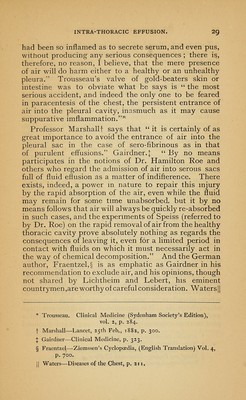
![had been so inflamed as to secrete serum, and even pus, without producing any serious consequences ; there is, therefore, no reason, I believe, that the mere presence of air will do harm either to a healthy or an unhealthy pleura. Trousseau's valve of gold-beaters skin or intestine was to obviate what he says is the most serious accident, and indeed the only one to be feared in paracentesis of the chest, the persistent entrance of air into the pleural cavity, inasmuch as it may cause suppurative imflammation.^^ Professor Marshall! says that it is certainly of as great importance to avoid the entrance of air into the pleural sac in the case of sero-fibrinous as in that of purulent effusions. Gairdner.J By no means participates in the notions of Dr. Hamilton Roe and others who regard the admission of air into serous sacs full of fluid efiusion as a matter of indifterence. There exists, indeed, a power m nature to repair this injury by the rapid absorption of the air, even while the fluid may remain for some time unabsorbed, but it by no means follows that air will always be quickly re-absorbed in such cases, and the experiments of Speiss (referred to b)^ Dr. Roe) on the rapid removal of air from the healthy thoracic cavity prove absolutely nothing as regards the consequences of leaving it, even for a limited period in contact with fluids on which it must necessarily act in the way of chemical decomposition. And the German author, Fraentzel,§ is as emphatic as Gairdner in his recommendation to exclude air, and his opinions, though not shared by Lichtheim and Lebert, his eminent countrymen ,are worthy of careful consideration. Waters |] * Trousseau. Clinical Medicine (Sydenham Society's Edition), vol. 2, p. 284. f Marshall—Lancet, 25th Feb., 1882, p. 300. I Gairdner—Clinical Medicine, p. 323. § Fraentzel—Ziemssen's Cyclopoedia, (English Translation) Vol. 4, p. 700. II Waters—Diseases of the Chest, p. 211,](https://iiif.wellcomecollection.org/image/b21210603_0045.jp2/full/800%2C/0/default.jpg)




 No text description is available for this image
 No text description is available for this image
 No text description is available for this image